Imagine this: you're finally ready to start that home renovation, garage cleanout, or construction project you've been putting off for months. You rent a dumpster, it's delivered right on the street in front of your house, and two days later, you wake up to a bright orange warning notice taped to it, along with a fine you never expected. If that sounds like your worst nightmare, you're not alone. Thousands of homeowners, contractors, and real estate investors in San Jose make the same mistake every year: renting a dumpster without understanding the permit rules. With the City of San José's most recent Public Works Permit Fees schedule revised in late 2025 and new CALGreen recycling thresholds in effect across California, the rules around dumpster placement are stricter, and more expensive to ignore, than they were even a year ago. This guide will walk you through everything you need to know about dumpster permits in San Jose and across California: what they are, when you need one, how much they cost in 2026, how to apply step by step, and what happens if you don't. If you've never done this before, our companion guide on 2026 dumpster rental prices in San Jose is a useful read alongside this one.
Listen to this article
--:-- · narrated
Do You Need a Permit for a Dumpster in San Jose?
The short answer to "do I need a permit for a dumpster" is: sometimes yes, sometimes no. It depends entirely on where the container will sit.
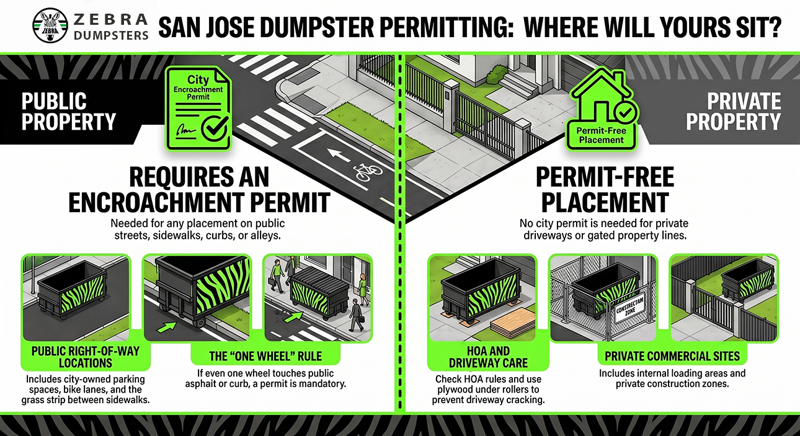
You need a dumpster permit in San Jose (technically an Encroachment Permit from the Department of Public Works) if your dumpster will be placed on:
- A public street
- A sidewalk, curb, or alley
- Any public right-of-way, including bike lanes
- A city-owned parking space
- The grass strip or "parkway" between the sidewalk and the street
You usually do NOT need a permit if the dumpster is placed entirely on:
- Your private driveway
- Your private construction site
- Behind a gated property line
- Inside a commercial loading area that belongs to you
For a deeper dive into where containers can legally sit, see our complete guide to dumpster placement laws in San Jose.
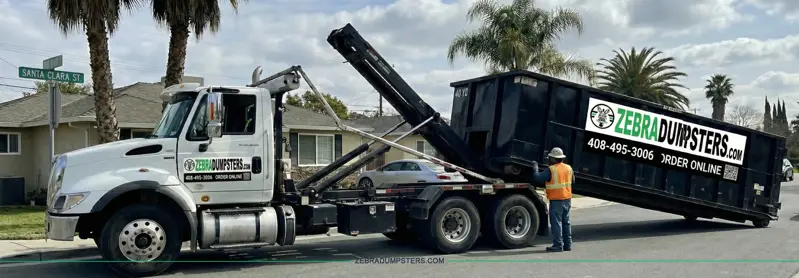
The most common permit homeowners and contractors need is a permit for a dumpster on street placement, since many San Jose homes simply do not have enough driveway space for a 20-, 30-, or 40-yard roll-off. If even one wheel of the container sits on the asphalt, the curb, or the sidewalk, you are inside the public right-of-way, and you need an Encroachment Permit before delivery.
Do I Need a Permit for a Dumpster on My Driveway?
In nearly every case, no, you do not need a city permit if the dumpster fits entirely within your private driveway and doesn't overhang the sidewalk or curb. However, there are two important caveats in 2026:
- HOA approval may still be required. Many Bay Area HOAs treat dumpsters as a temporary structure that affects community appearance, and they enforce their own placement rules.
- Driveway protection is on you. A 30-yard dumpster filled with concrete can exceed 10 tons. Most rental companies, including ours, recommend plywood under the rollers to prevent cracking.
If your driveway is tight or your HOA is strict, our guide to navigating HOAs, driveways and tight spaces walks through every workaround we use.
Permit for a Dumpster on Street: What San Jose Homeowners Should Know
If your driveway is too short, too steep, or already full of work vehicles, you'll almost certainly need a permit for a dumpster on street placement. The City of San José issues these as Encroachment Permits, and the fee depends on the classification of the street (residential, collector, or arterial) and how long you plan to occupy the space.
For larger jobs, we typically place a 20-yard general debris dumpster, 30-yard general debris dumpster, or 40-yard roll-off, and each size has slightly different street footprint requirements.
A few rules that catch most first-time renters off guard:
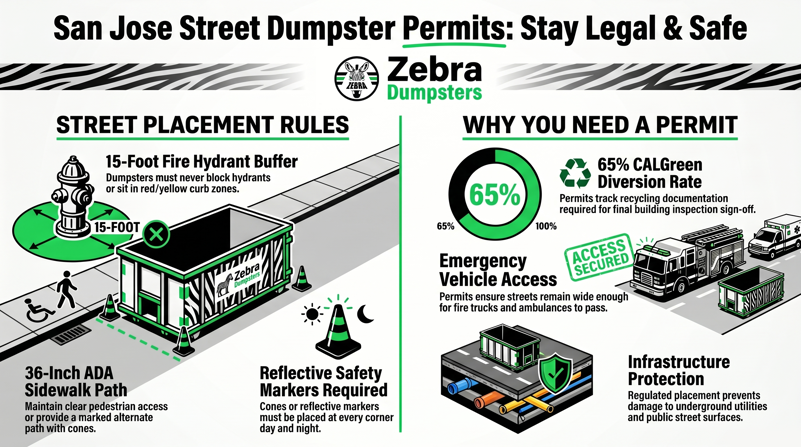
- The dumpster cannot block a fire hydrant within 15 feet.
- It cannot sit in a red or yellow curb zone, a disabled parking space, or a posted street-sweeping zone during sweeping hours.
- It must leave a minimum 36 inches of clear sidewalk for ADA pedestrian access. If the container itself blocks the sidewalk, you're required to provide an alternate pedestrian path with cones and signage.
- Reflective markers or traffic cones are required at each corner of the dumpster, day and night.
- A tow-away "No Parking" posting is sometimes required 72 hours in advance for street placements in heavily parked neighborhoods.
Why the City Requires Dumpster Permits
San Jose doesn't issue permits just to make things difficult. These permits exist to:
- Keep streets safe for traffic and pedestrians
- Protect underground utilities and infrastructure
- Ensure emergency vehicle access
- Control how long public spaces are blocked
- Prevent environmental hazards from leaking debris
- Track and enforce CALGreen construction and demolition (C&D) recycling requirements
The last point matters more than ever. Since CalGreen raised the statewide minimum C&D diversion rate to 65%, many California cities require you to document where the contents of your dumpster end up, especially on permitted construction projects. Skipping the permit means skipping that paper trail, which can create downstream problems with your building inspector at final sign-off.
Consequences of Leaving a Dumpster on the Street Longer Than Permitted
This is where people get hit the hardest, financially.
If you place a dumpster on a public street without a permit, or keep it longer than allowed, you may face:
- Immediate city fines, typically starting at $100–$250 per occurrence in San Jose
- Daily penalty charges that compound the longer the violation continues
- Forced removal at your expense, often $300–$600 in haul-off and storage fees
- Suspension of future permit requests for your address
- Project shutdowns for active construction sites
- Possible HOA fines stacked on top of city fines ($25–$500 per violation, depending on the community)
Even worse, fines can stack daily. What starts as a small mistake can turn into hundreds or even thousands of dollars in penalties within a week. That's why it's critical to secure your dumpster rental permits before delivery, not after.
How to Apply for a Dumpster Permit in San Jose: Step-by-Step Checklist
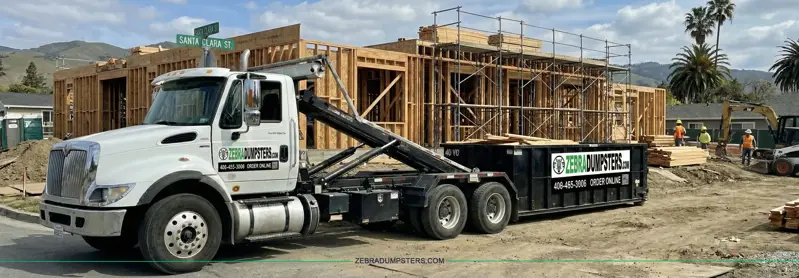
Whether you're a homeowner clearing out a basement or a general contractor running a full remodel, the City of San José follows the same general workflow through its Public Works Development Services Division. Here is the 2026 step-by-step process:
- Confirm the exact placement. Decide whether the container will sit on private property, the driveway apron, the curb, or the street itself.
- Determine the street classification. Encroachment permit fees vary based on whether the street is residential, collector, or arterial. The City publishes the classification list online.
- Create a simple site plan. A sketch showing the dumpster footprint, distance to driveways and hydrants, and the sidewalk clearance is usually required.
- Gather supporting documents (see checklist below).
- Submit the application through SJPermits.org or in person at the Development Services Permit Center at 200 E. Santa Clara St.
- Pay the permit fee by credit card or check.
- Wait for plan review and approval. Simple residential permits are often issued within 1–3 business days; construction permits may take 5–10 business days.
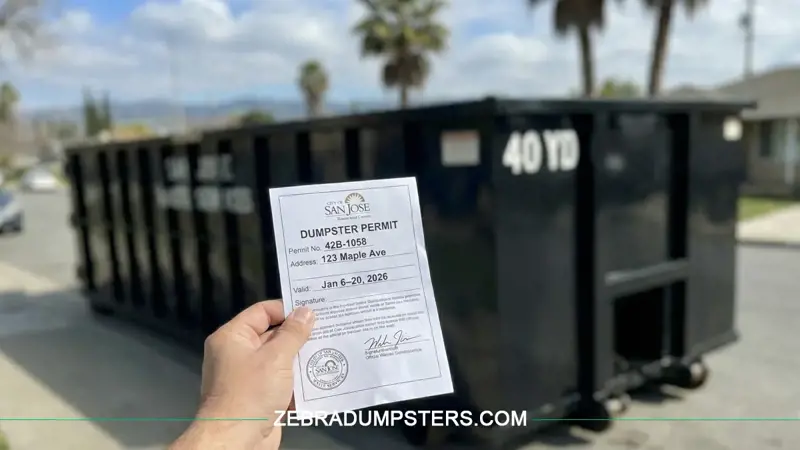
- Post the permit on or near the dumpster for the entire rental period.
- Apply for an extension at least 3 business days before expiration if you need more time.
Documents Required for a Dumpster Rental Permit
Before you start the application, have these ready:
- Property address and APN (Assessor's Parcel Number)
- Property owner authorization (if you're a tenant or contractor)
- Simple site plan or sketch (PDF or photo)
- Dumpster size and rental duration
- Rental company name and contact info
- Contractor license number (for construction projects)
- Certificate of insurance, when required
- Traffic control plan, for arterial streets or long-duration placements
How Long Does It Take to Get a Dumpster Permit?
In most San Jose residential cases, an Encroachment Permit is approved in 1–3 business days. Construction permits requiring a traffic control plan or arterial street review can take 5–10 business days, and rush processing is sometimes available for an additional fee. Plan ahead, especially around holidays and end-of-quarter construction surges.
How to Get Permit for Dumpster at Construction Site
If you're working on a construction, remodeling, or commercial renovation project, the process is more structured. Here's the general approach for 2026:
- Identify the exact placement location of the dumpster on the site plan.
- Confirm whether the area is public or private property by checking the parcel boundary.
- Submit a right-of-way (Encroachment) permit application to the City of San Jose through SJPermits.org.
- Provide supporting documents, including site plans, traffic control plans (if required), contractor license details, and a CALGreen Waste Management Plan if your project is permit-triggered.
- Pay the permit fee.
- Wait for approval before delivery.
- Coordinate with your rental company so the dumpster arrives within the permitted window, not before.
Many contractors mistakenly assume their general building permit covers dumpster placement; in most cases, it does not. Dumpster placement typically requires a separate Encroachment Permit, and CALGreen-covered projects also require a separate Waste Management Plan that documents how at least 65% of C&D debris is diverted from landfill.
If you're building an accessory dwelling unit, our ADU construction dumpster strategy breaks down the phased bin approach that saves contractors an average of $3,000 per project. For remodels specifically, see our kitchen remodel dumpster sizing and bathroom remodel dumpster sizing breakdowns.
Driveway placement needs no permit
Dumpsters from $439 in San Jose, delivered to your driveway
Most homeowners skip the permit entirely by keeping the bin on private property. We confirm the spot with you before delivery.
Cost of Dumpster Placement Permit in California
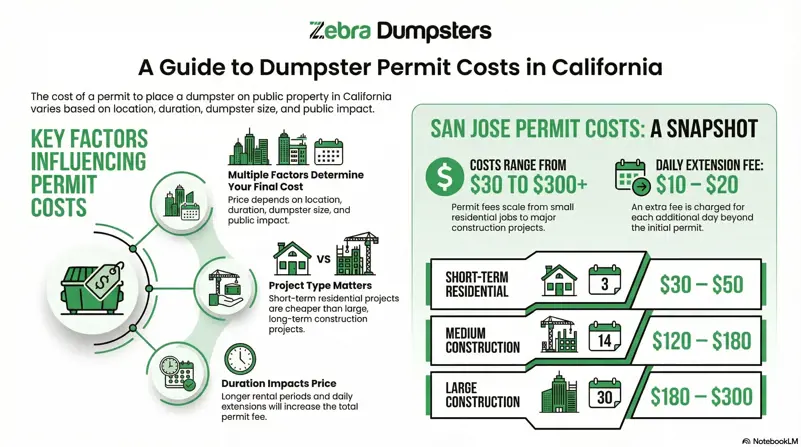
Permit costs vary depending on the city, duration, and project type. In San Jose and much of California, costs usually depend on:
- Exact placement location and street classification
- Number of days requested
- Dumpster size
- Impact on public access, parking, or traffic
- Whether a traffic control plan or off-duty officer is required
Permit fees aren't the only line item that surprises renters; review our weight limits and overage fees before you fill the container.
Approximate Dumpster Permit Costs in San Jose (2026)
| Permit Type | Typical Duration | Approximate Cost (2026) |
| Short-term residential street permit | 3–7 days | $40 – $90 |
| Standard residential permit | 7–14 days | $90 – $160 |
| Small construction Encroachment Permit | 14 days | $135 – $200 |
| Medium construction Encroachment Permit | 30 days | $200 – $300 |
| Arterial-street or traffic-impact permit | Varies | $300 – $600+ |
| Permit extension fee | Per additional period | $25 – $75 |
Note: Ranges are approximate and based on the City of San José Public Works Permit Fees schedule revised December 2025. Actual costs may vary depending on exact location, dumpster size, street classification, and whether traffic control or other requirements are needed.
In short, total dumpster permit costs in 2026 can range from about $40 for a short-term residential permit to $600 or more for long-term, high-impact construction projects.
Dumpster Placement Permit Cost (Typical Ranges)
While costs change over time, most people can expect:
- Short-term residential permits: lower end of the fee range
- Construction and commercial permits: mid-to-high range, plus daily occupancy fees
- Extended placement permits: additional daily fees and possible re-inspection
- Arterial street permits: highest tier, often requiring traffic control plans
This means your total dumpster placement permit cost could range from a modest administrative fee to a more significant expense for long-term projects.
Construction Dumpster Rental Permit Cost
Construction projects often require additional permitting due to:
- Larger dumpsters (typically 20-, 30-, or 40-yard roll-offs)
- Longer rental durations
- Safety and traffic regulations
- Multiple container placements
- CALGreen recycling documentation requirements
Construction dumpster permit costs usually include:
- Base permit fee
- Daily right-of-way occupancy fee
- Inspection or traffic control coordination
- CALGreen plan review fee (on some projects)
Approximate Construction Dumpster Permit Costs in San Jose (2026)
| Project Type | Typical Duration | Base Fee | Daily Additional | Approx. Total |
| Small construction project | 7 days | $90 | $10/day | $150 – $175 |
| Medium construction project | 14 days | $140 | $15/day | $200 – $260 |
| Large construction project | 30 days | $195 | $20/day | $300 – $450 |
| Extra-large / multi-container | 30+ days | $250+ | $25/day | $500+ |
Note: These are approximate ranges and can vary depending on dumpster size, placement location, and city inspection or traffic requirements. Always confirm directly with San Jose Public Works at pwgeneralinfo@sanjoseca.gov before budgeting.
This table allows users to plan their construction dumpster budget more accurately and avoid unexpected fines or extra charges.
Dumpster Permit Cost Comparison: San Jose vs. Other California Cities
A quick comparison of typical 2026 dumpster permit costs around California:
| City | Typical Residential Permit (7 days) | Typical Construction Permit (14–30 days) |
| San Jose | $40 – $90 | $150 – $450 |
| San Francisco | $75 – $200 | $250 – $700 |
| Oakland | $50 – $120 | $200 – $500 |
| Los Angeles | $75 – $150 | $250 – $600 |
| San Diego | $40 – $100 | $175 – $450 |
| Sacramento | $35 – $85 | $150 – $400 |
Costs are approximate and based on each city's most recently published Public Works fee schedule.
If you're managing projects across multiple cities, plan for permit costs to vary by up to 3x between municipalities. San Francisco and Los Angeles consistently sit at the top of the range; Sacramento and unincorporated Santa Clara County sit near the bottom.
How Long Are Dumpster Permits Valid?
Permit durations depend on what you request and what the city approves. Common durations include:
- 3 days
- 7 days
- 14 days
- 30-day construction permits
- Project-duration permits for larger jobs (with monthly renewal)
Extensions may be available, but never assume that twice-delivery or a re-up call automatically extends your permit window. Always confirm your expiration date in writing and apply for extensions at least 3 business days early.
Dumpster Permit Extensions and Renewals
If your project runs long, here's how to handle it:
- Log back into SJPermits.org or call Public Works before the expiration date.
- Pay the extension fee (typically $25–$75 in 2026).
- Update your traffic control plan if the extension crosses a weekend or street-sweeping cycle.
- Confirm with your rental company that they can leave the container in place.
What Happens If You Skip the Permit?
Skipping your dumpster permit might seem tempting when you're in a rush, but it's one of the riskiest choices you can make in 2026.
Without a valid dumpster permit, you risk:
- Immediate ticketing (often $100–$250 per violation in San Jose)
- Forced removal of the dumpster at your expense
- Delays to your project timeline
- Additional re-delivery fees from your rental company
- Damaged relationships with neighbors who complained
- City code-violation flags on your property record
- A failed final inspection if your project is permit-triggered
Compared to the cost of a fine, a permit is always the cheaper option, often by an order of magnitude.
Dumpster Permit Rules for HOA Communities
If your home is inside an HOA, the city Encroachment Permit is only half the story. Most Bay Area HOAs add their own layer of rules, and many HOAs require written approval even for dumpsters placed entirely on your private driveway. Common HOA restrictions include:
- Maximum dumpster size (often capped at 20 yards)
- Rental duration limits (typically 7–10 days)
- Placement location (back of driveway, screened from street view)
- Visible hours (some HOAs require covers or tarps overnight)
- Pre-approval lead time of 2–4 weeks
A few practical tips:
- Read your CC&Rs before you book the dumpster, not after.
- Submit your written request 4–6 weeks before the project start date so the HOA board has time to review.
- Ask the HOA for written approval in email, not verbal.
- Confirm whether the HOA requires the rental company to carry specific liability insurance limits.
For a deeper walkthrough of HOA workflows and driveway placement tricks, see our residential dumpster rental guide.
HOA violations typically result in fines of $25 to $500 per occurrence, depending on the community, and those fines stack independently from any city penalty.
Dumpster Safety, ADA & Signage Requirements
This is one of the most overlooked sections of municipal dumpster law, and it's where many homeowners accidentally trigger fines even after pulling a valid permit.
For street and sidewalk placements, you are generally required to:
- Maintain a minimum 36 inches of clear ADA-compliant sidewalk at all times
- Place reflective markers or delineators at each corner of the dumpster
- Use traffic cones around the perimeter during active loading
- Display the permit number visibly on or near the dumpster
- Avoid blocking curb ramps, transit stops, fire hydrants, and driveways
- Provide an alternate signed pedestrian path if the sidewalk must be closed
- Keep all debris fully contained inside the dumpster, with no overhang past the rim
In some San Jose neighborhoods and in cities like Pittsburgh and Los Angeles, you are also required to post project signage facing the sidewalk that remains legible at night. Reputable rental companies will install the signage and reflective markers for you as part of delivery.
California CALGreen & C&D Recycling Rules That Affect Your Dumpster Project
A piece many homeowners miss in 2026: California's CALGreen code requires permit-triggered construction and demolition projects to divert at least 65% of C&D debris from landfill, and many cities (San Jose, San Francisco, Pasadena, Thousand Oaks, Woodland) enforce a higher local rate or stricter documentation.
What that means for your dumpster rental:
- You may need a Waste Management Plan filed alongside your building permit.
- Your dumpster company must be a licensed hauler authorized to operate in your city.
- Self-hauling is allowed in some cities but still subject to weight tickets and documentation.
- Excavated soil, vegetation, and rocks from land clearing must be 100% recycled or reused.
- Starting April 2, 2026, Woodland (and a growing list of Northern California cities) require Waste Management Plans to be submitted through the Green Halo digital platform.
If you're a homeowner doing a small cleanout, none of this is likely to apply. If you're a contractor or developer, it absolutely will, so plan for it before the dumpster is on the ground.
How a Professional Dumpster Rental Company Helps You With Permits
A quality dumpster rental provider doesn't just drop off a container, they help you avoid costly mistakes. The best rental companies will:
- Tell you upfront if you need a permit
- Advise where you can legally place the dumpster
- Help you avoid relocating the container (which can trigger a second delivery fee)
- Coordinate delivery around your permit approval window
- Install reflective markers and signage at delivery
- Pull the permit on your behalf for a small administrative fee (often $35–$75)
- Provide CALGreen-compliant disposal receipts for your records
Our team follows the dumpster rental best practices checklist on every job, and we deliver across our service areas across the Bay Area.
This alone can save you days of delays and hundreds in fines, especially for first-time renters.
When to Hire a Permit Expediter vs. DIY Application
For most residential projects, doing the permit application yourself through SJPermits.org is fine. Consider a permit expediter or asking your rental company to pull the permit when:
- You're a contractor running multiple jobs in parallel
- Your project requires a traffic control plan
- You're placing the dumpster on an arterial street
- You need approval in less than 48 hours
- You're new to working with the City of San Jose
How to Avoid Dumpster Permit Fines: A Pre-Delivery Checklist
Run through this checklist 5–7 days before your dumpster is scheduled to arrive:
- Confirm whether placement is on private property or public right-of-way
- Check HOA CC&Rs and submit any required HOA approval
- Identify the street classification (residential / collector / arterial)
- Apply for the Encroachment Permit through SJPermits.org
- Verify dumpster size matches the permitted footprint
- Confirm 36" ADA sidewalk clearance is maintained
- Confirm the dumpster will not block a hydrant, driveway, or curb ramp
- Order reflective markers, cones, and signage (or confirm rental company will provide)
- Post the permit visibly on or near the dumpster
- Calendar the expiration date and set a reminder for the extension deadline
- Save the CALGreen disposal receipts for your final inspection file
Common Permit Mistakes to Avoid
Here are the mistakes we see over and over again from San Jose homeowners and contractors:
- Assuming driveway placement always avoids permits (some HOAs override this)
- Placing the dumpster across two on-street parking spaces without permit upgrades
- Blocking fire hydrants, curb ramps, or driveways
- Ignoring expiration dates and letting the permit lapse on a Friday
- Applying for the permit after the dumpster has already been delivered
- Ordering the wrong size container, then needing to swap mid-project
- Skipping the CALGreen Waste Management Plan on a building-permit-triggered job
- Forgetting to clear the placement zone of parked cars 72 hours in advance
- Trusting verbal HOA approval instead of getting it in writing
Avoid these, and you're already ahead of most renters.
Final Thoughts
Renting a dumpster in San Jose doesn't have to be stressful, but skipping the permit process can turn your project into a legal and financial headache. Whether you're tackling a small home cleanout or managing a full construction site, understanding the rules around dumpster permits is just as important as choosing the right container size. With the 2026 fee schedule revisions and tighter CALGreen documentation requirements, the cost of getting it wrong has gone up, but the cost of getting it right is still very reasonable.
Ready to start? Book your San Jose dumpster online and we'll handle the Encroachment Permit on your behalf for a small administrative fee. It's the fastest way to avoid fines, delays, and unnecessary surprises.
FAQ
Do I need a permit for a dumpster on my driveway in San Jose?
Usually no, as long as the dumpster sits entirely on private property and doesn't overhang the sidewalk or curb. However, your HOA may still require written approval, and you should always check before booking. Only street, sidewalk, or public right-of-way placement requires a city Encroachment Permit.
When do I need a dumpster permit in San Jose?
You need a dumpster permit any time the container will occupy a public street, sidewalk, alley, bike lane, city-owned parking space, or the parkway strip between the sidewalk and the curb. If even one wheel touches public right-of-way, you need the permit before delivery.
How much does a residential dumpster permit cost in 2026?
In San Jose, a residential permit for a dumpster on street placement typically costs about $40–$90 for 3–7 days, and $90–$160 for 7–14 days, based on the City's most recently revised Public Works fee schedule. Construction permits run higher, depending on duration and street classification.
How do I get a permit for a construction dumpster?
Submit a right-of-way (Encroachment) permit application through SJPermits.org or the Development Services Permit Center at 200 E. Santa Clara St. Provide your site plan, contractor info, dumpster size and duration, any required traffic control plan, and your CALGreen Waste Management Plan. Pay the fee, wait for approval, and then schedule delivery.
What happens if I leave a dumpster on the street without a permit?
You may face immediate fines (typically $100–$250 per violation), daily penalties, forced removal at your expense, project delays, and code-violation flags on your property record. In HOA communities, you can be fined again by the HOA, often $25–$500 per occurrence.
How long can I keep a dumpster on the street with a permit?
Typical permits range from 3 to 30 days, with construction permits sometimes extending for the full project duration with monthly renewals. Extensions are available but must be requested at least 3 business days before expiration, and they usually carry an extension fee of $25–$75.
Can HOAs prevent me from placing a dumpster?
Yes. Many Bay Area HOAs enforce stricter rules than the city, including maximum container size, required screening, time-of-day restrictions, and rental duration limits. Some HOAs require written approval even for dumpsters on your own driveway. Always check your CC&Rs and submit HOA paperwork 4–6 weeks before your project.
Do dumpster rental companies pull the permit for you?
Many reputable companies, including Zebra Dumpsters, will pull the Encroachment Permit on your behalf for a small administrative fee, typically $35–$75. This is often the easiest path for first-time renters and out-of-town property owners.
Are there new California rules I should know about in 2026?
Yes. CALGreen's 65% C&D recycling requirement continues to apply statewide, and more cities are moving Waste Management Plan submissions to the Green Halo digital platform in 2026. If your project is permit-triggered, expect to document where your dumpster contents end up, not just that you rented the container.
How do I avoid dumpster permit fines?
Pull the correct permit before delivery, follow placement rules (36" ADA sidewalk clearance, no blocked hydrants or driveways), respect the expiration date, install reflective markers and signage, and keep your CALGreen disposal receipts. When in doubt, ask your rental company, a good one will flag issues before they cost you.
Street placement?
Get the permit first, then book, and we drop once it is in hand
Bins from 5 to 40 yards, 7 days included, priced by delivery ZIP.