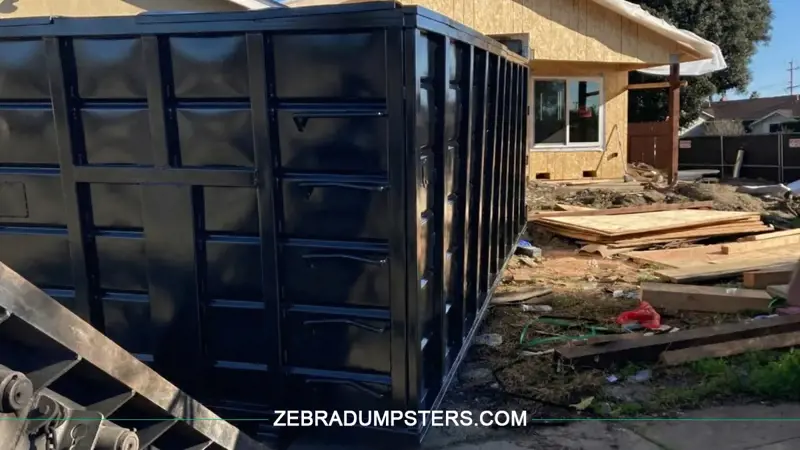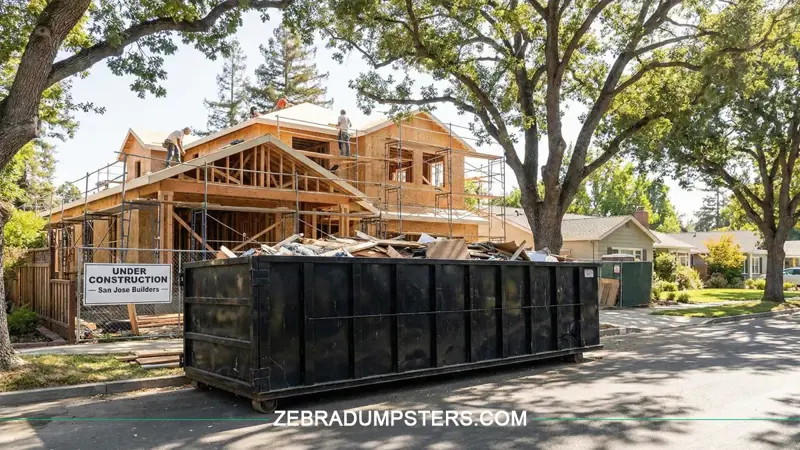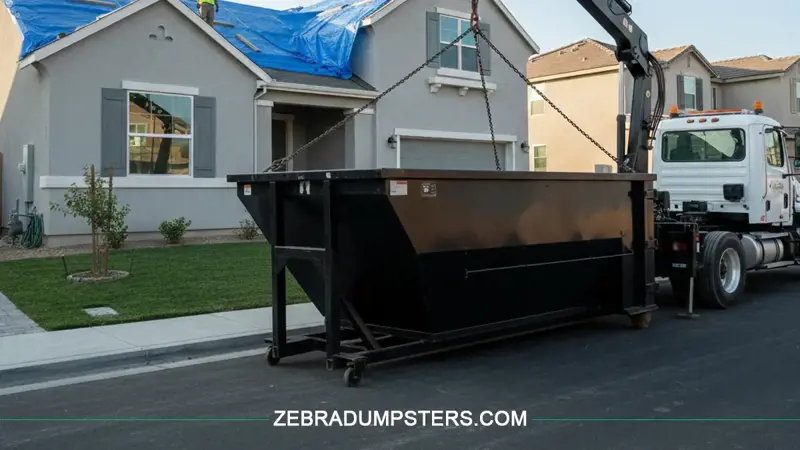
You've finally booked a container from Zebra Dumpsters for your home remodeling project in San Jose. It feels like the hard part is over, but dumpster placement is just as critical as the booking itself. If you place the Dumpster Rental in the wrong spot or overload it incorrectly, you could face unexpected fines, neighborhood complaints, or even a forced removal order.
Most homeowners don't realize that San Jose, and the Bay Area more broadly, has specific dumpster placement regulations not just about where a dumpster sits, but what goes in it and the operational space required for the truck. One mistake can quickly turn a simple cleanup job into a frustrating legal headache, and the rules have tightened in 2026 with new CALGreen documentation requirements and stricter local enforcement around ADA sidewalk access and right-of-way encroachment.
At Zebra Dumpsters, we want your project to run smoothly. Understanding San Jose's municipal codes, Bay Area operational constraints, and 2026 dumpster placement laws is non-negotiable. This guide breaks down everything you need to know to keep your project compliant and hassle-free.
Listen to this article
--:-- · narrated
Why Dumpster Placement Laws Matter in San Jose and the Bay Area
San Jose is known for its strict community standards and active municipal enforcement, and the rest of the Bay Area follows close behind. Improperly placed dumpsters can negatively impact:
- Pedestrian safety
- Traffic flow
- Emergency vehicle access
- Sidewalk accessibility (especially ADA compliance)
- Street sweeping schedules
- Underground utility access
- Bike lane and transit operations
Because of this, San Jose regulates dumpster placement under San Jose Municipal Code Title 13 (Streets, Sidewalks, and Public Places), right-of-way and encroachment laws, environmental service rules under Chapter 9.10 (Solid Waste Management), and California Fire Code adoptions. Non-compliance can lead to citations, project delays, dumpster towing at your expense, and liability for damage to public infrastructure. In 2026, San Jose Code Enforcement is also coordinating more closely with the Department of Environmental Services to flag projects that skip the CALGreen Waste Management Plan, so placement issues can now trigger a downstream recycling-compliance investigation as well.
What's New in 2026: Bay Area Dumpster Placement Regulations You Should Know
A quick snapshot of the regulatory changes that affect dumpster placement in 2026:
- CALGreen 65% diversion rate is now standard. The statewide construction and demolition diversion rate sits at 65% (up from 50% under older codes), and San Jose's local C&D program enforces it on most permitted projects.
- Green Halo digital reporting is expanding. Contra Costa County began requiring Waste Management Plans through Green Halo in August 2025, and the City of Woodland follows on April 2, 2026. San Jose, Mountain View, and Foster City are all routing more C&D paperwork through the same platform.
- Stricter ADA sidewalk enforcement. Code Enforcement officers are increasingly flagging dumpsters that leave less than 36 inches of clear sidewalk for ADA pedestrian access, a federal standard that's getting more attention from local complaint lines.
- Fire Code clarifications. California Fire Code adoptions now make it explicit that dumpsters within 15 feet of a hydrant, or blocking any fire access road, are subject to immediate towing without warning.
- Permit fee schedule revisions. San Jose's Public Works Permit Fees schedule was revised in December 2025, so older online estimates may underquote your encroachment permit cost.
For a deeper look at the permit side specifically, see our companion guide on San Jose dumpster permits, costs, and rules.
Core Dumpster Placement Guidelines
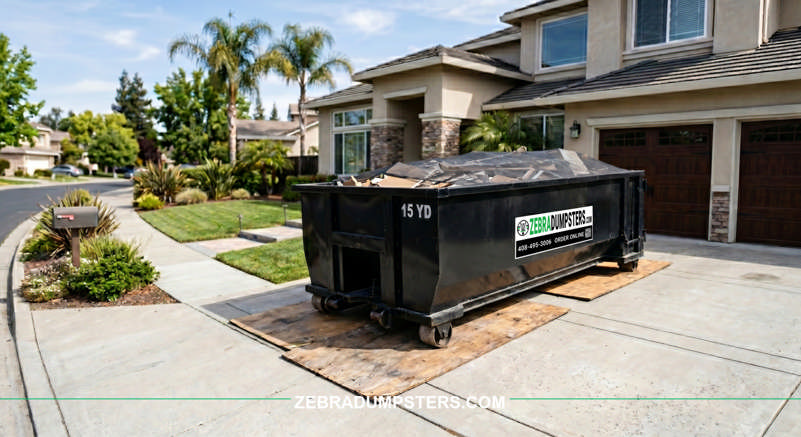
Construction and renovation projects produce large volumes of debris, making strategic dumpster placement critical. Follow these core guidelines:
Keep the Dumpster on Private Property When Possible
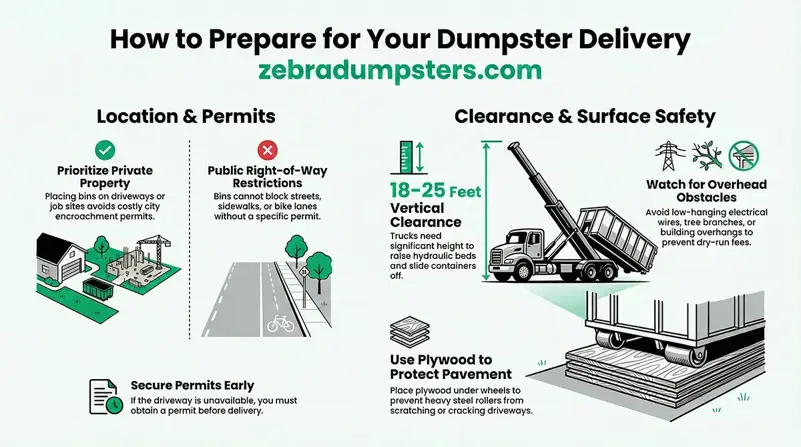
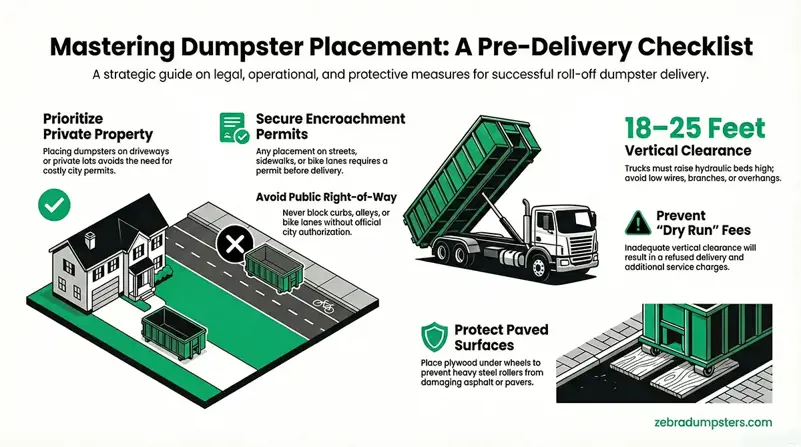
Driveways, construction pads, private lots, and job sites are the safest options. Placing the container fully on private property generally avoids the need for city encroachment permits, saving you time and money. In 2026, private-property placement is also the lowest-risk path because it sidesteps the most common citation triggers: blocked sidewalks, expired permits, and bike-lane encroachment.
Avoid Blocking Public Right-of-Way
A "public right-of-way" includes streets, curbs, sidewalks, alleys, bike lanes, transit stops, and even the planting strip between the sidewalk and the curb. Placing a dumpster in these areas without a specific Encroachment Permit is prohibited under San Jose Municipal Code Title 13. If your driveway isn't an option, you must secure this permit before delivery, and you're responsible for any safety equipment (cones, reflectors, signage) the city specifies in the permit conditions.
Ensure Vertical Clearance (Operational Requirement)
This is one of the most common issues we see at Zebra Dumpsters. While this isn't a "city law," it is a strict operational requirement.
- The Rule: You need 18 to 25 feet of vertical clearance.
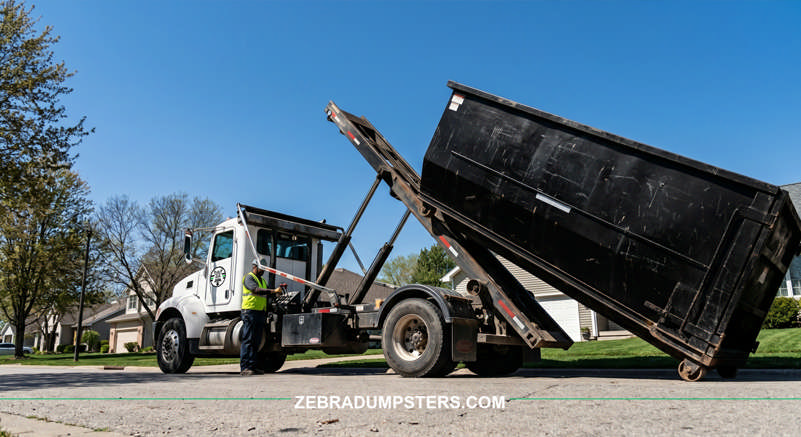
- Why: Although the bin sits low, the roll-off truck must raise its hydraulic bed high into the air to slide the container off.
- Warning: Do not plan to place dumpsters under low-hanging electrical wires, cable lines, tree branches, or building overhangs. If a driver cannot raise the bed safely, they will be forced to refuse delivery, likely resulting in a "dry run" fee. Ours is $250 in the South Bay and East Bay, or $350 north of Millbrae or Oakland.
- 2026 update: PG&E has been more active about citing customers for property-side trim violations around overhead service drops. If your delivery path is borderline, schedule a tree trim or service-drop inspection before delivery day.
Protect Paved Surfaces
Steel rollers on heavy dumpsters can damage decorative driveways, older asphalt, or brick pavers.
- Best Practice: We highly recommend placing sheets of plywood underneath the dumpster's wheels to distribute the weight and prevent scratching, cracking, or gouging your driveway.
- Stamped concrete and pavers: Use two layers of 3/4" plywood, not one. Decorative surfaces crack under point loads more easily than standard concrete.
- Asphalt in summer heat: Bay Area asphalt softens above 90°F. Plywood is mandatory, not optional, on hot days.
Maintain ADA Sidewalk Clearance
A 2026 enforcement focus that's catching many homeowners by surprise: even if you have a valid encroachment permit, you must maintain at least 36 inches of clear, ADA-accessible sidewalk at all times. If your dumpster narrows the path below 36", you're required to either:
- Move the dumpster, or
- Provide a clearly marked alternate pedestrian path with cones and signage
Failure to maintain ADA clearance can be cited independently of permit status, and complaints filed by neighbors or pedestrians are taken seriously.
San Jose’s Recycling & Environmental Rules (C&D Program)
Placement isn't just about the physical spot; it's about compliance with the City's Construction & Demolition (C&D) Waste Diversion Program. When arranging a Dumpster Rental in San Jose, you must keep the following regulations in mind:
- The 65% Diversion Rule (updated): Under the current CALGreen standard, permitted construction and demolition projects are required to divert at least 65% of their waste from landfills through recycling or reuse. San Jose's local C&D program enforces this for most permitted projects (the 50% figure that used to apply has been superseded for CALGreen-covered work).
- Green Halo System: For projects subject to the City's C&D deposit program, you may be required to track your waste using the Green Halo online system. Failing to provide proof of recycling can result in the forfeiture of your project deposit. Adjacent jurisdictions are following suit: Contra Costa County (August 2025) and Woodland (April 2, 2026) are now routing C&D paperwork through Green Halo too.
- Strategy: If you are separating materials (e.g., one bin for concrete, one for trash) to meet these goals, ensure your dumpster placement plan has space for multiple containers and enough turning room for two truck deliveries.
- Document everything: Keep your weight tickets and disposal receipts from delivery to pickup. Building inspectors increasingly ask for this paperwork at final sign-off.
How CALGreen Affects Your Dumpster Placement Plan
A practical implication of the 65% rule: more contractors are switching to a two-bin or three-bin strategy (clean inert, mixed C&D, and metal) instead of a single mixed dumpster. That means your site plan now has to accommodate more square footage of placement, and you should think about it before you book.
Weight Limits: "Inert" Materials vs. General Debris
Understanding weight limits is key to avoiding hidden fees. The rules differ significantly based on what you are tossing.
A. Inert Materials (Concrete, Dirt, Asphalt)
At Zebra Dumpsters, we specialize in heavy debris removal with high-capacity limits for clean materials.
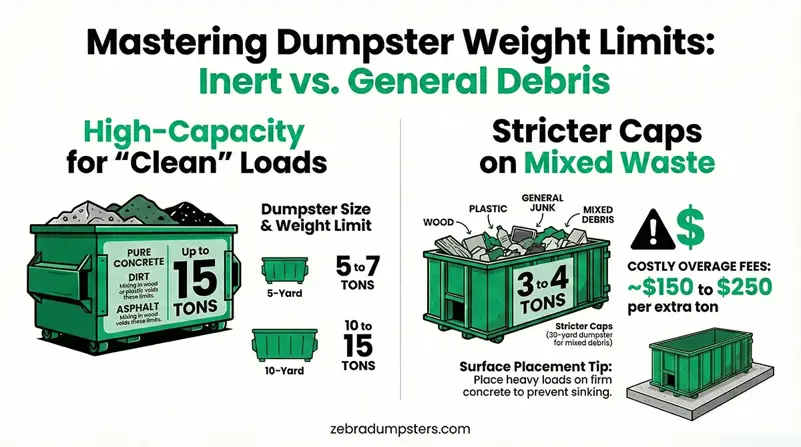
- The Benefit: For pure heavy materials (dirt, concrete, asphalt) with no trash mixed in, we offer specific heavy-duty containers:
- 5-Yard Dumpsters: Allow for 5 to 7 tons of material.
- 10-Yard Dumpsters: Allow for 10 to 15 tons of material.
- The Condition: To qualify for these high weight limits, the load must be "clean." Mixing in wood, plastic, or drywall contaminates the load, making it impossible to recycle as inert material and likely exceeding legal transport limits.
B. General Construction Debris
- The Risk: Mixed trash (drywall, wood, household junk) usually comes with stricter weight caps (e.g., a 30-yard dumpster might have a 3 to 4-ton limit).
- The Cost: Exceeding the weight limit is expensive. Overage fees commonly range from $150 to $200 per extra ton, depending on the disposal facility rates in the Bay Area.
Placement Tip: If you expect a heavy load, place the dumpster on the firmest concrete surface available to prevent it from sinking into the ground.
Placement on Grass or Unpaved Surfaces
Placing a dumpster on grass or dirt comes with risks that homeowners often overlook.
- Sinking Hazard: Rain or irrigation can turn the soil soft. A heavy truck or a full dumpster can sink, get stuck, or tear up your landscaping.
- Bay Area microclimates: Even during the dry summer months, irrigation can keep the top six inches of soil saturated enough to cause sinking. The risk is not just a winter problem.
- HOA concerns: Many Bay Area HOAs explicitly prohibit dumpsters on lawns or visible front-yard turf, regardless of city law.
- Recommendation: Avoid grass whenever possible. If it is unavoidable, use thick plywood sheets (3/4" minimum, doubled up under the wheels), pre-water restrictions during heat advisories, and consider choosing a smaller dumpster size to minimize weight.
Emergency Access & Fire Lanes (Strictly Enforced)
San Jose Fire Department regulations are strictly enforced to ensure public safety, and 2026 California Fire Code adoptions reinforce this.
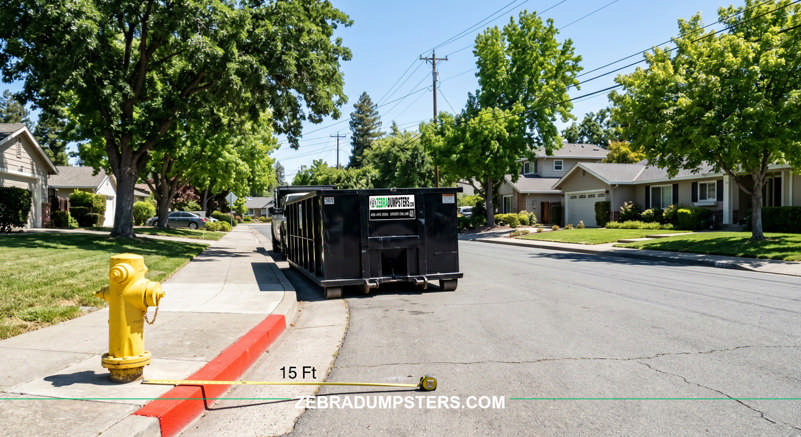
- Hydrants: Never place a dumpster within 15 feet of a fire hydrant.
- Fire Lanes: Never block a marked fire lane, red curb, or designated "Fire Lane – No Parking" zone in a commercial complex.
- Exits: Do not obstruct emergency exits, stairwells, or alleyways used by emergency vehicles.
- Apartment and condo driveways: Many multi-family complexes have private fire lanes that are enforced even when the property looks like a typical driveway. Confirm with your property manager.
- Wildland-Urban Interface zones: Properties in the South San Jose foothills and other WUI areas have additional defensible-space requirements; a dumpster placed in a brush-clearance zone may need to be relocated if a Red Flag Warning is issued.
Warning: Serious violations, especially those blocking fire access, can result in immediate removal of the dumpster by the city or authorities, along with significant fines that frequently exceed $1,000 for first offenses on commercial sites.
Dumpster Placement on the Street: Encroachment Permit Rules
If your dumpster placement has to be on the street because your driveway is too short, too steep, or already full of work vehicles, you're entering encroachment-permit territory.
What that involves in 2026:
- Apply through SJPermits.org or in person at the Development Services Permit Center at 200 E. Santa Clara St.
- Permit fees vary by street classification (residential, collector, arterial); typical residential ranges are $40–$160 for 3–14 days.
- You must post the permit visibly on or near the dumpster for the duration.
- Reflective markers, cones, and signage are required day and night.
- Tow-away "No Parking" postings may be required 72 hours in advance in heavily parked neighborhoods.
- Extensions are available but must be requested at least 3 business days before expiration.
How to Avoid Dumpster Placement Citations: A Step-by-Step Checklist
Run through this checklist before your delivery day:
- Walk the placement zone. Measure overhead clearance with a tape or laser, not by eye.
- Take photos of the delivery path, including any trees, wires, or low awnings.
- Confirm public vs. private property by checking the sidewalk line and parcel boundary.
- Apply for an encroachment permit if any part of the dumpster touches the right-of-way.
- Check the street-sweeping calendar and red/yellow curb zones near the placement spot.
- Notify neighbors if the dumpster will sit near their driveway or favorite parking spot.
- Set up plywood pads under the wheel positions before the truck arrives.
- Stage cones and reflectors for street placements.
- Verify HOA approval in writing if you're inside a managed community.
- Calendar the pickup date and check the permit expiration.
Dumpster Placement Compliance at a Glance
| Compliance Area | Rule in 2026 | What Triggers a Citation |
| Private property | No permit needed if fully on driveway/yard | Overhang onto sidewalk or curb |
| Public right-of-way | Encroachment permit required | Placement without permit |
| ADA sidewalk clearance | Minimum 36" clear path | Narrowing path below 36" |
| Fire hydrant clearance | Minimum 15 feet | Blocking hydrant access |
| Fire lane / red curb | Always prohibited | Any placement in zone |
| Vertical clearance (operational) | 18–25 feet | Low wires, trees, awnings |
| CALGreen diversion | 65% of C&D debris recycled | Missing Waste Management Plan |
| Weight limits (mixed debris) | Bin-specific (3–4 tons typical for 30-yard) | Overage fees $155/ton in San Jose |
| Reflective markers/signage | Required day and night on street | Missing or knocked-down markers |
| Permit posting | Visible on or near dumpster | No permit displayed during inspection |
Dumpster Placement & Size Guide
Choosing the right size helps with placement and compliance.
| Dumpster Size | Best Use Case | Placement & Weight Notes |
| 5-yard dumpster rental (Lowboy) | Pure Dirt, Concrete, Asphalt | Heavy Duty: Designed for 5–7 tons of clean inert material. Easy to load. |
| 10-yard dumpster rental | Concrete, Dirt, Heavy Tile | High Capacity: Can hold 10–15 tons of clean inert material. Fits easily in driveways. |
| 20-yard dumpster rental | Medium Renovations, Roofing | Fits in most driveways. Be mindful of weight limits with heavy roofing shingles. |
| 30-yard dumpster rental | Large Cleanouts, Remodels | Long footprint. Needs a significant driveway length. Strict weight limits for mixed debris. |
| 40-yard dumpster rental | Major Demolition | Requires maximum vertical clearance (25 ft) and a large turning radius for the truck. |
Common Dumpster Placement Mistakes to Avoid
After years of Bay Area deliveries, these are the recurring mistakes we still see weekly:
- Assuming the planting strip between the sidewalk and curb is "your" property — it isn't, and placing a dumpster there triggers an encroachment violation
- Pulling permits for the wrong street classification (arterial vs. residential fees differ significantly)
- Underestimating vertical clearance because the driver "made it work last time" — driveways change with tree growth
- Skipping plywood on stamped concrete because the renter trusts the rollers
- Mixing inert and general debris in the same bin and triggering both an overage fee and a CALGreen documentation gap
- Letting the dumpster sit over a Red Flag Warning weekend in a WUI zone
- Forgetting that HOA bylaws can override more permissive city rules
- Booking a 40-yard for a driveway that can't fit a 30-yard truck turn
- Letting bin contents overhang the rim, which triggers transport-law fines for the hauler and an additional charge to the renter
How Zebra Dumpsters Helps You Stay Compliant
A good rental partner doesn't just deliver a container, they help you navigate the dumpster placement laws so your project doesn't get derailed. Our drivers and dispatch team will:
- Verify vertical clearance and approach angles before delivery
- Flag likely encroachment-permit needs based on your address
- Recommend plywood and pad configurations
- Provide CALGreen-compliant disposal receipts for your file
- Schedule pickup within your permit expiration window
- Reposition the bin mid-rental if your project changes (with appropriate fees)
Our team also follows the dumpster rental best practices checklist on every job, and we deliver across our service areas across the Bay Area.
Before the truck rolls
Get the placement rules for your actual address
Driveway, street or private lot changes the permit, the setback and the fee. Give dispatch the address when you book and we confirm what applies before delivery, not after a citation.
FAQ
What is the most common reason for a failed delivery?
Low-hanging wires or tree branches. Ensure you have 18–25 feet of overhead clearance so the Zebra Dumpsters driver can safely raise the truck bed. Other common reasons include unposted no-parking signs blocking street placements and HOA disputes flagged at the gate.
How much does it cost if I go over the weight limit?
Our general-debris overage rate in San Jose is $155 per ton, billed off the landfill weight ticket rather than an estimate. Rates run higher in some cities — $165 on the northern Peninsula, $175 in San Francisco and Livermore, $200 in the Tri-Valley. For clean dirt or concrete in our 5- or 10-yard inert bins there is no weight cap at all on standard service.
Do I need a permit for a dumpster in my driveway?
Generally, no. As long as the dumpster is entirely on your private property and doesn't overhang into the sidewalk, curb, or planting strip, no city permit is usually needed. HOA approval is a separate matter and may still be required.
Can I mix concrete with regular trash?
We strongly advise against it. Mixing heavy concrete with general trash prevents the concrete from being recycled as "inert" material. This will likely push you over the weight limit, resulting in expensive overage fees, and it can also break your CALGreen documentation if your project is permit-triggered.
What is the Green Halo system?
It is the online system San Jose and a growing list of Bay Area cities use to track construction waste diversion. If your project has a city permit, you may need to upload your Zebra Dumpsters weight tickets to Green Halo to prove you diverted at least 65% of your waste from landfill.
Can I leave a dumpster on the street overnight?
Only if you have an active Encroachment Permit. Without one, you risk citations, fines, and having the dumpster towed at your expense. Reflective markers and signage are required for the full duration, day and night.
What are the new 2026 dumpster placement regulations Bay Area homeowners should know?
The main updates are the CALGreen 65% diversion rate replacing the older 50% standard on most permitted projects, expanded Green Halo digital reporting (Contra Costa County and Woodland are the latest to adopt it), tighter ADA sidewalk enforcement requiring a 36" clear path, and a refreshed San Jose Public Works Permit Fees schedule from December 2025.
How close to my property line can I place a dumpster?
There's no single setback rule, but you cannot let the dumpster overhang the sidewalk, planting strip, or your neighbor's driveway. Practically, keep at least 2 feet of clearance from any shared property line to avoid disputes and damage.
Can the city tow a dumpster without warning?
Yes, in some situations. Dumpsters blocking fire hydrants, fire lanes, emergency exits, or active street-sweeping routes can be removed immediately. Encroachment violations without immediate safety risk typically get a warning notice first, but repeat offenses escalate quickly.
Do dumpster placement laws differ across Bay Area cities?
Yes. While CALGreen and California Fire Code set a baseline, each city tunes its own ordinance. San Francisco requires Debris Box Permits under Article 15 of the Public Works Code with much higher fees than San Jose. Oakland, Berkeley, and Palo Alto each have their own permit windows and ADA enforcement priorities. If you're working across multiple cities, expect permit costs and timelines to vary by up to 3x.
Ready to start your project?
Compliance doesn't have to be complicated. At Zebra Dumpsters, we help you choose the right size, from heavy-duty dirt bins to large renovation containers, and we'll walk you through the dumpster placement laws that apply to your address before delivery. Contact us today to schedule your delivery, and let us help you avoid the fines, towing, and "dry run" fees that catch unprepared renters off guard.