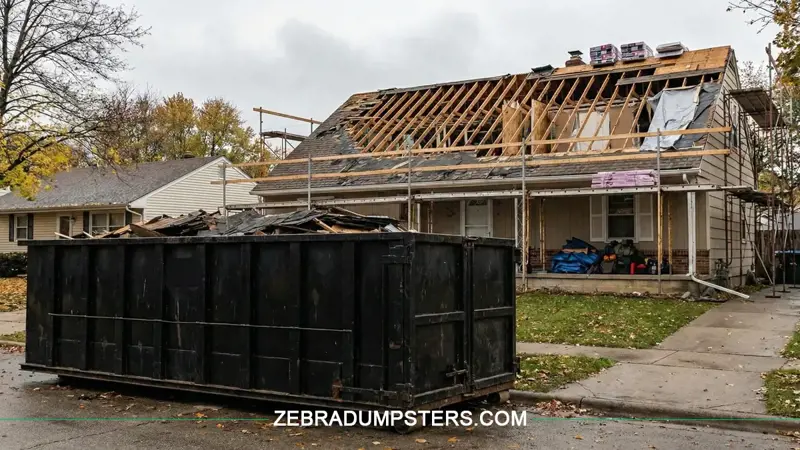
A roofing crew that shows up to a tear-off with no container on site loses the morning. That is the whole problem in one sentence. The shingles come off faster than anyone expects, the pile in the driveway grows past the point where it can be moved twice, and somebody ends up calling around at 10 AM asking who can deliver today.
Roofing is one of the few jobs where the debris arrives all at once. A kitchen remodel trickles waste out over two weeks. A roof produces almost everything it will ever produce in a single day, usually before lunch. That timing, not the size of the house, is what decides which container you should have sitting there when the first bundle comes off.
What Size Dumpster Do I Need for a Roof?
The mistake we see most often on roofing jobs is ordering by how the pile looks instead of what it weighs. Asphalt shingles are dense. A single square, meaning 100 square feet of roof, runs roughly 250 pounds for a standard three-tab tear-off. Architectural and laminated shingles push well past 400 pounds a square.
Run that math on a typical Bay Area ranch house. A 2,000 square foot roof is about 20 squares. One layer of three-tab comes off at roughly 5,000 pounds, which is two and a half tons of material sitting in a container that still looks two-thirds empty.
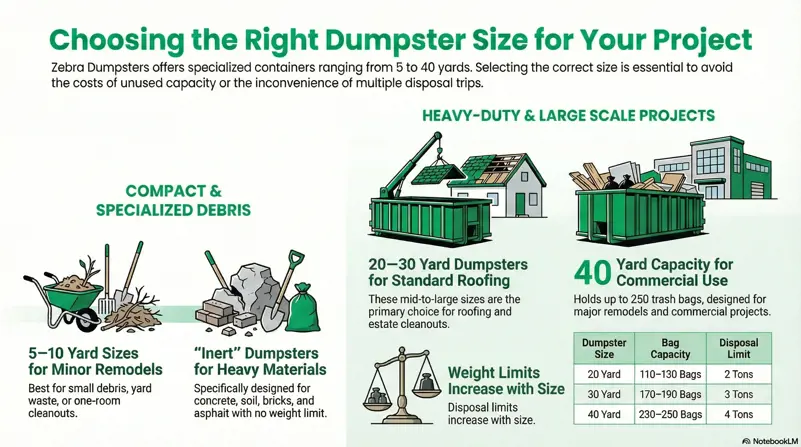
That gap between visual fullness and actual weight is where the overweight charges come from. Here is the sizing table we work from, based on included tonnage at 250 pounds per square for a single-layer tear-off.
| Container | Tons included | Roughly covers | Typical roof |
|---|---|---|---|
| 10 yard | 1.0 | 8 squares | Garage, shed, small addition |
| 20 yard | 2.0 | 16 squares | Most single-story homes |
| 30 yard | 3.0 | 24 squares | Larger two-story, steep pitch |
| 40 yard | 4.0 | 32 squares | Multi-unit, commercial flat roof |
Two things move those numbers. A second layer of shingles roughly doubles the weight, so a 20-square roof with two layers behaves like a 40-square job. And wet material is heavier than dry, which matters between November and March when a tarped pile sits overnight in the rain.
Roof dumpster size by roof square footage
If you only know the size of the house, this is the shortcut we give over the phone. Take the roof's square footage, divide by 100 to get squares, and read across.
| Roof size | Roof squares (100 sq ft) | Recommended dumpster size |
|---|---|---|
| Small repair or partial reroof | 1 to 10 squares | 10 yard |
| Average single-story home (1,500 to 2,000 sq ft) | 15 to 20 squares | 20 yard |
| Larger home, or two layers of shingles | 20 to 30 squares | 30 yard |
| Multi-layer tear-off or large home | 30+ squares | 30 or 40 yard |
| Multi-unit, commercial, or steep pitch with heavy shingles | 40+ squares | 40 yard, or two staged bins |
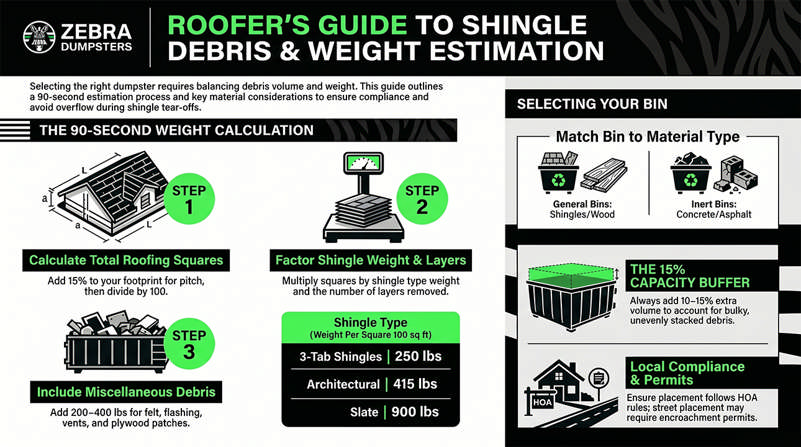
Your roofer's quote usually states the squares already. If it does not, measure the footprint, add about 15 percent for pitch and overhangs, and divide by 100.
How many shingles can a roofing dumpster hold?
The other half of the sizing question is weight per square. Three-tab asphalt runs 230 to 250 pounds a square. Architectural and laminated shingles run 400 to 430. Slate sits in a different league at 800 to 1,000 pounds a square, and clay or concrete tile is heavier still and counts as inert material.
Translated into containers: a 10 yard dumpster holds about 8 squares of three-tab within its one ton, or 4 to 5 squares of architectural. A 20 yard dumpster holds about 16 squares of three-tab within two tons, or 9 to 10 squares of architectural. A 30 yard dumpster handles about 24 squares of three-tab or 14 of architectural within three tons, and a 40 yard covers about 32 squares of three-tab or 19 of architectural within four tons.
To estimate your own load, run five quick steps: measure the roof footprint and add 15 percent for pitch; divide by 100 for squares; multiply squares by the weight per square (250 pounds for three-tab, 415 for architectural, 900 for slate); multiply by the number of layers coming off; then add 200 to 400 pounds for felt, flashing, vents and starter strips. Divide the result by 2,000 for tons and pick the container whose included tonnage covers it. A bin that looks half empty at its weight cap is normal for shingles.
The layer count matters more than the roof size
Older Bay Area housing stock frequently carries two layers, occasionally three. Homes built before the late 1980s were often re-roofed over the original shingles rather than stripped, and nobody finds out until the crew opens up a corner on the first morning.
We had a Willow Glen job last spring where the homeowner ordered a 20 yard for what he measured as an 18-square roof. The crew found a second layer under the first. That container was full and over tonnage by early afternoon on a job that should have finished in a day. Most of our roofing dumpster rental in San Jose runs into the same question at some point, so if there is any chance of a second layer, ask the roofer to check before the container is ordered rather than after.
Tile and slate are a different product entirely
Concrete and clay tile weigh between 600 and 1,100 pounds a square, three to four times what asphalt weighs. A tile roof coming off a 2,000 square foot house can exceed six tons on its own. Tile is also inert material, which means it does not belong in a general debris container at all. Those jobs need an inert bin with no weight limit, and often two containers running in parallel if the underlayment and framing are coming off with it.
Honestly, on roofing work we would rather see a customer take the 30 yard and finish under tonnage than squeeze into a 20 and pay the overage. The price gap between the two sizes is usually smaller than a single ton of overweight.
What a Roofing Dumpster Actually Costs Here
Prices move by delivery city because the haul distance from the yard changes. San Jose is the cheapest run we make, and the numbers climb as the truck goes further out.
| City | 20 yard | 30 yard | 40 yard | Overweight |
|---|---|---|---|---|
| San Jose | $630 | $786 | $910 | $155/ton |
| Hayward | $780 | $926 | $1,070 | $150/ton |
| Oakland | $880 | $1,026 | $1,170 | $150/ton |
| Palo Alto | $740 | $840 | $940 | $150/ton |
Every one of those includes delivery, pickup, a seven day rental and disposal. There is no separate haul fee and no fuel surcharge. If the job runs long, extra days are $45 each.
The question we hear most often from roofers is whether it is cheaper to order small and pay the overage. It almost never is. Stepping from a 20 to a 30 yard in construction dumpster rental in Hayward costs $146. One ton of overweight costs $150. The moment you go a single ton over, the smaller container has already lost.
Prices subject to change. Verify current rates at zebradumpsters.com/weight-limits-and-fees.
Booking a tear-off
Get the container there the night before
Tell us the roof size in squares and whether a second layer is coming off. We will put the right size in your driveway before the crew arrives, with delivery, pickup, seven days and disposal in one price.
Getting the Bin Where the Crew Actually Needs It
Placement decides how fast a tear-off goes. Roofers throw debris down, and every extra step between the eave and the container costs the crew time they will bill you for.
Park it along the longest run of roof if the driveway allows. On a typical Bay Area lot that means the bin sits parallel to the house rather than nose-in, which sounds obvious until the truck arrives and the only clear space is behind two parked cars.
We put boards under the rollers and support feet on every driveway drop, which protects the surface from the container and from the loaded weight sitting on it for a week. That matters more on pavers and stamped concrete than most people expect.
Street placement is a different question. Most Bay Area cities require an encroachment permit for a container on a public road, and the processing time runs from same day to two weeks depending on the city. If your driveway will hold the bin, use it. If it will not, start the permit before you book the roofer, not after. Our San Jose placement and permit guide covers the city-by-city process.
Clearance the truck needs
A roll-off truck needs about 60 feet of straight approach to set a container and roughly 23 feet of vertical clearance to raise the bed. Low branches are the usual surprise. On tree-lined streets in older neighborhoods the driver can often work around them, but a single low limb over the driveway apron can turn a ten minute drop into a rescheduled delivery.
The other thing worth checking before delivery day is what is parked where. Roofing crews arrive with their own vehicles and a material trailer, and the container competes with all of it for driveway space. Deciding that layout the night before saves an argument at 7 AM.
Protecting the roof line while the bin is there
Position the container so debris falls clear of landscaping, air conditioning condensers and the gas meter. Roofers work fast and material does not always land where it was aimed. A sheet of plywood leaned against the wall below the work area costs nothing and prevents the stucco damage we see on maybe one job in ten.
Where Roofing Jobs Go Over Budget
Four patterns account for almost every roofing job that costs more than the quote.
The first is mixing materials. Old chimney brick, a section of concrete tile, or a broken skylight surround goes into the same bin as the shingles and the load gets reclassified. Inert material belongs in a separate no-weight-limit container, and separating it on the ground is far cheaper than paying for it after the scale.
The second is the second haul. A crew fills the container by 2 PM, work stops, and the remaining half of the roof waits for a swap. On a one-day tear-off that stall can cost more in labor than the larger container would have cost outright.
The third is nails and underlayment. Felt, ice-and-water shield and the nails that come with them add real weight that nobody counts. Budget an extra 10 to 15 percent above the shingle math.
The fourth is scheduling the container for the wrong day. A roofing dumpster should be on site the evening before the tear-off, not the morning of. Same-day delivery in roll-off dumpster rental in Oakland is available, but a truck routed at 9 AM does not always arrive before a crew that started at 7.
Booking Around the Tear-Off
Order the container to arrive the day before the roofers do. It costs nothing extra, and it removes the single biggest source of delay on roofing jobs.
Tell us the roof size in squares rather than the square footage of the house, whether there is a second layer coming off, and whether anything inert is going in the same load. Those three answers are enough for us to put the right size in front of your crew.
What to have settled before the truck arrives
Five things, and they take about ten minutes to work through with the roofer.
- Roof size in squares, and whether a second layer is coming off.
- Shingle type, because architectural weighs nearly double what three-tab does.
- Where the container sits, with parking cleared and overhead branches checked.
- Whether any tile, brick or chimney masonry is coming down, which needs its own inert bin.
- Delivery the evening before, not the morning of the tear-off.
Most roofing customers book a 20 or 30 yard. The 30 is the one we recommend when a second layer is involved, or when the pitch is steep enough that the crew will be moving fast and nobody wants to stop for a swap.
Weight, not space
Shingles run out of tonnage before they run out of room
A 20-yard is $630 in San Jose with 2 tons included. One layer of shingles on a typical roof lands near that line; a second layer goes over it. Price the 20-yard for your own ZIP and budget the overage instead of guessing.
Frequently Asked Questions
What size dumpster do I need for a roof?
Count the roof in squares, where one square is 100 square feet. A 20 yard handles roughly 16 squares of single-layer asphalt shingles, and a 30 yard handles about 24. If a second layer is coming off, cut those figures in half.
How much does a roofing dumpster cost in the Bay Area?
A 20 yard runs $630 in San Jose, $780 in Hayward and $880 in Oakland, including delivery, pickup, seven days and disposal. Prices climb with distance from the yard, so ask for your specific city rather than assuming the San Jose number applies.
Can I put roofing shingles and concrete in the same dumpster?
No. Concrete, brick, tile and dirt are inert materials and need a separate container with no weight limit. Mixing them into a general debris load reclassifies the whole load and triggers extra charges.
How many squares of shingles fit in a 20 yard dumpster?
About 16 squares of standard three-tab shingles, which is the two tons included with that container. Architectural shingles weigh closer to 400 pounds a square, so the same bin holds roughly 10 squares of those.
Do I need a permit for a roofing dumpster?
Not if the container sits on your own driveway. Placement on a public street requires an encroachment permit in most Bay Area cities, and processing takes anywhere from a day to two weeks.
When should the dumpster arrive?
The evening before the tear-off. Roofing debris comes off fast, and a container that arrives mid-morning means the crew is either stacking material on the ground or standing still.
What size dumpster do I need for a small roofing project?
For a repair or partial reroof under about 10 squares, a 10 yard is the right call. It carries one ton, roughly 8 squares of three-tab shingles, and runs $472 in San Jose with delivery, pickup and seven days included.
How many shingles can a 10 yard dumpster hold?
About 8 squares of three-tab asphalt within the one ton included, or 4 to 5 squares of architectural shingles. If the roof has two layers, halve those figures.
Is a 20 yard dumpster enough for a full roof replacement?
For a single-story home of 15 to 20 squares with one layer of asphalt, yes. It carries two tons, about 16 squares of three-tab. A two-layer tear-off or architectural shingles on the same house usually calls for the 30 yard.
For most roofing jobs the container decision comes down to one number, and it is not the size of the house. Count your squares, add a layer if there is one, and order the bin that finishes the job in a single haul.