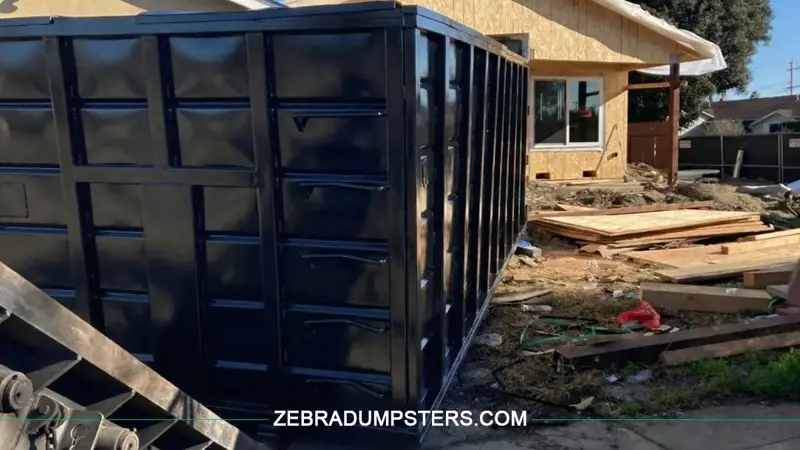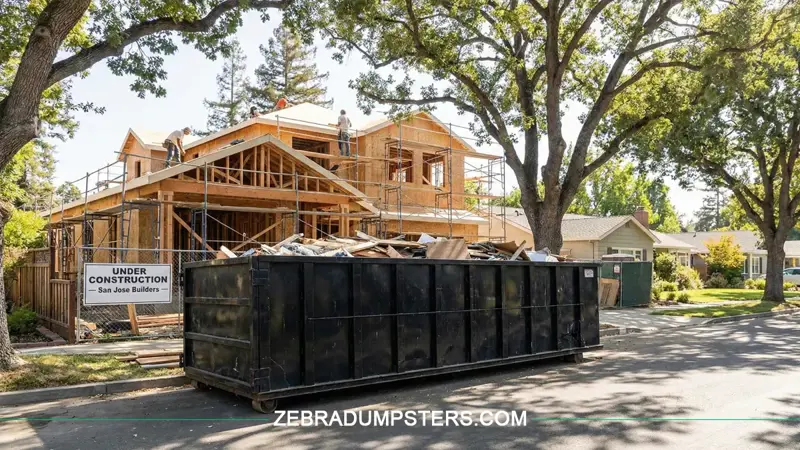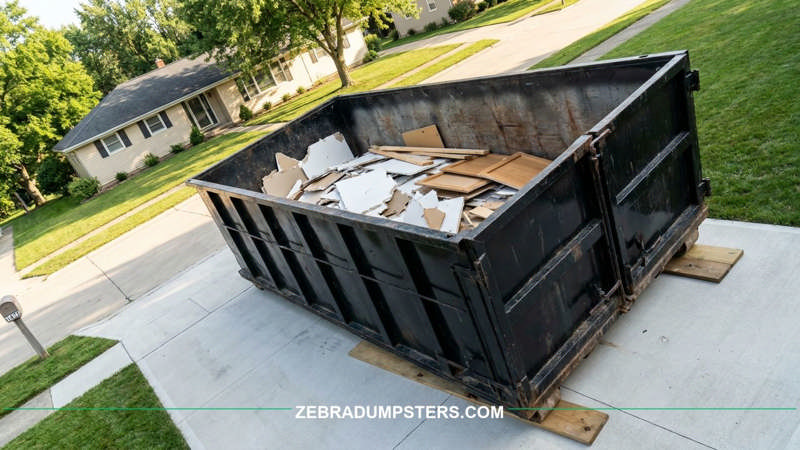
Every renovation produces two kinds of waste, and they go in different bins. Drywall, cabinets, wood, fixtures, flooring and tile go in a general debris dumpster. Concrete, brick and dirt go in an inert (heavy-material) bin. Get that split right and most of the cost surprises disappear.
The short answer on size: a single bathroom or a small kitchen fits a 10-yard general bin ($472 in San Jose, 1 ton included). A full kitchen or two to three rooms fits a 20-yard ($630, 2 tons). A whole-house gut needs a 30 or 40-yard, often more than one load. Tile goes in the general bin too, and it is heavy, so check the included tons before you pick the size.
Size the Bin by the Room, Not the Square Footage
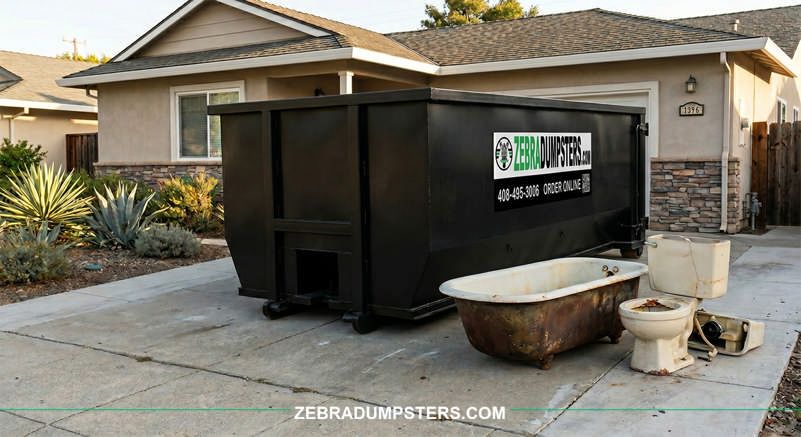
Square footage of the house tells you little. What matters is which rooms are being opened up and how far down they go. These are the San Jose rates for 7 days, delivery and pickup included:
| Size | Tons included | San Jose price | Typical renovation job |
|---|---|---|---|
| 5-yard | 0.5 | $439 | Cabinet swap, powder room refresh |
| 10-yard | 1 | $472 | One bathroom, a galley kitchen |
| 20-yard | 2 | $630 | Full kitchen, two or three rooms |
| 30-yard | 3 | $786 | Whole-house remodel, garage conversion |
| 40-yard | 4 | $910 | Whole-house gut to studs |
Bathrooms fall into four tiers, and the tier decides the bin:
Powder room refresh. New vanity, toilet and faucet, no tile or tub coming out. About 2 to 3 cubic yards. A 10-yard is more than enough.
Mid-range remodel. Vanity, toilet, flooring and a tub surround or shower pan replaced. About 4 to 6 cubic yards. The 10-yard fits. Tile is the heavy part: at 5 to 8 pounds per square foot, 100 square feet of tile on thinset is 500 to 800 pounds of the 1 ton included.
Full gut to studs. Drywall, fixtures, flooring and tile all out, sometimes lath and plaster in older homes. About 6 to 10 cubic yards. A 10-yard is tight, so look hard at the 20-yard.
Expansion into a closet or bedroom. Everything above plus wall framing and ceiling. About 10 to 15 cubic yards, a 20-yard job.
Here's the catch with old bathrooms: a cast-iron tub weighs a few hundred pounds on its own, and plaster walls are heavier than drywall. Those two together are what push a 10-yard past its 1-ton allowance, not the volume. Most of the debris comes out in the first few demo days, and the finish phase is mostly packaging you can bag.
Kitchens follow the same logic: a 10-yard for a galley or a cabinet swap, a 20-yard for most full remodels. Our kitchen remodel dumpster guide covers cabinets and counters in detail. A whole-house gut or a garage conversion usually means a 30 or 40-yard for the tear-out, and a second, smaller bin for finish waste.
Tile Goes in the General Bin, and It Is Heavy
Tile is the material that trips up most remodels. It goes in the general debris bin, and that includes tile with the thinset still stuck to the back. It is heavy: 5 to 8 pounds per square foot on thinset and 15 to 16.5 on a mortar bed, so 200 square feet of floor tile is 0.5 to 0.8 ton on thinset and 1.5 to 1.65 tons on a mortar bed. That counts toward the bin’s included tons, and extra weight is $155 per ton in San Jose.
The layer under the tile goes in the same bin: cement backerboard and stucco are general debris too. The inert bin takes only concrete, brick, asphalt and dirt. Anything else found in it carries a $300 cleaning fee, and mixing heavy materials (concrete with dirt, for example) moves the load to the San Jose mixed rate of $805 or $940.
For a typical bathroom gut, that means one general bin for the vanity, toilet, drywall, backerboard and tile, sized for the weight. A 5 yard inert dumpster is only for concrete, brick, asphalt or dirt from the job. A whole-house tile tear-out of 1,000 square feet on thinset is 2.5 to 4 tons, so it needs the tons of a 30 or 40-yard.
Two safety notes before the chisel comes out. Chipping thinset releases fine silica dust, so wear a proper respirator and close off the room. And if the floor is old enough that the tile or the adhesive under it might contain asbestos, have it tested first: asbestos is prohibited in every Zebra bin.
Most renovations land here
The 20-yard is the one we send out most
Kitchen, two or three rooms or a garage conversion: the 20-yard covers the middle of almost every renovation, at $630 in San Jose with 2 tons included. Open it with your delivery ZIP and you will see the rate for your own address.
Drywall: Light Per Sheet, Heavy Per Bin
Drywall goes in the general debris bin with no special handling, and it counts toward the bin's included tons. One sheet does not feel heavy. According to USG, regular 1/2 inch drywall weighs 1.6 pounds per square foot, so a 4 x 8 sheet is about 51 pounds. Lightweight board is about 40 pounds a sheet.
That adds up faster than people expect. A bathroom or a 12 x 12 bedroom has fewer than 20 sheets on its walls and ceiling, which a 10 or 20-yard absorbs easily. A whole-house gut is different: every 100 sheets of regular board is about 2.5 tons, more than a 20-yard's allowance before a single cabinet goes in. That's where things change, and a 30 or 40-yard, or two loads, makes more sense than paying overweight on a smaller bin.
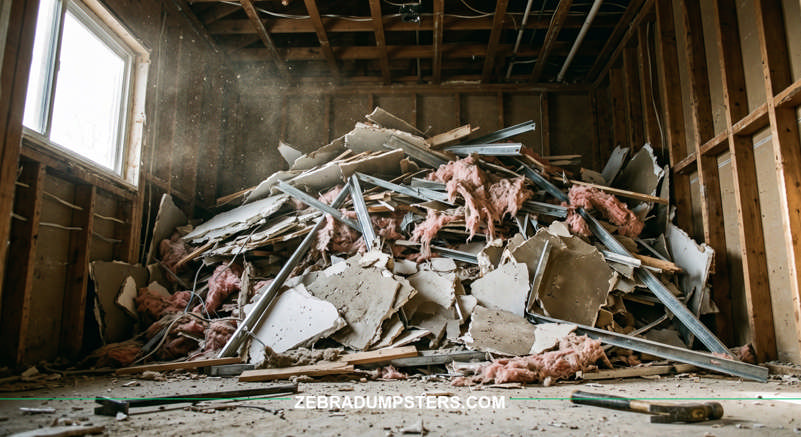
Older homes add a twist. Lath and plaster walls weigh noticeably more than drywall for the same wall area, so on a pre-war remodel we size up a step. Wet or moldy drywall from water damage goes in the same general bin, but it is heavier still.
Hardwood and Other Flooring: Wood Goes General, Weight Adds Up
All wood goes in the general debris bin: hardwood flooring, subfloor, framing, cabinets, and pressure-treated lumber too. The one wood item we do not take is railroad ties. Carpet, pad and vinyl plank go general as well.
Hardwood is denser than it looks. Red oak weighs about 44 pounds per cubic foot (USDA Forest Products Laboratory), so 3/4 inch oak flooring is about 2.75 pounds per square foot. A whole main floor of 1,200 square feet is about 1.65 tons of wood before the subfloor comes up.
That is why a full-floor removal is a weight job, not a volume job. In a San Jose 20-yard with 2 tons included, if hardwood and subfloor together come to 2.7 tons, the extra 0.7 ton at $155 adds about $109 to the $630. One or two rooms fit a 10-yard with room to spare.
If the old floor might be vinyl tile with asbestos underneath, the same rule as tile applies: test before you pull it up.
What a Renovation Bin Costs, Fees Included
The bin price covers delivery, pickup, 7 days and the included tons. A few things cost extra, and they are worth knowing before demo day:
| Item | San Jose | Other cities |
|---|---|---|
| Each ton over the allowance | $155 | $155 to $200 by city |
| Appliances and big items (fridge or A/C only with refrigerant removed) | $25 each | $75 each |
| Electronics (TV, computer, monitor, printer, vacuum) | $25 each | $100 each |
| Tires | $25 each | $25 each |
| Extra rental day after 7 | $45 | $45 |
| Dead run (truck cannot drop or collect) | $250 | $250 ($350 north of Millbrae or Oakland) |
Prices rise with distance from our yards. A 20-yard is $630 in San Jose, $715 in Sunnyvale, $780 in Hayward and $880 in Oakland. Same-day delivery is available, with a $100 fee outside San Jose and Campbell.
Two San Jose examples. A bathroom gut with its tile: a 10-yard general bin at $472 with 1 ton included, or a 20-yard at $630 with 2 tons if the floor is on a mortar bed. A full kitchen: a 20-yard at $630, plus $25 for each appliance going in.
Liquid paint, solvents, batteries and other hazardous waste are prohibited in every bin. The full rules are on our dumpster weight limit page, and booking a bin for a home project is on our residential dumpster rental page. Prices subject to change. Verify current rates at zebradumpsters.com/weight-limits-and-fees.
One bin, sized by weight
Count the tile when you size the bin
Tell dispatch about the tile when you book, so the bin is sized for its weight as well as its volume.
Frequently Asked Questions
What size dumpster do I need for a bathroom remodel?
A 10-yard general debris bin ($472 in San Jose, 1 ton included) covers a powder room refresh or a mid-range remodel. A full gut to the studs is tight in a 10-yard, so look at a 20-yard ($630, 2 tons), which also fits a master bath expansion or a gut with a cast-iron tub and plaster walls. The tile goes in the same bin and counts toward its included tons.
How big of a dumpster do I need for a kitchen remodel?
A 10-yard for a galley kitchen or a cabinet swap, and a 20-yard for most full kitchen remodels of 150 to 250 square feet. Granite counters and plaster walls add weight, so check the 2-ton allowance before you settle on the 20-yard.
Can tile go in a regular dumpster?
Yes. Tile, including tile with thinset still on it, goes in a general debris bin, and so does cement backerboard. Tile is heavy, so it counts toward the bin’s included tons: extra weight is $155 per ton in San Jose.
Can drywall go in a dumpster?
Yes. Drywall goes in a general debris bin and counts toward the bin's included tonnage. A 4 x 8 sheet of regular 1/2 inch drywall weighs about 51 pounds, so 100 sheets come to about 2.5 tons.
What size dumpster do I need for hardwood floor removal?
A 10-yard for one or two rooms. For a whole floor of 3/4 inch oak, around 1,200 square feet, plan a 20-yard: the wood alone is about 1.65 tons, and the subfloor adds more. Weight beyond the allowance is $155 a ton in San Jose.
How much does it cost to rent a dumpster in San Jose?
General debris bins in San Jose are $439 (5-yard), $472 (10-yard), $630 (20-yard), $786 (30-yard) and $910 (40-yard) for 7 days, with 0.5 to 4 tons included and $155 per extra ton. Inert bins for concrete and asphalt are $585 and $640, dirt $675 and $740, and brick or a mix $805 and $940.