The kitchen is the easy part of a remodel to imagine and the hard part to plan the back end of. Granite slabs, particleboard boxes, and a tile backsplash all share one truck on demo day, but they do not share one disposal logic. A homeowner who books a 10-yard general-debris dumpster for a full tear-out usually ends up with an overweight fee they did not budget for, because a single run of granite countertop already eats most of the included tonnage.
After eight years and more than 15,000 Bay Area cleanouts, we have watched kitchens come apart in every order possible, and the surprises almost always come from countertop weight, not cabinet volume. This guide walks through how to think about cabinets and countertops separately, what dumpster size to put on the road, and where the inert option saves a couple hundred dollars on a typical kitchen.
What You Are Actually Disposing Of
The phrase "cabinet and countertop removal" hides four very different material categories, each with its own weight, volume, and disposal path. Sorting them out before demo day is the difference between one clean haul and three.
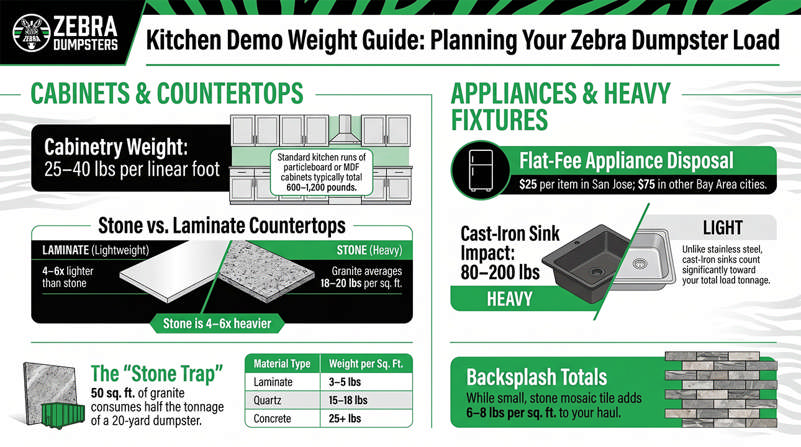
Cabinet boxes are usually one of three things. Big-box stock cabinets from the 1990s and 2000s are particleboard or MDF with a thin veneer or melamine face. They are bulky, splinter easily when pried off the wall, and weigh roughly 25 to 40 pounds per linear foot of upper or lower run. A standard kitchen with twelve linear feet of base cabinets and ten feet of uppers comes out to roughly 600 to 1,200 pounds of cabinet material once you include face frames and doors.
Older kitchens (anything pre-1990) often have plywood-sided cabinets with hardwood face frames. These are heavier per foot but stack cleaner, and a good portion can be donated if they come down intact. Custom or semi-custom cabinets built after 2010 fall somewhere in between depending on what the cabinetmaker used.
Countertops are where the math gets interesting. Laminate over particleboard is light, around 3 to 5 pounds per square foot. A typical 50-square-foot kitchen of laminate is maybe 200 pounds of material. Solid surface (Corian and similar) sits around 5 to 7 pounds per square foot. These two go into a general-debris dumpster without any drama.
Stone countertops are a different conversation. Granite runs 18 to 20 pounds per square foot. Quartz is 15 to 18 pounds per square foot. A 50-square-foot kitchen of granite is roughly 900 to 1,000 pounds. That is already half the included tonnage on a 20-yard dumpster, before a single cabinet or piece of drywall goes in. Concrete countertops are heavier still, in the 25-plus pounds per square foot range.
Backsplash tile is light per piece but adds up fast on weight if the tile is porcelain or stone. Subway tile and small ceramic tile are usually under 4 pounds per square foot. Stone mosaic and porcelain hex tile can run 6 to 8.
The bits people forget: a cooktop, range, dishwasher, microwave, garbage disposal, and sink are not part of the cabinets or counters. They are appliances. Putting a fridge or a built-in cooktop into the dumpster is allowed at Zebra, but it carries the per-item appliance fee of $25 each in San Jose and $75 each in other Bay Area cities. The sink is general debris if it is stainless or composite, but cast-iron sinks weigh 80 to 200 pounds each and count toward your tonnage.
The Weight Math Most Homeowners Skip
Here is the simplest way to budget a kitchen tear-out by weight. A 20-yard general-debris dumpster, our most popular size, includes 2 tons (4,000 pounds) and runs $550 with delivery, pickup, and a 7-day rental included. Most kitchens come in well under 2 tons. Most kitchens with a granite or quartz slab going into the same dumpster come in right at or over 2 tons.
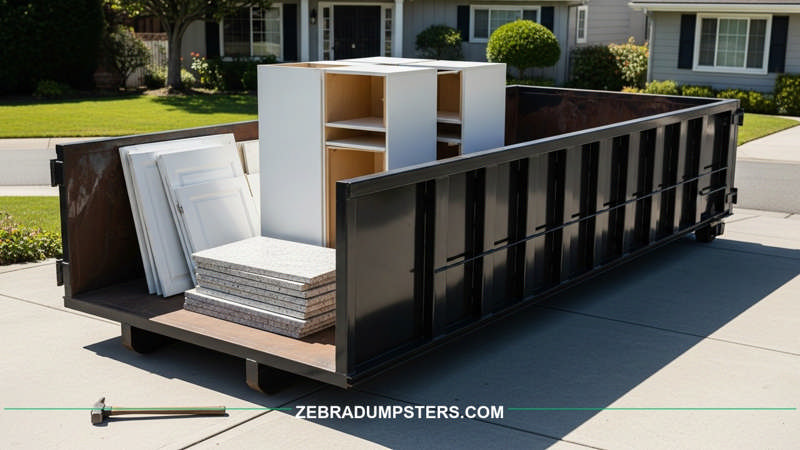
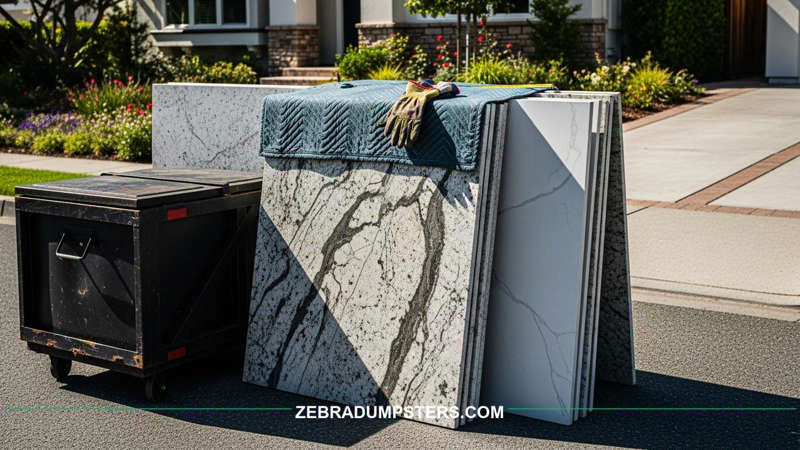 Granite and quartz slabs stage cleanly on a driveway and weigh more than most kitchens.
A worked example using real numbers from a Sunnyvale kitchen we hauled last spring:
| Item | Weight |
| Particleboard cabinets, 22 linear feet | 900 lb |
| Granite countertop, 56 sq ft | 1,050 lb |
| Tile backsplash, 28 sq ft porcelain | 200 lb |
| Drywall, flooring, misc demo | 600 lb |
| Total | 2,750 lb |
That kitchen at 2,750 pounds is 750 pounds over the 2-ton allowance on a 20-yard. In Sunnyvale the overweight rate is $150 per ton, so the surprise on the invoice is around $56. Small enough that nobody minds, but big enough that it would be nice to know ahead of time. Swap the granite for laminate and the same kitchen comes in under 1,800 pounds, well under the limit.
The instinct is to "just go up a size" to a 30-yard for the extra 1,000-pound allowance. That works, but it adds dollars to the base rental that often exceed the overweight fee. The smarter call on a granite kitchen is to send the slab on its own path.
The Inert Dumpster Trick for Stone Countertops
Granite, quartz, and stone tile all qualify as inert debris. Inert dumpsters at Zebra come in 5 and 10 yard sizes, and they carry no weight limit. You can fill the box solid. We use this same option for concrete, dirt, brick, and asphalt jobs.
For a typical Bay Area kitchen with a 50 to 80 square foot stone countertop, a 5-yard inert plus a 20-yard general-debris dumpster on the same delivery often beats a single 30-yard. The split-stream approach also keeps the recycling clean. Stone goes to an aggregate facility and gets crushed for base rock. Mixed loads do not. If keeping the slab out of landfill matters to the project, the inert option is also the greener path.
A practical sequence on demo day: pop the slab off the cabinets first, walk it (or wheel it on a dolly) into the inert box, then break apart the cabinets and load them into the general-debris box. Cabinet boxes are awkward but light. Stone is heavy but compact. Keeping them separate makes the loading easier and the bill smaller.
Stone countertops
Put the granite in an inert bin, not the 20-yard
A 5-yard inert is $505 in San Jose with no weight cap. The same slab in a general bin is billed by the ton, and stone is exactly where kitchen tear-outs go over.
Dumpster Sizing by Kitchen Type
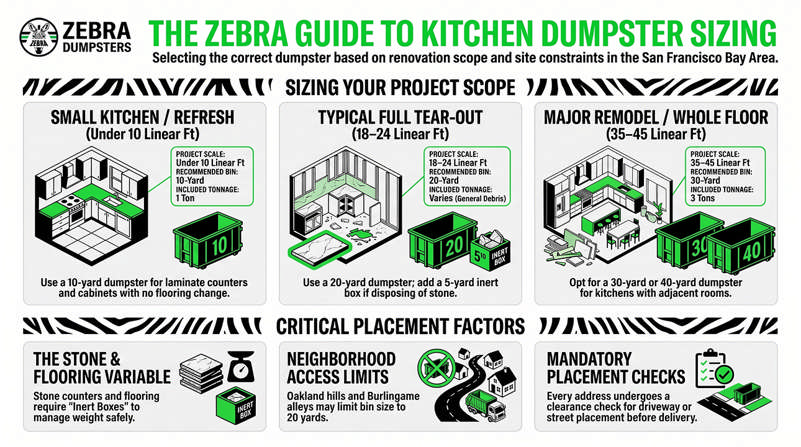
The right size depends on how much of the kitchen is coming out and what is in the counters. A few rough buckets that hold up across the South Bay, East Bay, and Peninsula.
A single bathroom-adjacent or small kitchen with under 10 linear feet of cabinets, laminate counters, and no flooring change fits in a 10-yard general-debris dumpster with room to spare. Included tonnage is 1 ton, plenty for this scope.
A typical full kitchen tear-out of 18 to 24 linear feet of cabinets, full backsplash, and stone counters wants a 20-yard general-debris plus a 5-yard inert for the stone. Or, if the counters are laminate or solid surface, a single 20-yard handles it without the split.
A kitchen plus adjacent dining or laundry tear-out of 35 to 45 linear feet of cabinets and built-ins moves to a 30-yard general-debris and still benefits from a separate inert box for stone. The 30-yard includes 3 tons, which absorbs the cabinet weight comfortably.
A whole-floor remodel covering a kitchen, two bathrooms, and flooring throughout usually needs a 40-yard general-debris and an inert box together. At that scale the booking conversation also covers swap-outs, since you may fill the box mid-project and want a fresh one delivered.
The other variable is street access. Bay Area driveways are not all the same. A flat South San Jose driveway takes a 30-yard without thinking. A hill driveway in Oakland or a narrow alley in Burlingame might max out at a 20-yard for clearance reasons. When you book, the address goes through a placement check before the truck rolls.
What Is Worth Saving, and How to Sort
Not everything that comes off the wall needs to go in the box. A few categories tend to have real second-life value.
Solid-wood cabinets in decent shape, even with dated finishes, get picked up quickly by Habitat for Humanity ReStore, especially the East Bay locations. The trick is to keep them intact. A pry bar and patience save a $200 donation. A sledgehammer turns it into firewood.
Stone countertop offcuts and undamaged slab sections sometimes get reused by fabricators for vanity tops, hearths, or shelving. Local fabricators in San Jose and Hayward will occasionally come pick up clean offcuts if you call ahead. This is more common for quartz than for granite, because granite color matching is hard once the original slab is gone.
Hardware (pulls, knobs, hinges) is small money individually but easy to bag and sell. A bag of fifty matching brushed-nickel pulls clears $40 to $80 on a local resale page without much effort.
Appliances in working order, even old ones, go to the appliance recyclers who pay scrap value, or to a buyer through a local resale page. Putting them in the dumpster costs $25 to $75 each, so a working washer or dryer is worth ten minutes of listing time.
A reasonable rule: anything intact that took skill to install is worth a thirty-second pause before it goes in the box. Anything broken, water-damaged, or finished with lead paint goes straight in.
The Demo-Day Sequence That Saves Money
Watching a kitchen come apart efficiently is its own small art form. After many years of pulling up to demo day with a dumpster ready to load, the sequence that consistently produces the cleanest haul looks like this.
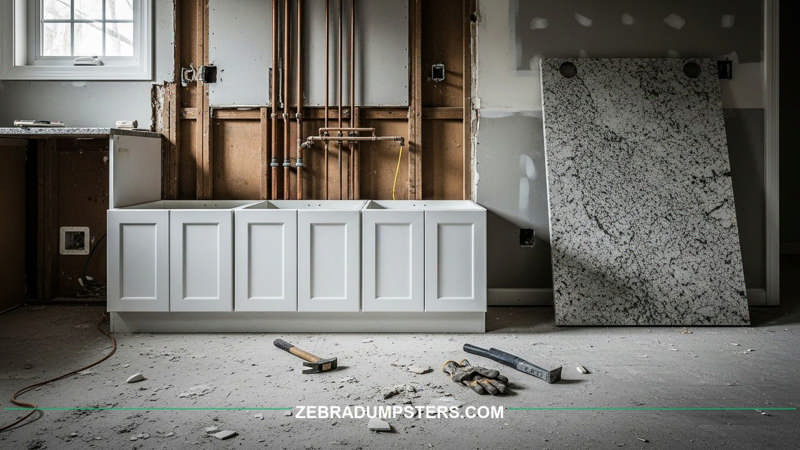 Mid-demo: base cabinets pulled, plumbing exposed, slab staged for the inert box.
Clear the room first. Appliances out, drawers and shelves emptied, base cabinets disconnected from plumbing and gas. The disposal still bolts to the sink, so it comes off as a unit if you have one.
Pop the countertop next. Stone counters are silicone-bonded to the cabinets, not screwed down. A utility knife along the seam and a couple of pry points usually free a slab without breaking it. Walk or dolly it directly to the inert box. Granite and quartz crack if dropped on a hard edge, so moving them whole protects both the floor and your back.
Take the wall cabinets down before the bases. Uppers come off easier with the counter already gone and someone to catch them. Empty cabinets weigh 15 to 30 pounds each, and a full upper can run 50.
Break up the base cabinets in place if they will not fit through the doorway intact. Particleboard splits along the dado joints with a pry bar. Plywood needs a sawzall. Either way, the cabinets stack flatter when they come apart at the seams.
Backsplash tile comes off last, after the counter is gone and the cabinets are clear. A floor scraper does most of the work, and a hammer drill handles stubborn thinset. The tile bucket goes in the general-debris box.
City-by-City Overweight Reality
If the load does come in over the included tonnage, the per-ton overweight fee depends on where the dumpster is sitting. The Bay Area splits into a few clear tiers, and a kitchen tear-out is usually small enough that the overweight bite, if any, lands under $100. The full canonical table is on our weight limits and fees page, but the kitchen-relevant slice is below.
| Region | $/ton over |
| San Jose, Santa Clara, Sunnyvale, Cupertino, Milpitas | $150 |
| Oakland, Hayward, Fremont, most East Bay | $150 |
| Mountain View, Palo Alto, Menlo Park, most Peninsula | $150 |
| Daly City, South SF, Burlingame, San Bruno, Millbrae | $165 |
| San Francisco, Pacifica, Albany, Richmond, El Cerrito | $175 |
| Tri-Valley: Pleasanton, Dublin, Danville, San Ramon, Walnut Creek | $200 |
The takeaway is that the $50 to $100 you might save by pre-sorting the stone slab almost always exceeds the rental cost difference between a 20-yard and a 30-yard dumpster. Sorting wins on small kitchens. Up-sizing wins on full-floor remodels.
Common Mistakes That Cost Real Money
A short list of the patterns we see on invoices when something went sideways.
Loading the dumpster with the cabinets still full of stuff. Pots, pans, spice jars, that one waffle iron, they all count toward the weight and they all push the load above the overweight line. Empty the cabinets before they hit the box, not after.
Throwing the granite slab into a 10-yard general debris. The 10-yard includes 1 ton. A 50 to 80 square foot stone counter is 75 to 100 percent of that allowance by itself. The overweight fee on a single dropped slab into a 10-yard usually exceeds the price difference of going up to a 20-yard plus an inert box.
Mixing inert debris into the general-debris box. Concrete chunks, broken stone, or brick fragments from the demo bump the general-debris recycling charge because they cannot be sorted out at the facility. Keep stone separate, since the inert option is cheaper anyway.
Forgetting the dead-run fee. If the truck shows up and the driveway is blocked, has a low-hanging branch, or has cars in the way, that round trip costs $250 (or $350 north of Millbrae or Oakland). The dumpster does not get dropped, the truck still gets paid for the trip. A two-minute walk of the dropoff path the day before saves a $250 surprise.
Skipping the appliance fee math. A built-in cooktop, fridge, dishwasher, microwave, washer, dryer, range, or water heater each carries the appliance per-item fee. Five appliances in San Jose is $125. Five appliances in Oakland or Palo Alto is $375. Sometimes the local scrap-metal yard or a buyer on a resale page beats both numbers.
Overfilling the box. Loads have to sit below the top rail to be hauled legally. A box that is heaped over the rail gets re-loaded into a second dumpster, which becomes a second rental. Pay attention to fill line, especially on cabinets, which compress visually as you stack them.
Cabinets, drywall and flooring
The 20-yard covers the rest of the kitchen
$550 in San Jose with 2 tons included. Most kitchens land under that once the stone is out of the load. Open it with your delivery ZIP for your own city's rate.
Booking the Right Setup for a Kitchen Tear-Out
For a single-kitchen project with stone counters, the booking that usually lands cleanest is a 20-yard general-debris plus a 5-yard inert, dropped the same day. Total is well under $700 with the inert recycling, the rental period is 7 days, and the overweight risk is close to zero.
For a laminate or solid-surface kitchen, a single 20-yard handles it. For a multi-room remodel, a 30-yard general-debris with a 10-yard inert is the workhorse setup. The online booking at zebradumpsters.com runs the placement and pricing checks together, so the right combo of boxes shows up with one delivery window and one pickup window.
A last thought from doing this for 8 years: the homeowners who plan the disposal path two weeks before demo day pay 20 to 30 percent less, on average, than the ones who scramble for a dumpster the morning of. The boxes are the same. The math is the same. The difference is just whether the granite slab has a home before the hammer comes out.