An old backyard shed is the kind of project that looks like a one-Saturday job until you start. The wood walls and roof are easy. The concrete pad, the lag-bolted foundation framing, the buried sewer cleanouts that nobody told you about, the dozens of nails dating from 1985 that's the work. Bay Area homes built in the 1960s and 1970s often have detached sheds slated for removal as homeowners build ADUs, expand patios, or simply tire of maintenance.
This guide covers the demolition sequence for a typical Bay Area backyard shed, the dumpster size that fits the debris, the disposal channels for shed materials, and the cost of doing the project yourself versus hiring it out. Numbers are calibrated for the most common Bay Area shed footprints: 80 to 200 square feet, single-story, wood-framed with composite or asphalt-shingle roofing.
Listen to this article
--:-- · narrated
Shed Demolition Volume and Weight
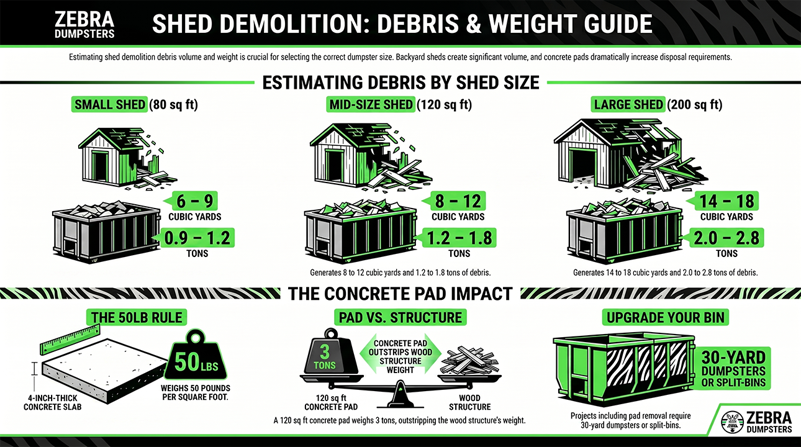
A backyard shed produces more debris than a deck of the same square footage because the walls and roof add three-dimensional volume. A 120 sq ft shed (10x12 footprint) with 8-foot walls generates 8 to 12 cubic yards of debris and 1.2 to 1.8 tons, mostly framing lumber, roof shingles, and the concrete pad.
Typical shed math:
- Small shed (80 sq ft, 8x10): 6 to 9 cubic yards, 0.9 to 1.2 tons
- Mid-size shed (120 sq ft, 10x12): 8 to 12 cubic yards, 1.2 to 1.8 tons
- Large shed (200 sq ft, 10x20): 14 to 18 cubic yards, 2.0 to 2.8 tons
The concrete pad is the weight story. A 4-inch slab weighs about 50 pounds per square foot, so a 120 sq ft pad alone is 3 tons, more than the entire wood structure above it. Pad staying: a 20-yard's 2.0-ton allowance covers the shed. Pad coming up: the project moves into split-bin territory.
For homeowners booking dumpster rental in San Jose for a typical 120 sq ft shed demo (pad staying), a 20-yard general handles the entire load.
A Metal or Resin Shed Is a One-Bin Job
Everything above assumes wood framing, and that's worth checking before you book anything. A 10x12 steel shed generates 250 to 450 pounds of debris total, and a resin shed 200 to 400 pounds, against 2,000 to 2,800 pounds for the same footprint in wood. That changes the plan: unbolt the panels, nest them flat, and one 5-yard general bin (from $409 in San Jose) swallows the structure. Steel panels are worth a scrap-yard run first, since Bay Area yards take clean sheet steel free. The split-bin strategy only matters when there's wood mass and a concrete pad involved.
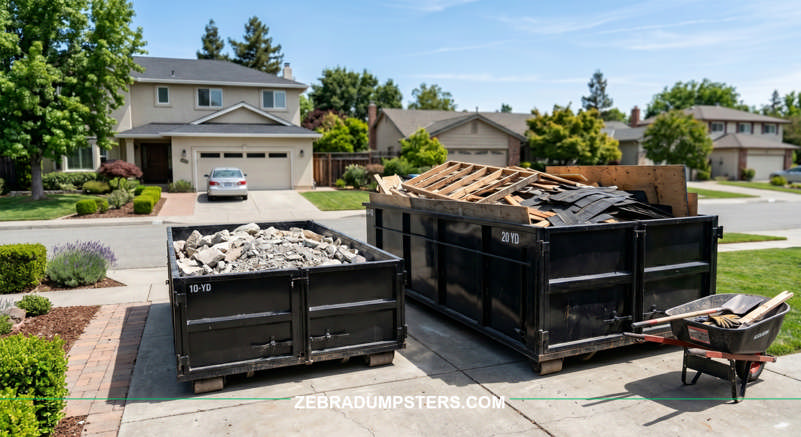
Right Dumpster Size by Shed Project
| Project | Volume | Weight | Dumpster | Cost (from, San Jose) |
| Small shed, pad staying | 6-9 cu yd | 0.9-1.2 tons | 10-yard or 20-yard | $430-$550 |
| Mid-size shed, pad staying | 8-12 cu yd | 1.2-1.8 tons | 20-yard general | $550 |
| Mid-size shed + pad removal | 10-15 cu yd | 4-5 tons (with concrete) | 10-yd inert + 10-yd general | $990 |
| Large shed + pad removal | 18-25 cu yd | 5-7 tons | 20-yd general + 10-yd inert | $1,110 |
Prices are San Jose bases. East Bay and Peninsula cities run one to two tiers higher (a 20-yard is $660 in Hayward, $710 in Palo Alto).
The split-bin approach for pad-removal projects almost always beats single-bin rental once the concrete is included. The 10-yard inert holds concrete with no weight cap, and the 10-yard general handles the wood and roofing. For homes in dumpster rental in Sunnyvale and other Peninsula cities with ADU projects underway, the split-bin matches the project phasing in the ADU construction debris guide. If the shed is coming down to clear an ADU footprint, keep the pad question in front of your designer: most ADU foundations need the old slab gone anyway, so folding pad removal into the shed demo saves a second mobilization.
Demo Sequence and Safety Setup
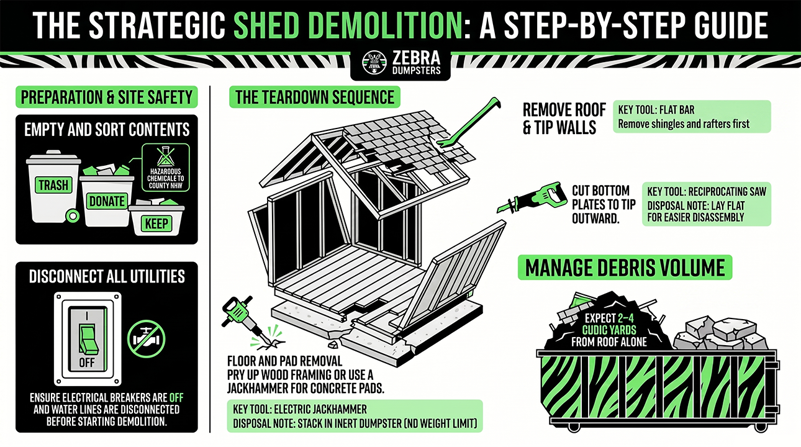
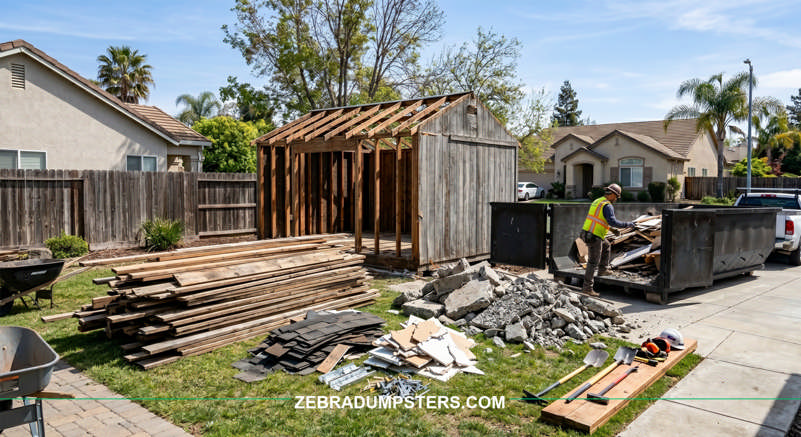
The cleanest shed demolition runs roof-down, walls-out, foundation-last. Skipping the sequence creates unstable structures that need bracing mid-project.
Step 1: Clear the contents. Empty everything and sort into trash, donate, and keep piles. Paint and chemicals go to county HHW (never the dumpster). Working tools donate to Habitat ReStore or sell on NextDoor.
Step 2: Disconnect utilities. Sheds with electrical runs need the breaker off and the wire pulled back to the panel. Water hookups get shut off and disconnected.
Step 3: Remove the roof. Start at the peak with a flat bar, then pull sheathing, then rafters. Roof debris is voluminous but light 2 to 4 cubic yards from a typical shed roof.
Step 4: Tip the walls. Cut at the bottom plate with a reciprocating saw, tip each wall outward, and lay flat. Walls disassemble easier flat than standing.
Step 5: Remove the floor framing. For pad sheds, the floor framing pries up off the pad. For pier-block sheds, the framing comes free with the wall removal.
Step 6 (optional): Break up the concrete pad. A rented electric jackhammer breaks a 120 sq ft pad into 6-12 inch pieces in 2 to 4 hours. Stack them in the inert dumpster no weight limit.
Disposal Channels for Shed Materials
Most shed materials are dumpster-eligible without complication. A few items need separate handling.
Standard general-debris dumpster accepts: framing lumber, sheathing, asphalt shingles, fasteners, doors and windows, drywall, insulation, siding, flashing.
Inert dumpster accepts: concrete pad pieces, brick foundation walls, pier blocks, gravel base. Inert bins have no weight limit on the standard service concrete loads up to 5 tons in a 10-yard inert are routine.
Needs separate handling:
- Old paint and chemicals. Liquid paint, solvents, pesticides never in any dumpster. County HHW programs take them free. Dried-out latex (lid off 3-5 days) is dumpster-acceptable.
- Pressure-treated lumber. Landfill-acceptable in residential volumes, never burned.
- Roofing felt with asbestos. Pre-1980 sheds may have asbestos in roofing felt or siding. Test kits run $30 to $50. Confirmed asbestos requires certified abatement, never dumpster disposal.
- Electrical wiring scraps. Under 50 feet is dumpster-OK. Larger volumes route to scrap yards where the copper has value.
For larger projects that include the shed plus broader yard cleanup, the workflow in the yard waste dumpster guide applies to the surrounding vegetation work.
Bay Area Pricing and Cost Comparison
Demolition dumpster rental prices in the Bay Area start at $430 for a 10-yard general and $560 for a 10-yard inert in San Jose, with the 20-yard at $550. East Bay and Peninsula cities price one to two tiers higher: in Hayward the same bins run $560, $610, and $660.
Worked example. 120 sq ft mid-size shed in Hayward, pad coming up. Split-bin strategy:
- Phase 1 Shed demo (wood, roofing, framing): 10-yard general at $560. Debris: 8 cubic yards, 1.0 ton. No overage. Total: $560.
- Phase 2 Pad removal (concrete): 10-yard inert at $610. Concrete: 3 tons. No weight limit on inert. Total: $610.
- Project total: $1,170.
Compare to a single 30-yard general in Hayward: $770 base plus roughly 3 tons of concrete overage at $150 per ton, about $1,220 all-in. The split-bin approach lands $50 cheaper AND routes the concrete to inert recycling instead of landfill. For homes in dumpster rental in Hayward and other East Bay cities, the split approach is the standard recommendation.
DIY tool costs add $80 to $200 for jackhammer rental, saw blades, pry bars, and PPE. Total DIY: $1,100 to $1,400 for a mid-size shed with pad removal, depending on city tier. Hiring a demolition service runs $1,800 to $3,500 for the same scope.
Standard fees: same-day delivery $100, dead-run $250 South Bay/East Bay, extra days $45/day. Prices subject to change. Verify current rates at zebradumpsters.com/weight-limits-and-fees.
Zebra Dumpsters services the South Bay, East Bay, and Peninsula corridor. Call (408) 495-3006 to discuss split-bin scheduling for a shed-plus-pad project.
Frequently Asked Questions
What size dumpster do I need to demolish a shed?
For a mid-size shed (120 sq ft) with the pad staying, a 20-yard general handles the debris within the 2.0-ton allowance. For shed plus pad removal, a split bin (10-yard inert + 10-yard general) costs about the same as one oversized rental and routes the concrete to recycling. Metal and resin sheds are far lighter and usually fit a single 5-yard general bin.
How much does it cost to tear down a shed in the Bay Area?
DIY with a dumpster runs $510 to $750 for a wood shed when the pad stays ($430-$550 bin plus tools), and $1,100 to $1,400 when the concrete pad comes up too. Hiring a demolition service runs $1,800 to $3,500 for a mid-size shed with pad, roughly $15 to $29 per square foot. Metal and resin sheds land far lower because the debris weight is a tenth of wood.
Can I demolish a shed myself in the Bay Area?
Yes. The demo itself is a one-to-two weekend job for most residential sheds, and most Bay Area cities don't require a permit under 200 sq ft (see the permit question below).
How long does shed demolition take?
One full weekend day for a small shed (80 sq ft) with two people. Two full weekend days for a mid-size shed (120 sq ft), and three days for a large shed (200 sq ft) or any shed with concrete pad removal. The slowest part is breaking up the concrete pad with a jackhammer.
Can concrete pad pieces go in a regular dumpster?
Yes, but they count toward the bin's weight allowance. A 120 sq ft pad is roughly 3 tons of concrete that's overage on every general-debris bin. The cleaner approach is a 10-yard inert (heavy-material) dumpster for just the concrete, which has no weight limit on standard service.
Do I need a permit to demolish a shed?
Most Bay Area cities exempt sheds under 200 sq ft from demolition permits when there are no utilities to disconnect. Sheds over 200 sq ft, sheds with electrical or plumbing service, and sheds in HOA-managed developments may require a permit. Check with your city's building department before starting.