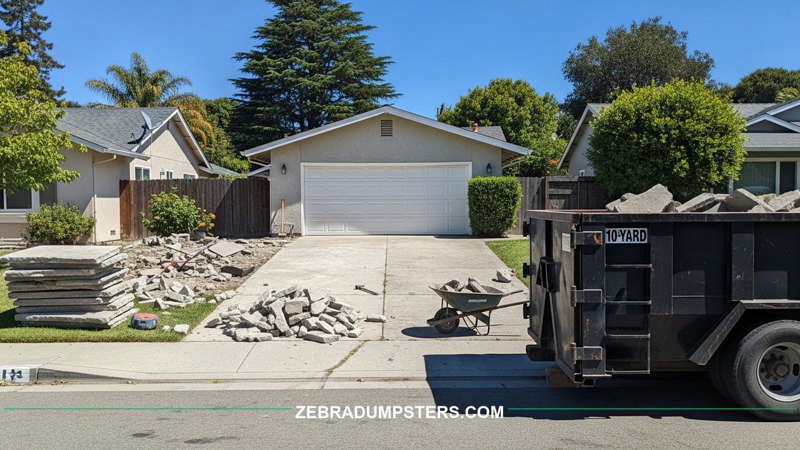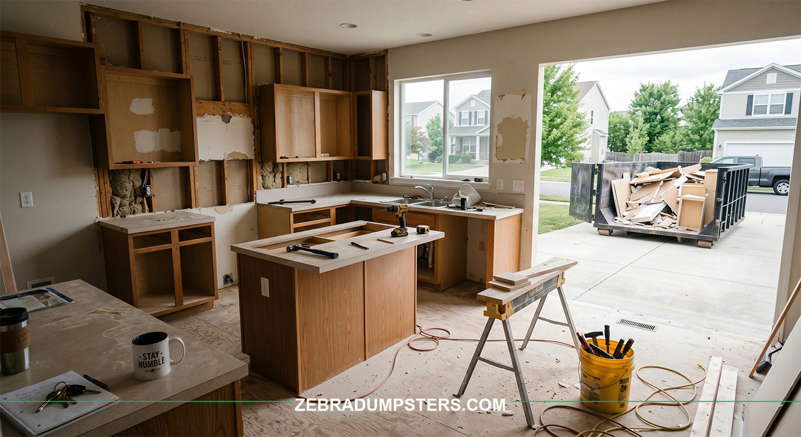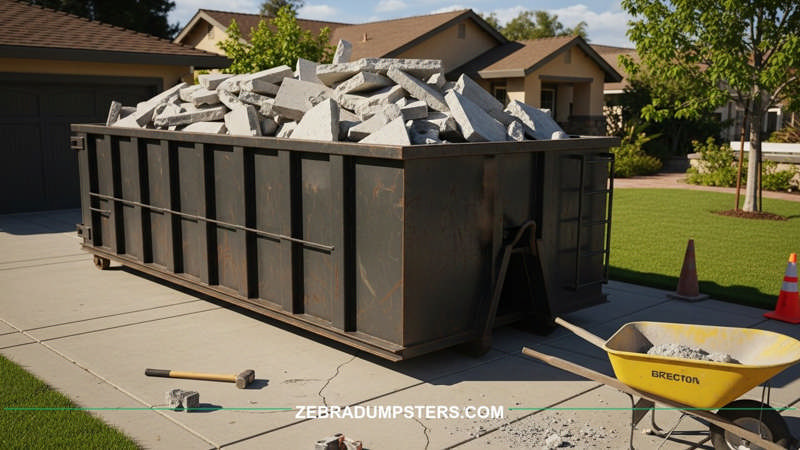
Demolition tear-outs, driveway replacements, and brick chimney removals all leave behind one thing in common: dense, heavy debris that ordinary trash service will not touch. Concrete, dirt, brick, and asphalt are classified as inert materials, and they need their own container what the industry calls a heavy debris dumpster or inert material dumpster. Use the wrong container and a single 10-yard concrete load can weigh 10–12 tons, blow past every weight limit on a general debris dumpster, and trigger reclassification fees that erase any cost savings.
This guide covers what counts as heavy debris, which size fits the volume you are hauling, the rules around contamination, and how concrete dumpster pricing compares to general debris in the Bay Area.
What Is a Heavy Debris Dumpster?
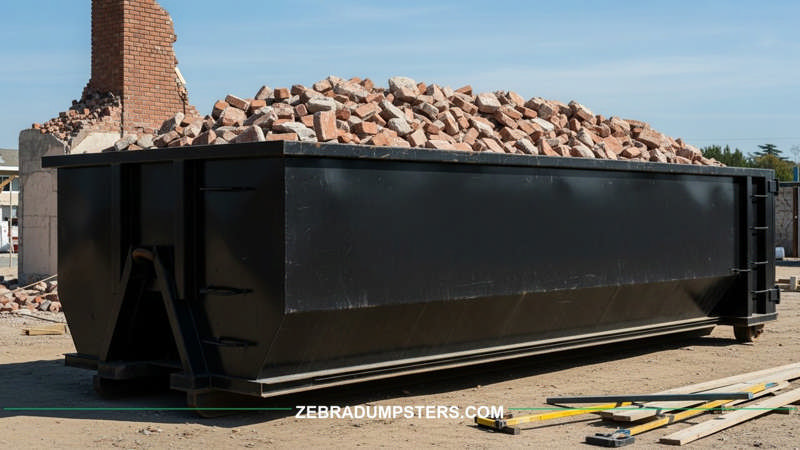 Brick chimney teardown debris filling a 5-yard heavy debris dumpster.
A heavy debris dumpster also called an inert material dumpster or a concrete dumpster is a roll-off container designed for the four materials that local recycling facilities accept as inert: clean concrete, clean dirt, clean bricks, and clean asphalt. Unlike a general debris dumpster, an inert container has no tonnage limit under standard service in San Jose, because the load is bound for an inert recycling facility rather than a transfer station with weight-based tipping fees.
That single fact changes the math of any slab break-out, patio demo, or asphalt resurfacing job. With a general debris container you pay for every ton over the included allowance typically $150 per overweight ton in San Jose, Sunnyvale, Fremont, and most of the East Bay. With an inert container you pay one flat rental price and the recycling center handles the weight on its end.
The trade-off is strict load purity. Heavy debris dumpsters are size-limited (only 5-yard and 10-yard options) and material-restricted. No stucco, no rebar protruding more than three inches, no pieces longer than three feet, and nothing else mixed in. If garbage makes up more than 5% of the load, the recycling center reclassifies it as general debris on arrival and bills it under that weight schedule instead.
Best Uses for Heavy Debris Disposal
The use cases for an inert dumpster all share one trait: a project that produces a tight, clean stream of one or two heavy materials. The four scenarios below cover roughly 90% of inert rentals.
Concrete demolition and slab removal. Driveway replacements, garage-floor pours, foundation tear-outs, and patio demos are the most common reason homeowners book a concrete dumpster rental in San Jose. A typical 200 sq ft, 4-inch driveway slab weighs around 8 tons that fits comfortably in a 10-yard inert container.
Brick disposal from chimney or wall demolition. Bricks pack densely, so volume runs out before weight does. A standard residential chimney teardown produces 1.5–2.5 tons of brick, and the 5-yard option is usually the right call.
Asphalt removal. Driveway resurfacing, parking-pad replacement, and small commercial repairs. Asphalt mills and chunks are accepted as inert as long as they are clean no tar paper, no fabric, no wood forms.
Clean dirt and excavation spoils. Pool excavations, basement digs, and grading projects. Dirt mixed with a little grass is accepted; significant green waste is not. If your project requires a Green Halo certificate or a specific recycling center, a special-recycling fee applies and weight is capped at 5 tons (10-yard) or 2.5 tons (5-yard) before per-ton overage charges kick in.
Heavy Debris Dumpster Sizes & Weight Capacity
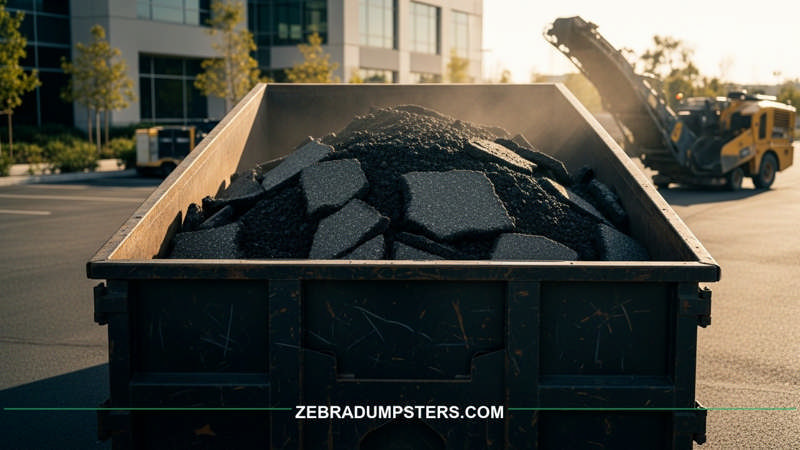 Clean asphalt millings loaded into an inert dumpster during a parking-pad replacement.
Inert dumpsters in the Bay Area come in two sizes. There is no 20-yard, 30-yard, or 40-yard inert option those larger roll-offs exist only for general debris, because a 40-yard concrete load would exceed road-weight limits long before it filled the box.
| Size Exterior | Dimensions | Tons Included (Standard) | Best For |
| 5 Cubic Yards | 19' L × 5.7' W × 2.3' H | No limit (2.5 tons if special recycling) | Single chimney, small patio, half-driveway |
| 10 Cubic Yards | 19' L × 5.7' W × 3.3' H | No limit (5 tons if special recycling) | Full driveway, foundation, asphalt pad |
The footprint is identical between the two sizes, so site access does not change. The 10-yard takes the same parking space as the 5-yard but holds twice the load, and for most clean inert streams it is the better value because the per-cubic-yard cost drops significantly.
A few practical weights to know before you book. A 10-yard load of mixed brick and concrete typically weighs 10–12 tons. A 10-yard load of dirt typically weighs 12–14 tons. A 5-yard load of clean asphalt millings runs 6–8 tons. None of these exceed the standard inert allowance, but every one of them would be illegal in a same-size general debris dumpster which is why material choice matters so much.
Heavy Debris vs. General Debris Dumpsters
The fastest way to choose is to ask one question: is the project producing a clean stream of concrete, dirt, brick, or asphalt, or a mixed demolition with wood, drywall, and trash? If the first, an inert container is almost always cheaper. Bay Area contractors booking construction dumpster rental in Santa Clara overwhelmingly choose the inert option when the project is concrete-only. If the second, a general debris dumpster is the right call.
| Factor | Heavy Debris (Inert) | General Debris |
| Sizes Available | 5 yd, 10 yd | 5, 10, 20, 30, 40 yd |
| Weight Limit | No limit (standard service) | 0.5–4 tons included by size |
| Overweight Fee | None (standard); $95/ton if special recycling | $150–$200 per extra ton (varies by city) |
| Accepted Material | Concrete, dirt, brick, asphalt only | Wood, metal, drywall, furniture, yard waste |
| Penalty for Mixing | $300 cleaning fee + reclassification | None (within material rules) |
The penalty side is where projects most often go wrong. Drop a few wood form scraps, a torn-out gutter, or a couple of trash bags into an inert container and the load gets classified as general debris on arrival a $300 cleaning fee plus the general-debris weight schedule on top. A single careless bag of garbage can add several hundred dollars to a job.
Brief the crew before the bin lands, and keep a separate trash can on site for non-inert material. Inert dumpster jobs run smoothest when the load stays pure from day one.
How to Rent a Heavy Debris Dumpster
Renting an inert dumpster takes about five minutes once you have the basics ready. Three pieces of information speed up the booking call: the delivery address (city determines pricing tier and same-day eligibility), the material type (concrete, brick, asphalt, dirt, or a mix), and the estimated volume. If you are unsure on volume, the rule of thumb is that a 10-foot square of 4-inch concrete slab is roughly 1 cubic yard.
The standard rental covers seven days, with each additional day billed at $45. Pickup is scheduled within 1–3 days of your ready call. Same-day delivery is available outside San Jose and Campbell for a $100 fee, subject to truck availability, and a $250 dead-run fee applies if the truck cannot place or retrieve the bin (or $350 north of Millbrae or Oakland) so confirm access before the truck rolls.
Zebra Dumpsters services the South Bay, East Bay, and Peninsula, including heavy debris dumpster rental in Oakland and the surrounding cities. Call (408) 495-3006 to book or confirm city pricing. Prices subject to change. Verify current rates at zebradumpsters.com/weight-limits-and-fees.
Frequently Asked Questions
How much does concrete weigh in a dumpster?
Standard reinforced concrete weighs about 4,050 pounds per cubic yard just over 2 tons. A full 10-yard inert dumpster of mixed brick and concrete typically lands between 10 and 12 tons; a full 5-yard load of pure clean concrete runs roughly 5–6 tons. Neither is a problem under standard inert service, since heavy material containers have no tonnage limit at the recycling facility.
What materials can go in a heavy debris dumpster?
Only four: clean concrete, clean dirt, clean bricks, and clean asphalt. Dirt with a small amount of grass is allowed. No stucco, no garbage, no wood, no drywall. Rebar can stay in concrete pieces but cannot protrude more than three inches, and no individual piece can be longer than three feet.
Do I need a 5-yard or 10-yard for a residential driveway?
For a standard 400 sq ft, 4-inch driveway slab about 6 tons of concrete the 10-yard is the right call. Same footprint as the 5-yard (taller walls only), so it does not take more space. The 5-yard is sized for smaller jobs like a single chimney teardown or a partial walkway demo.
What happens if I mix trash with the concrete?
If garbage makes up more than 5% of the load, the recycling center reclassifies the dumpster as general debris triggering the general-debris weight schedule (1 ton included, $150 per overweight ton in San Jose) plus a $300 cleaning fee. Avoid it by keeping a separate trash bin on site.
How long can I keep the dumpster?
The standard rental is seven days, with additional days at $45 each. Call ahead to extend rather than letting the bin go past the pickup date.