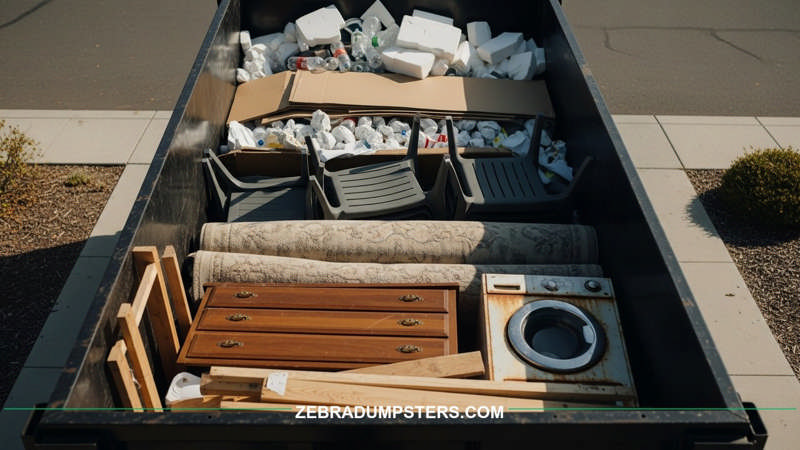
A 20-yard dumpster holds 20 cubic yards of debris on paper. Loaded badly random items thrown in vaguely it averages 12 to 15 cubic yards before the rim is reached and the rest of the volume is wasted on air pockets between awkwardly-stacked bulk items. Loaded well, it actually holds 20. That's a 30 to 60% difference in usable capacity, which directly translates to whether you finish the project in one bin or have to call for a swap.
This guide is the loading playbook: the order things should go in, the rules that prevent overage and refused-pickup fees, and the small habits that turn the same dumpster into 30% more debris removal.
The Loading Order That Actually Matters
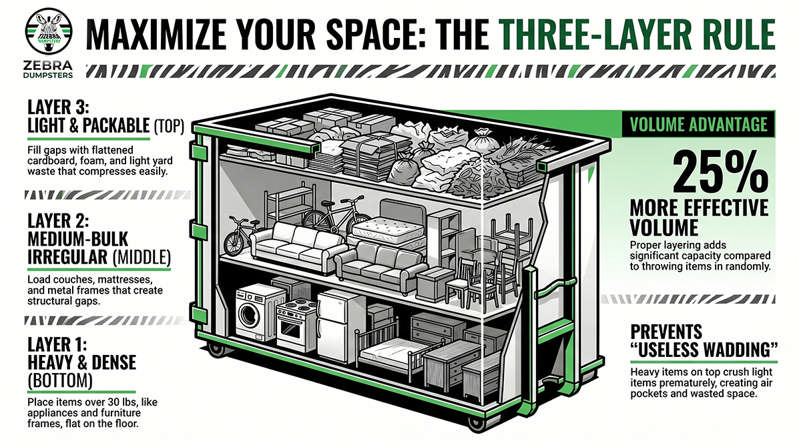
Three layers, in this order. This single rule produces most of the volume gain.
Layer 1: heavy and dense (bottom). Furniture frames, appliances, broken doors, dense wood, large pieces of drywall, books in boxes, broken patio stones (if any are mixed in), heavy yard tools. Anything that sits flat and weighs more than ~30 lbs.
Layer 2: medium-bulk irregular (middle). Couches, mattresses, metal frames, bicycle frames, large pieces of carpet, broken furniture parts, roofing shingles, miscellaneous junk. Items that don't pack well but aren't featherweight.
Layer 3: light and packable (top). Cardboard boxes (broken down flat), foam packing, plastic, light yard waste, soft items, broken cabinet doors. Anything that compresses or slides into gaps.
The reason this works: heavy items at the bottom don't crush light items underneath them, and irregular middle-layer items create the gaps that the light top layer fills. Reverse the order light stuff thrown in first, heavy items dropped on top and the heavy items break and crush the light layer into dense, useless wadding without filling the air pockets.
For most cleanouts via dumpster rental in Santa Clara, this rule alone adds about 25% effective volume vs random throwing.
Break It Down First
Volume savings beyond the layer rule come from one habit: breaking down everything that breaks down before it goes in.
The five worst air-pocket producers if loaded whole:
- Cardboard boxes. A typical packed moving box is 4 cubic feet of mostly-air. Flattened, it's a 1/3 cubic foot of cardboard. Always break boxes down.
- Furniture with hollow frames. Bed frames, IKEA shelving, particle-board dressers, hollow doors. Disassembling adds 5 minutes per item and removes 70 to 80% of the volume.
- Metal patio furniture. Folds flat in seconds; takes huge volume if loaded standing.
- PVC pipes, lumber, ladders. Long thin items waste a foot of bin in every direction. Cut to fit if possible.
- Empty plastic containers. Crush them or stack inside other items.
Five minutes of breakdown per category usually adds another 10 to 15% effective volume. Combined with the layer order, the same bin holds about 35 to 45% more material than a random load.
Distribute the Weight
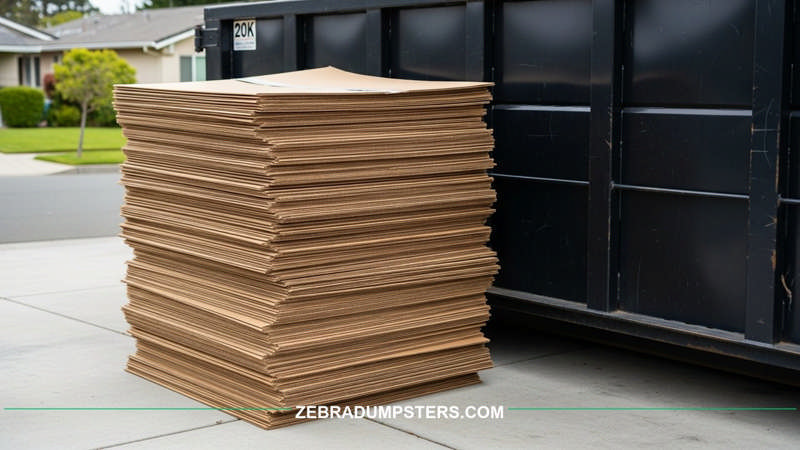 Break boxes down before loading a packed cardboard box is mostly air; flattened cardboard packs to a fraction of the volume.
Beyond volume optimization, weight distribution matters for two reasons: pickup safety and overage avoidance.
Front-back balance. A dumpster that's heavily loaded toward the front (street side) or back (deep side) handles awkwardly during pickup. The truck's hook hits the bin asymmetrically and the bin can swing. Front-half and back-half should weigh roughly the same.
Left-right balance. Same principle, even more important. A heavily-loaded driver-side or passenger-side bin tilts during the pickup, can dump material, and in extreme cases trips a refusal. Balance side-to-side as you load.
Below-the-rim rule. This is non-negotiable. Anything sticking above the bin rim makes the load illegal to haul on California roads because the bin can't be tarped properly. An overloaded bin cannot be collected, so the driver leaves without it: that is a $250 dead run ($350 north of Millbrae or Oakland), plus the time to bring the load back under the rim before a second trip. Stay below the rim from the start; it's not a suggestion.
A consistent pattern with whole-house cleanouts via dumpster rental in Hayward: most homeowners assume "fill it up" means stack until the rim is reached. The actual rule is below the rim everywhere, including the corners.
Size for the load you actually have
The right size beats clever loading
Every trick on this page buys back a few feet of volume. The next size up buys back all of it, and the step from a 10-yard to a 20-yard is $120 in San Jose. Compare the two before you book.
Common Loading Mistakes That Cost Money
Five specific patterns that turn a routine rental into a billing surprise. Each costs $100 to $400 if it happens.
| Mistake Cost | When It Happens | How to Avoid It |
| Mixing concrete or dirt into a general-debris bin | $300 cleaning fee + reclassification to general-debris weight schedule | Concrete, dirt, brick, asphalt go in an inert bin; one small chunk is fine, a meaningful pile (>500 lbs) reclassifies the load |
| Loading prohibited items (paint, batteries, refrigerants) | $300 cleaning fee + hazardous-waste handling charge | Liquid paint, pool chemicals, automotive fluids, refrigerated appliances → county hazardous-waste drop-off |
| Overfilling above the rim | $250 dead run, then a second trip once the load is level | Cap the load at the rim, period. If it doesn't all fit, schedule a swap or rent a larger size next time |
| Heavy-on-top loading collapsing light layers | Lost 20–30% volume → may force a swap (a second delivery at that size's rate) | Heavy at the bottom, light on top the layer rule |
| Overloading a general bin past included tonnage | $150–$200 per ton overage | Plan tonnage ahead of time heavy material (roof tear-off, dirt-filled landscape debris) trips overage on a 10-yard fast |
The first three are the most common and the most fixable. The last two are about right-sizing the bin in the first place covered in the size guides for each yardage.
Safety, Speed, and the Wrap-Up
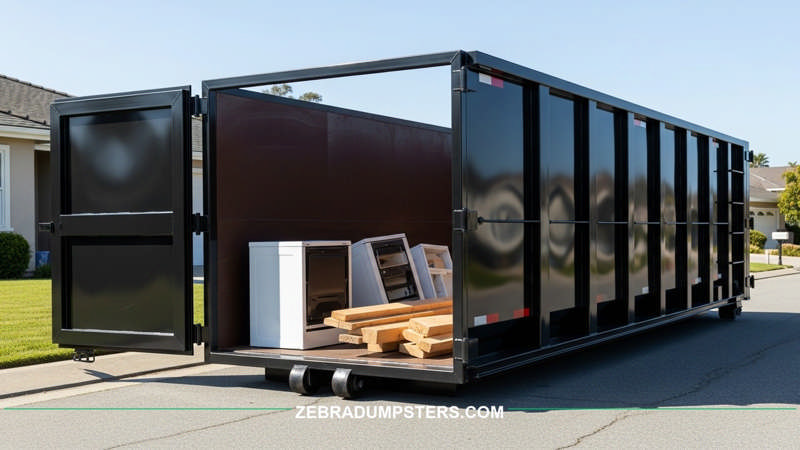 Use the side gate for heavy items. It is safer than lifting over the wall and lets you stage the bottom layer flat.
Three habits make the loading process meaningfully faster and safer.
Lift with your legs, walk with your back straight. Most homeowner cleanout injuries happen on day 2 of a multi-day project fatigue + bad form + bulky items. Take 5-minute breaks every 30 minutes of loading, and have one rest day mid-project on long cleanouts.
Use the side gate. Most roll-off dumpsters have a side gate that swings open. Use it. Walking heavy items through a side gate is far safer than lifting them over the 4-5 foot wall, and it lets you stage the heavy bottom layer flat on the floor of the bin where it belongs.
Keep a separate trash bag for the contamination corner. Things that should NOT go in the dumpster (paint cans, batteries, electronics, the occasional surprise item from the back of a closet) accumulate during a cleanout. Stage them in a labeled trash bag near the bin and run them to county hazardous-waste drop-off in one trip. Keeps the load clean.
Final pass before pickup. Walk around the bin the morning of pickup and check for items above the rim. If anything's sticking up, push it down or pull it out. Saves the dead run.
Booking takes a five-minute call: delivery address (city sets pricing tier), start date, rough volume estimate. Standard rental covers seven days; same-day pickup is free if you finish early. Zebra Dumpsters services the South Bay, East Bay, and Peninsula corridor including same-day routing for dumpster rental in Sunnyvale and the surrounding cities. Call (408) 495-3006 to book. Prices subject to change. Verify current rates at zebradumpsters.com/weight-limits-and-fees.
Heavy load coming?
Say so when you book
Tile, plaster and soil are where general bins go over their tonnage. Tell dispatch what is going in and we size the bin, or send an inert one, before the scale ticket decides for you.
Frequently Asked Questions
Does loading order really make that big a difference?
Yes typically 25 to 40% effective-volume difference between a random-throw and a heavy-bottom-light-top load. On a 20-yard bin, that's 5 to 8 cubic yards of capacity, which is often the difference between finishing in one bin or having to swap mid-project.
What happens if I overfill the dumpster?
Two things, both bad. The driver cannot take it until the load is brought below the rim, so the visit becomes a $250 dead run ($350 north of Millbrae or Oakland) and pickup waits for a second trip. If a truck did haul it, the load could be cited under California overweight and oversize rules. Always cap the load at the rim.
Can I throw furniture in without breaking it down?
You can, but you'll waste 30 to 50% of the bin's volume on air pockets. For small projects this is fine; for a whole-home cleanout it usually means upgrading to the next size or paying for a swap. Five minutes per piece to disassemble usually saves 20 to 30 minutes of "where do I fit this" loading time later.
Is it OK to load over the side wall?
Yes, but the side gate is faster and safer. Most roll-off dumpsters have a hinged side gate that swings open use it for the heavy bottom layer. Switch to over-the-wall loading for the lighter top layer once the bin fills past chest height.
What should I do with hazardous waste during a cleanout?
Stage it in a labeled bag near the bin. Don't put it in the dumpster paint, pool chemicals, batteries, refrigerants, and automotive fluids are prohibited and trigger $300+ cleaning fees if mixed in. Most Bay Area counties offer free hazardous-waste drop-off for residents schedule a separate trip to your county HazMobile or HHW facility before the dumpster is picked up.