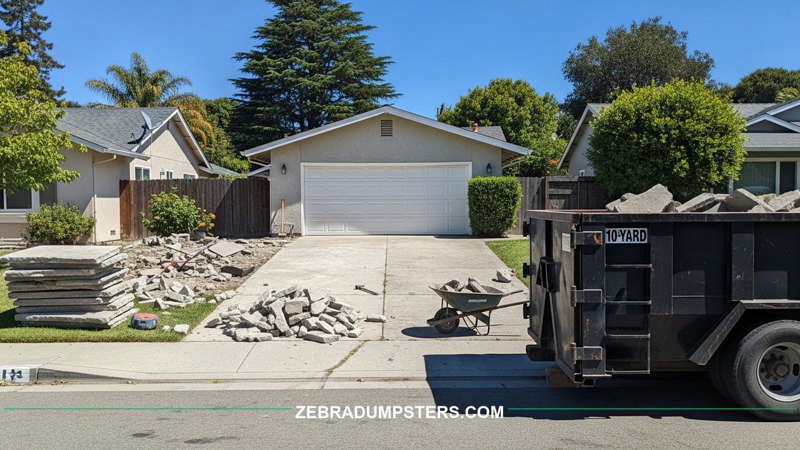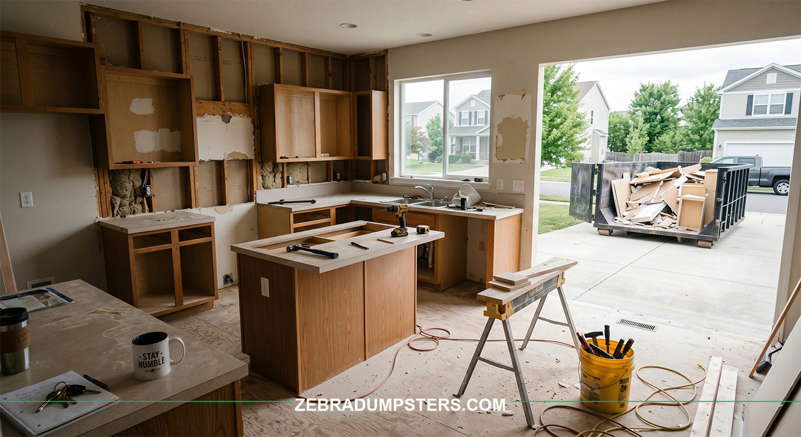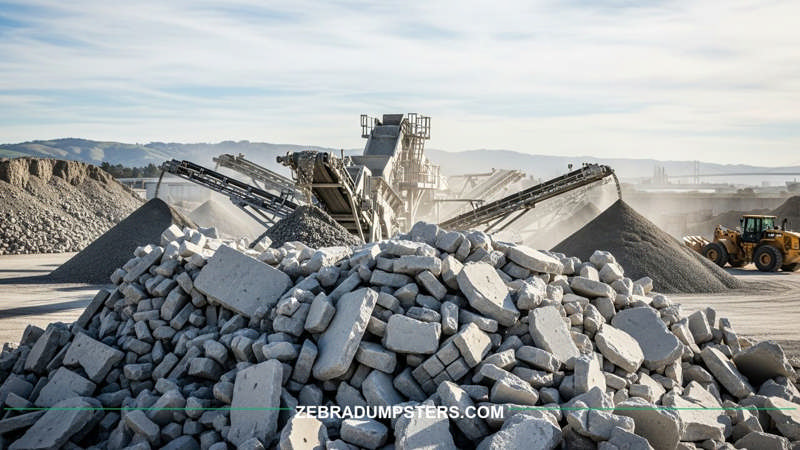
Broken concrete from a residential demolition, ready for recycling at a Bay Area facility.
Concrete is a strange material to throw away. It is too heavy for the trash. Too dense for most curbside services. Too valuable to landfill recycled concrete becomes road base, fill aggregate, and new concrete itself. And there is far more of it than people realise: a typical residential driveway demolition produces 6 to 10 tons of broken concrete, more weight than most homeowners have ever needed to move at once.
A dumpster rental (called a skip in the UK and Australia, same open-top container) is one answer. It is not the only one, and it is not always the cheapest. This guide covers every concrete disposal option available in the Bay Area, the volume range each one fits, and how to decide which is right for your specific job.
Listen to this article
--:-- · narrated
Why Concrete Is Different
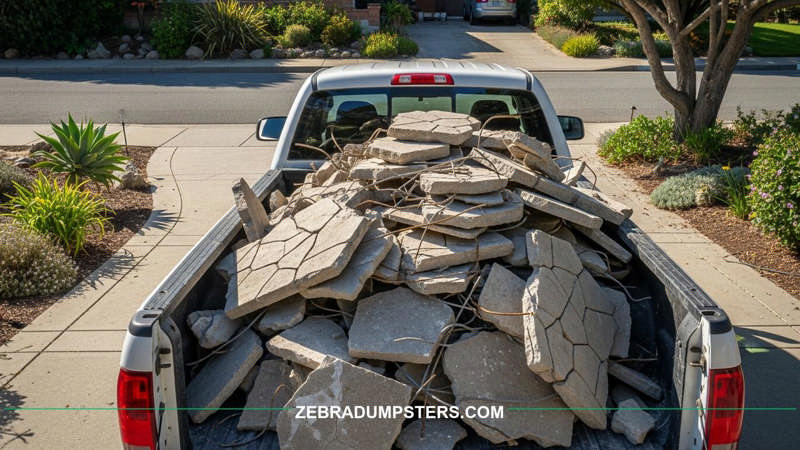 A pickup truck load of clean concrete — the DIY drop-off path for under one ton.
Concrete weighs about 4,000 pounds per cubic yard roughly twice the density of household trash and four times a typical mixed-renovation load. That weight matters because almost every disposal channel charges by weight, not volume. A small pile that fits in a pickup bed can weigh more than a fully-loaded household trash dumpster.
Concrete is also regulated. California state law (CALGreen) and various municipal ordinances require construction projects above certain thresholds to recycle 65% or more of their inert debris. That catches most commercial projects and many residential renovations.
The good news: the Bay Area has the densest network of concrete-recycling facilities in California. Most South Bay and East Bay cities have a recycling option within 10 to 15 miles, and most accept clean concrete at low or zero cost. Whether you can use them depends on getting the concrete to the gate.
Can You Throw Concrete in the Trash or a Regular Dumpster?
No on both counts, and this is the question we field most often. Curbside trash and green bins reject concrete outright: haulers won't lift a can that heavy, and concrete contaminates the organics stream. A regular general-debris dumpster technically accepts a stray paver, but a real concrete load blows through its tonnage allowance almost immediately. Concrete goes in one place: an inert bin, where clean loads carry no weight cap on standard service.
The options break into three buckets by size: DIY for under a ton, rental or pickup for one to five tons, full-service rental for five to fifteen tons. For projects needing a fast verified solution at any size, concrete dumpster rental in San Jose remains the most-booked path it covers all three buckets with one call.
Small-Volume DIY: Under One Ton
If your concrete pile is one or two pickup-truck loads a broken patio stone, a small slab section, the remains of a single chimney pad direct drop-off at a recycling facility is usually cheapest. Free or near-free disposal, plus the cost of the truck rental and your time.
The trick is finding facilities that accept walk-up loads from non-contractors. Several South Bay and East Bay yards take small residential drop-offs without a contractor account. The one we point San Jose callers to most often is the GreenWaste Zanker Resource Recovery Facility at 675 Los Esteros Road, open to the public Monday through Saturday. Call 408-263-2384 for gate pricing before you load the truck. Call ahead hours and acceptance criteria change without notice, and a wasted trip with a loaded truck is its own punishment.
Typical acceptance criteria:
- Clean concrete only no rebar protruding more than three inches, no embedded plumbing
- No oversize chunks most facilities want pieces under three feet
- Loose load only no concrete in bags or cardboard
- Cash or card at the gate; no invoicing without an account
The wildcard is rebar. Recycling facilities run concrete through crushers, and protruding rebar damages equipment. If your concrete has rebar (most slabs from the past 50 years do), cut it flush with an angle grinder, or pay the contaminated-load surcharge ($25 to $75). Most homeowners find the surcharge worth it.
The Free Paths: Reuse It or Give It Away
Before paying anyone, check whether your concrete has a second life. Broken slab pieces, sold to landscapers as "urbanite," build retaining walls, garden steps, and permeable patios, and a free listing on Craigslist or Facebook Marketplace under "free clean fill" often clears a small pile within a weekend in most Bay Area neighborhoods. The catch is timing: give-away works when you can leave the pile curbside for a week, not when the new driveway pour is scheduled for Thursday. Clean chunks only, and note rebar in the listing so nobody shows up expecting hand-size pieces.
Medium-Volume Hauling Options: One to Five Tons
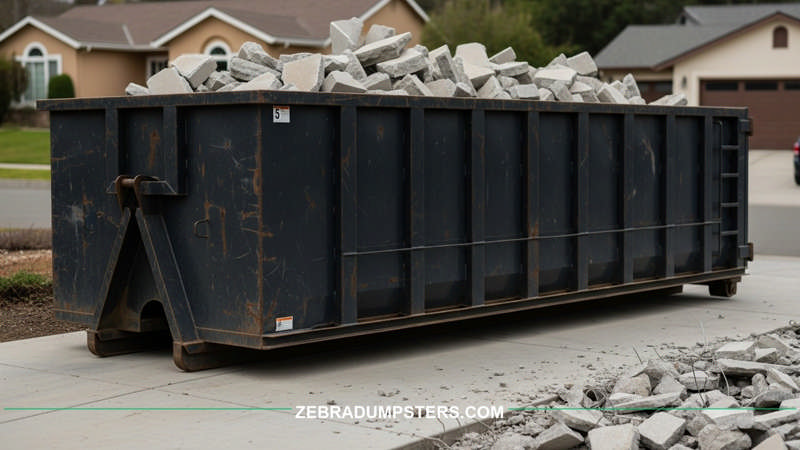 5-yard inert dumpster filled with broken concrete on a Bay Area residential driveway.
The middle band somewhere between a pickup-truck load and a full driveway demolition is where the disposal decision gets interesting. You have three options, each with different math.
| Option | Best For | Typical Cost | Time Investment |
| Multiple pickup-truck DIY trips | 1–2 tons, you own a truck, time is cheap | $0–50 in tipping fees + 4–8 hours of your time | 4–8 hours over 2–4 trips |
| 5-yard inert dumpster rental | 2–5 tons, no hauling, want one delivery + one pickup | Standard rental rate, no per-ton overage | 30 minutes to load (per session, project-paced) |
| Concrete haul-away service (contractor pickup) | You want it gone today and have a generous budget | $300–600 typically | Single appointment |
The 5-yard inert dumpster is the most popular choice in this band for a specific reason: it has no included weight cap under standard service. A 5-yard inert can hold 5 to 6 tons of concrete legally that is the max road weight, not a billing cap. You pay one flat rental rate. Compare that to a general-debris dumpster, where 5 tons of concrete would trigger crushing overage fees, or a haul-away service, where the per-pound pricing escalates fast.
The "no weight cap" applies to clean concrete only (plus clean dirt, brick, and asphalt). Mix in trash, wood, or drywall and the load is reclassified as general debris on arrival at the recycling facility that means a $300 cleaning fee plus the standard general-debris weight schedule. Brief the crew before the bin lands; this is where most contractor projects get surprise-billed. Crews handling construction dumpster rental in Santa Clara often ship a separate small trash can to keep the inert load pure.
Large-Volume Demolition: Five to Fifteen Tons
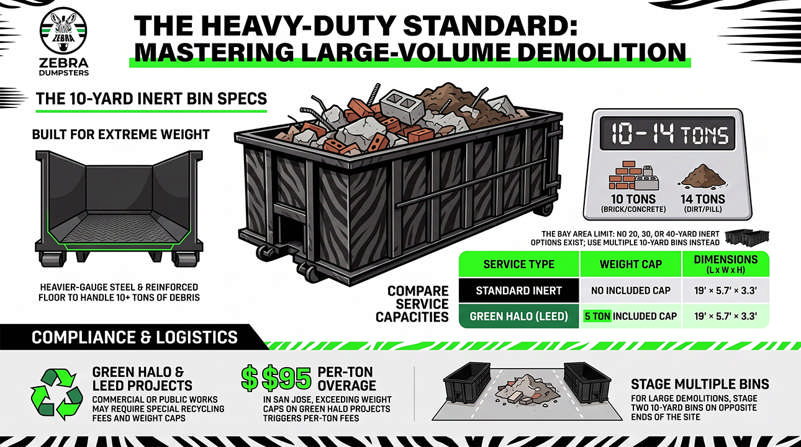
Above five tons of concrete you are in full demolition territory driveway replacements, foundation tear-outs, large patio removals. The 10-yard inert dumpster is the standard solution.
A 10-yard inert has the same exterior dimensions as a 10-yard general (19' × 5.7' × 3.3') but heavier-gauge steel and a reinforced floor. A fully-loaded 10-yard inert with mixed brick and concrete typically lands at 10 to 12 tons; with dirt or fill it can hit 12 to 14. Like the 5-yard, the 10-yard inert has no included tonnage cap under standard service.
One caveat: some projects require a Green Halo certificate typically LEED-rated commercial work, public-works projects, or general-contractor reporting. When that applies, the bin routes to a specific facility and a special-recycling fee kicks in. Included weight caps at 5 tons (10-yard) or 2.5 tons (5-yard); per-ton overage runs $95 in San Jose. Confirm before booking.
There is no 20-yard, 30-yard, or 40-yard inert option anywhere in the Bay Area. Beyond a 10-yard, plan multiple bins or contractor haul-away. Most contractors stage two 10-yards on opposite ends of the job for large demolitions.
How to Decide and How to Book
The right choice is a function of three things: volume, time, and access.
Volume. The three buckets above cover it: DIY under a ton, 5-yard inert to five tons, 10-yard inert beyond that, and multiple bins or a concrete haul-away crew above ten tons.
Time. A rental gives seven days. DIY takes whatever time you have. Contractor haul-away is one day. Inert rentals are unique you only pay for the included period, no per-day pressure within seven days.
Access. A 10-yard inert plus delivery truck needs 22 feet of straight access and 8 feet of width. A pickup truck needs much less. Tight-access sites (downtown lot, condo, narrow side yard) may force DIY hauling.
To book, the call takes three minutes with address, rough volume, and start date. Zebra Dumpsters services the entire South Bay, East Bay, and Peninsula corridor including heavy debris dumpster rental in Oakland. Call (408) 495-3006 to book or to confirm no-weight-cap eligibility. Prices subject to change. Verify current rates at zebradumpsters.com/weight-limits-and-fees.
Frequently Asked Questions
How much does concrete weigh per cubic yard?
Plain concrete weighs about 4,050 pounds per cubic yard, or roughly 2 tons per cubic yard. Reinforced concrete (with rebar) is slightly heavier. A standard 4-inch-thick driveway slab works out to roughly 2 tons per 100 square feet.
Can I put concrete in a regular trash dumpster?
A small amount of incidental concrete (a single broken paver, a chunk from a saw cut) is usually fine in a general-debris dumpster. A full demolition stream is not the weight will exceed the bin's tonnage allowance and the recycling facility will reject the load. For any project producing more than 500 pounds of concrete, use an inert dumpster.
What is the cheapest way to dispose of one truckload of concrete?
For under one ton (roughly one full pickup-truck bed), direct drop-off at a local concrete recycler is the cheapest option typically free to $50 in tipping fees. The catch is finding a facility that accepts walk-up residential loads. Call ahead to confirm acceptance and hours.
Do I need a special permit to demolish my own driveway?
Most Bay Area cities do not require a permit for owner-occupied residential demolition under a certain square footage threshold (varies by city typically 200 to 500 sq ft of slab area). Larger demolitions, commercial work, or any work touching the public right-of-way usually do require a permit. Check with your city's building department before starting; the permit cost is usually under $100 and processing takes days, not weeks.
Can a dumpster rental include concrete and other debris together?
Generally no, and mixing is expensive. Inert dumpsters are for concrete, dirt, brick, and asphalt only anything else triggers a $300 cleaning fee plus reclassification to general-debris weight pricing. If your project produces both inert and general debris (rare but possible), it is usually cheaper to rent two bins than to mix. Brief the crew before the bins land so loaders know which goes where.
Can you put concrete in a dumpster?
Yes, in the right dumpster. Concrete belongs in an inert bin, which is built with heavier-gauge steel and carries no weight cap on standard service for clean loads. Putting a demolition's worth of concrete in a general-debris dumpster is the mistake we see most: the weight blows past the tonnage allowance before the bin looks half full, and the overage charges usually exceed the rental itself.
What bin does concrete go in?
An inert (heavy-material) bin, available in 5-yard and 10-yard sizes in the Bay Area. Not the household trash, not the green organics bin, not curbside recycling: every curbside program in the region rejects concrete. The inert bin routes your load to a concrete recycler, where it becomes road base and new aggregate, which is also what keeps the disposal cost low.
How do I dispose of concrete slabs?
Break the slab into chunks under three feet, cut any rebar flush with an angle grinder, then match the route to the tonnage. A 4-inch slab runs about 2 tons per 100 square feet, so a small 50 sq ft pad fits the DIY drop-off path, a patio up to 250 sq ft fits a 5-yard inert bin, and a full driveway (300+ sq ft) needs a 10-yard inert or a concrete haul-away crew.
Can you put concrete in a dumpster?
Yes, in the right dumpster. Concrete belongs in an inert bin, which is built with heavier-gauge steel and carries no weight cap on standard service for clean loads. Putting a demolition's worth of concrete in a general-debris dumpster is the mistake we see most: the weight blows past the tonnage allowance before the bin looks half full, and the overage charges usually exceed the rental itself.
What bin does concrete go in?
An inert (heavy-material) bin, available in 5-yard and 10-yard sizes in the Bay Area. Not the household trash, not the green organics bin, not curbside recycling: every curbside program in the region rejects concrete. The inert bin routes your load to a concrete recycler, where it becomes road base and new aggregate, which is also what keeps the disposal cost low.
How do I dispose of concrete slabs?
Break the slab into chunks under three feet, cut any rebar flush with an angle grinder, then match the route to the tonnage. A 4-inch slab runs about 2 tons per 100 square feet, so a small 50 sq ft pad fits the DIY drop-off path, a patio up to 250 sq ft fits a 5-yard inert bin, and a full driveway (300+ sq ft) needs a 10-yard inert or a concrete haul-away crew.