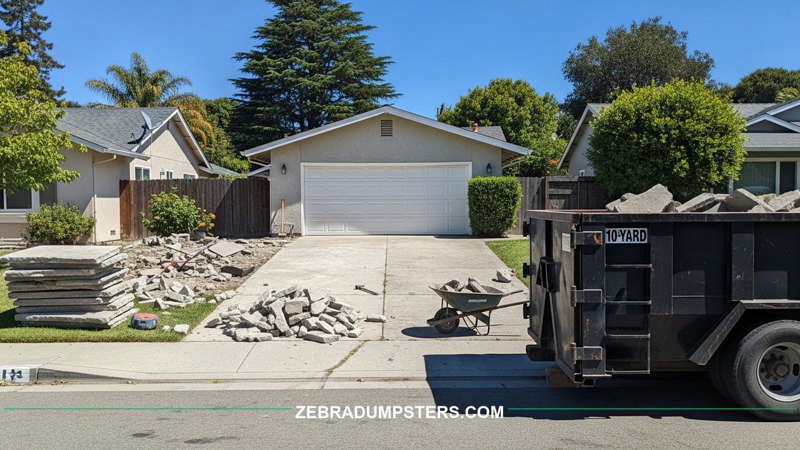
Residential driveway demolition with a 10-yard inert dumpster receiving broken concrete.
Most driveway-removal cost estimates online are wrong, vague, or both. They quote a single per-square-foot number that does not exist in reality. The actual cost of taking out a driveway has four parts labor, disposal, permits, and contingencies and the relative weight of each piece changes depending on your driveway's size, material, and location.
This guide breaks down what each part actually costs in the Bay Area, with real numbers from typical projects in San Jose, Oakland, and the surrounding cities. By the end you will have a working budget for your specific driveway and a sense of where contractor quotes are genuinely fair versus where you are getting marked up.
Listen to this article
--:-- · narrated
What Drives the Cost
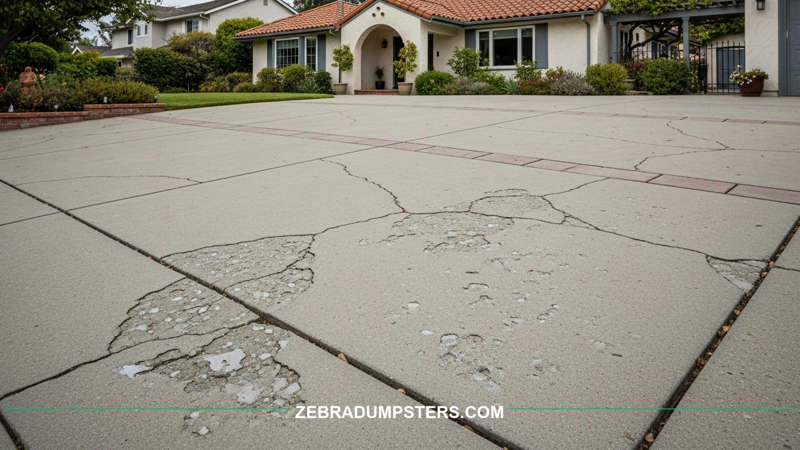 An older concrete driveway with surface damage — typical replacement candidate.
An older concrete driveway with surface damage, a typical replacement candidate.
Driveway removal cost is the sum of four categories, each with its own per-unit rate that scales differently with project size.
Demolition labor. Breaking and loading the concrete or asphalt. Bay Area rates run $4 to $7 per square foot for residential driveways, depending on thickness, reinforcement (rebar adds 10 to 20%), access difficulty, and labor market. San Francisco pushes the high end. South Bay and East Bay sit in the middle.
Disposal. Getting the broken material off your property, the part most homeowners under-estimate. A 400 sq ft, 4-inch driveway produces ~10 tons of concrete. Options range from a 5-yard inert dumpster ($505 in San Jose) to contractor haul-away ($600 to $1,200 for the same volume). Many homeowners booking concrete dumpster rental in San Jose report disposal alone at 25 to 35% of total project cost.
Permits. Most Bay Area cities require a demolition permit. Costs run $80 to $250, processing takes 3 to 10 business days. Add $50 to $150 if your driveway is in the public right-of-way (curb cut, sidewalk-adjacent) and requires an encroachment permit.
Contingencies. The 10 to 20% buffer experienced contractors build in. Common surprises: hidden rebar, buried utilities (gas, electric, irrigation), sub-base issues, soft soil. Not optional math.
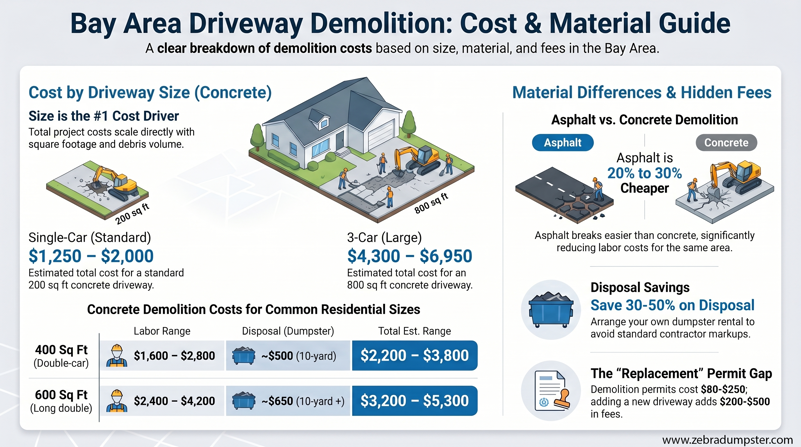
Cost by Driveway Size and Material
Driveway size is the single biggest driver of total cost. Material is the second, and concrete driveway removal cost runs meaningfully above asphalt for the same footprint. Here is what a typical Bay Area project actually costs end-to-end, broken out by these two variables.
| Driveway Size | Material | Demolition Labor | Disposal (Dumpster) | Permits | Total (Range) |
| 200 sq ft (single-car) | Concrete, 4" | $800 - $1,400 | 5-yard inert ($505) | $80 - $150 | $1,400 - $2,100 |
| 400 sq ft (double-car) | Concrete, 4" | $1,600 - $2,800 | 10-yard inert ($560) | $80 - $200 | $2,250 - $3,600 |
| 600 sq ft (long double-car) | Concrete, 4" | $2,400 - $4,200 | 10-yard inert ($560) | $100 - $250 | $3,100 - $5,000 |
| 800 sq ft (3-car or extended) | Concrete, 4" | $3,200 - $5,600 | 2 x 10-yard inert ($1,120) | $100 - $250 | $4,400 - $7,000 |
| 400 sq ft (asphalt, 2") | Asphalt | $1,200 - $2,000 | 10-yard inert ($560) | $80 - $200 | $1,850 - $2,800 |
A few notes on this table. Asphalt is meaningfully cheaper to demolish than concrete because it breaks easier: asphalt rates run roughly 20 to 30% below concrete. The disposal costs above assume you arrange the dumpster yourself rather than letting the contractor mark it up. Contractor-supplied disposal typically adds 30 to 50% over the rental rate. Permits in the table cover demolition only. If you are also installing a new driveway, the building permit for the replacement adds another $200 to $500. Numbers are pre-tax and do not include contingencies, so add 10 to 20% for those.
Asphalt Driveway Removal Cost
Asphalt driveway removal cost runs $3 to $5 per square foot for demolition labor in the Bay Area, against $4 to $7 for concrete. The material works in your favor twice. A 2-inch asphalt driveway weighs roughly 24 lbs per square foot against concrete's 50, so a 400 sq ft asphalt tear-out is about 5 tons instead of 10, loads faster, and fits a single 10-yard inert bin with room to spare. All-in, the same double-car footprint that costs $2,250 to $3,600 in concrete lands at $1,850 to $2,800 in asphalt.
One asphalt-specific note: recyclers love clean asphalt (it becomes new hot-mix), so keep dirt and concrete chunks out of the load. The full demo sequence, recycling channels, and disposal math live in our dedicated asphalt removal and disposal guide.
How to Save Money on Driveway Removal
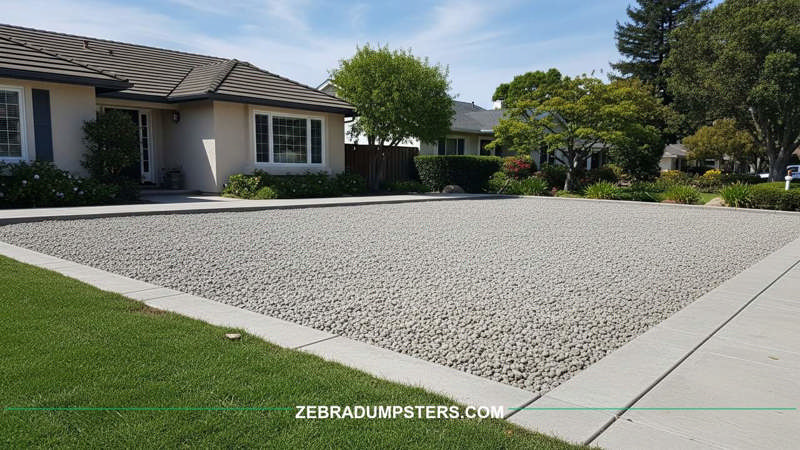 After demolition: bare sub-base ready for new concrete or asphalt.
Three places where Bay Area homeowners consistently overpay.
Arrange your own dumpster. Contractors who supply the bin mark it up, sometimes meaningfully. A $560 retail rental may show up on a contractor invoice at $730 to $840. Renting directly is the simplest and biggest saving on a driveway demo. The contractor still does the work, they just do not handle disposal. Confirm before signing so they do not double-bid the disposal line. Contractors on concrete dumpster rental in Santa Clara are usually fine with homeowner-supplied bins, and some prefer it.
Time the permit before scheduling labor. Demolition permits take 3 to 10 business days. Most homeowners pull the permit after signing the contractor, meaning the contractor sits idle for a week. Apply as soon as you know the project is happening. The permit is cheap and refundable in most cities.
Get three bids, read them carefully. The lowest bid wins on apples-to-apples scope. The catch is "apples-to-apples." Bids that exclude disposal or assume "homeowner provides dumpster" can come in 30% under all-inclusive bids, fine if you know what you are getting. The trap is reading "demolition: $1,800" on bid A and "$2,400" on bid B and picking A without realising A excludes disposal.
Common Cost Surprises
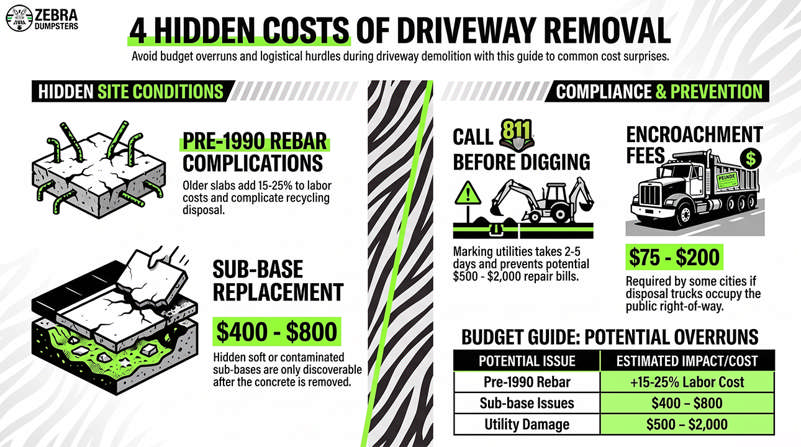
Four common overruns on driveway-removal projects, and how to avoid them.
Rebar in older slabs. Driveways built before about 1990 often have rebar. It slows demolition (15-25% additional labor) and adds disposal complexity (rebar protruding more than 3 inches disqualifies the load from inert recycling). For pre-1990s driveways, assume rebar and add 15% to labor.
Sub-base issues. Once concrete is gone, the original sub-base is exposed. Soft, settled, or contaminated sub-base needs replacement before any new pour, typically $400 to $800. Impossible to pre-quote, only discoverable during demo.
Buried utilities. Older homes sometimes have gas, electric, or irrigation lines under the driveway. Hitting one is a same-day stoppage and can add $500 to $2,000. Mark utilities before starting (call 811, free and required by California law). 811 marking takes 2 to 5 business days.
Encroachment fees. If your driveway connects to a city sidewalk or curb, the disposal truck may need to occupy the public right-of-way during pickup. Some cities charge $75 to $200 for an encroachment permit. Confirm with the dumpster provider whether your address requires it.
Putting It All Together
A working driveway-removal budget for a typical Bay Area homeowner has five lines.
| Line | Typical 400 sq ft project |
| Demolition labor | $1,800 - $2,500 |
| Inert dumpster rental | $560 |
| Demolition permit | $80 - $200 |
| 10-15% contingency | $250 - $400 |
| Total | $2,690 - $3,660 |
That is for demolition only. If you are replacing the driveway with new concrete, add another $7 to $12 per square foot for forming, pouring, and finishing, roughly $2,800 to $4,800 for a 400 sq ft replacement. Total project cost (demo plus new) for a typical mid-size driveway lands between $5,500 and $8,500 in 2026 Bay Area dollars.
The single biggest variable is disposal. Get the dumpster right and the rest of the project's math gets predictable. For a 400 sq ft, 4-inch concrete driveway, a 10-yard inert dumpster (no weight cap under standard service) is the right call: the slab produces about 10 tons, within what a 10-yard inert handles in a single load. Zebra Dumpsters covers the South Bay, East Bay, and Peninsula corridor, including same-day delivery in San Jose and Campbell. Call (408) 495-3006 to book or to talk through which size fits your specific driveway, including dumpster rental in Oakland and the surrounding cities. Prices subject to change. Verify current rates at zebradumpsters.com/weight-limits-and-fees.
Frequently Asked Questions
Can I demolish my own driveway?
Yes, but only for small driveways. Up to about 200 square feet, DIY demolition with a sledgehammer and a rented jackhammer is possible over a weekend. Above 400 square feet, the time investment makes hired labor cheaper per hour. The disposal piece (renting an inert dumpster) is identical whether you DIY or hire: homeowners can rent the same bins contractors use.
How much does asphalt removal cost per square foot?
Budget $3 to $5 per square foot for asphalt demolition labor in the Bay Area, plus disposal. A 400 sq ft, 2-inch asphalt driveway generates about 5 tons, which fits one 10-yard inert bin at $560 flat with no weight cap. That works out to roughly $4.50 to $6.50 per square foot all-in for a typical double-car asphalt driveway, about 20 to 30% below the same job in concrete.
How long does driveway removal take?
A typical 400 sq ft driveway demo runs one to two crew-days for a two-person team, about 16 to 32 person-hours. The dumpster sits on-site for one to seven days depending on whether the project includes immediate replacement. Permit processing adds 3 to 10 business days before any work can start, so plan three to four weeks from signing a contractor to driveway-replaced.
Do I need to get the dumpster myself?
Usually yes if you want to control disposal costs. Contractors who supply the bin typically mark it up by 30 to 50%. Renting directly from a dumpster company saves $170 to $280 on a typical 10-yard inert. Coordinate the delivery date with your contractor's start date so the bin arrives the morning of demolition.
What size dumpster do I need for my driveway?
Roughly: 200 sq ft of 4-inch concrete = 5-yard inert. 400 sq ft = 10-yard inert. 800+ sq ft = two 10-yards (staged or back-to-back). Asphalt is lighter than concrete (about half the weight per square foot at typical thicknesses) but follows the same size brackets. There is no 20 or 30-yard inert option: heavy materials top out at 10-yard.
What happens to the broken concrete?
Recycled. Bay Area concrete recyclers crush and screen the material into road base, fill aggregate, and feedstock for new concrete. State law (CALGreen and various municipal ordinances) requires construction projects above certain thresholds to recycle 65% or more of inert debris, and the recycling facility infrastructure to support that exists across the Bay Area. Your inert dumpster contents almost certainly end up in a road or new pour somewhere within 50 miles.