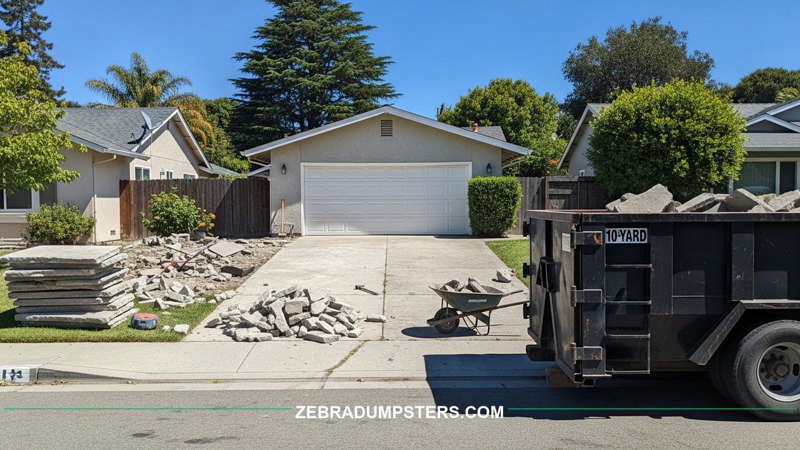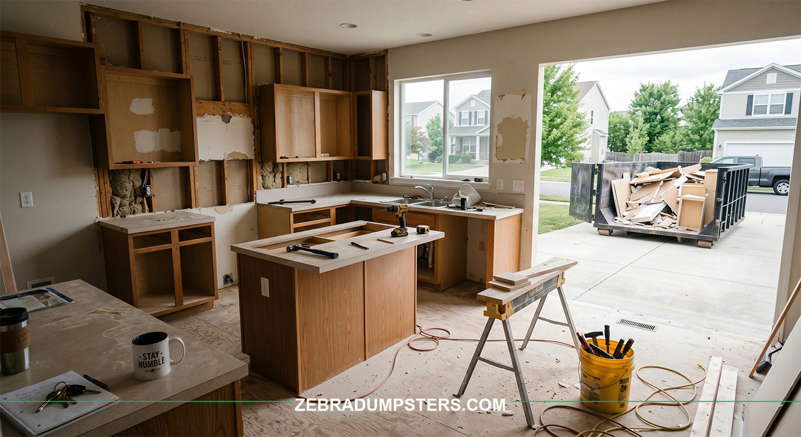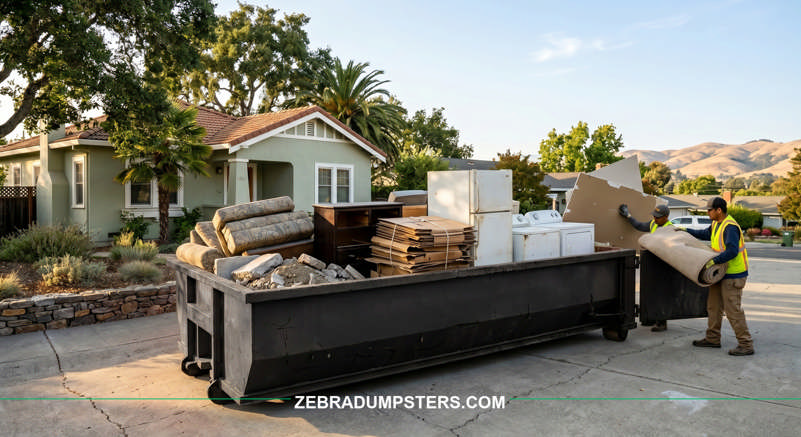
Most overage fees on Bay Area dumpster rentals come from one mistake: estimating the project by what the debris LOOKS like instead of what it WEIGHS. A 20-yard bin full of cardboard packaging weighs maybe 1,200 lbs. The same 20-yard full of broken tile, drywall, and concrete chunks weighs 8,000 lbs. The volume looks identical from the curb. The invoice is $450 different.
This guide is the math for estimating debris weight before booking, so you pick the right bin size and avoid surprise overage charges. Material density tables, project-type templates, and worked examples for typical Bay Area home and contractor projects. Numbers calibrated for typical Bay Area pricing tiers and dumpster sizes.
Listen to this article
--:-- · narrated
Why Weight Drives Pricing, Not Volume
Bay Area dumpsters charge by base rental (includes a tonnage allowance) plus per-ton overage above that allowance. Standard tonnage allowances:
| Bin Size | Volume | Tonnage Included | Per-Ton Overage (Tier 1-2) |
| 5-yard general | 5 cubic yards | 0.5 ton | $150 |
| 10-yard general | 10 cubic yards | 1.0 ton | $150 |
| 20-yard general | 20 cubic yards | 2.0 tons | $150 |
| 30-yard general | 30 cubic yards | 3.0 tons | $150 |
| 40-yard general | 40 cubic yards | 4.0 tons | $150 |
| 5-yard inert (heavy material) | 5 cubic yards | No cap (special-recycling threshold 2.5 tons) | $95/ton in SJ above threshold |
| 10-yard inert (heavy material) | 10 cubic yards | No cap (special-recycling threshold 5.0 tons) | $95/ton in SJ above threshold |
The math: a 20-yard general at $549 base with 2.0 tons included. Project produces 3.5 tons of debris. Overage: 1.5 tons × $150 = $225. Total: $774. If you'd estimated weight correctly and picked a 30-yard ($699 base, 3.0 tons included), the same project would have run $699 base + 0.5 ton overage at $150 = $774 wait, same total. The point isn't always to size up; it's to ESTIMATE FIRST so you pick the right bin and aren't surprised.
For homes in dumpster rental in San Jose with mixed renovation projects, the estimation math below avoids $200-$500 overage surprises that most homeowners don't see coming.
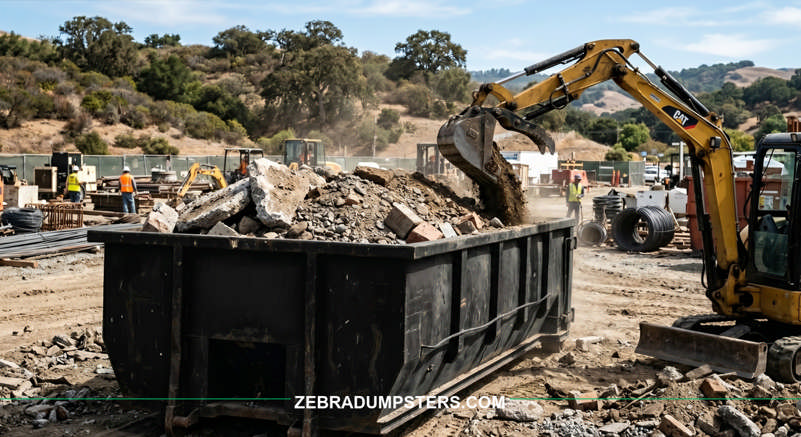
Material Density Reference (Pounds per Cubic Yard)
To estimate weight, multiply debris volume (cubic yards) by material density. Use the densities below:
| Material | Pounds per Cubic Yard | Tons per 10 Cubic Yards |
| Cardboard, packaging | 100-150 | 0.05-0.075 |
| Household furniture, mixed | 150-250 | 0.075-0.125 |
| Mixed renovation debris (wood, drywall, mixed) | 250-400 | 0.125-0.2 |
| Wood framing scraps, lumber offcuts | 300-500 | 0.15-0.25 |
| Drywall | 400-600 | 0.2-0.3 |
| Carpet + padding (rolled) | 200-350 | 0.1-0.175 |
| Roofing shingles (asphalt) | 700-1,000 | 0.35-0.5 |
| Ceramic / porcelain tile (with thinset) | 1,500-2,200 | 0.75-1.1 |
| Hardwood flooring (with subfloor) | 600-1,000 | 0.3-0.5 |
| Concrete (broken) | 4,000-4,500 | 2.0-2.25 |
| Brick | 3,000-3,500 | 1.5-1.75 |
| Dirt / sod (dry) | 2,500-3,000 | 1.25-1.5 |
| Dirt / sod (wet) | 3,000-3,500 | 1.5-1.75 |
These are typical-load densities, not maximum-pack densities. Real-world loading rarely achieves textbook max density debris stacks with air gaps, especially for irregular materials like wood scraps and broken tile.
For homes in dumpster rental in Sunnyvale doing kitchen or bathroom remodels, the mixed-renovation row (250-400 lbs/cy) is the working number for most of the debris stream.
Project Templates: Typical Weights for Common Projects
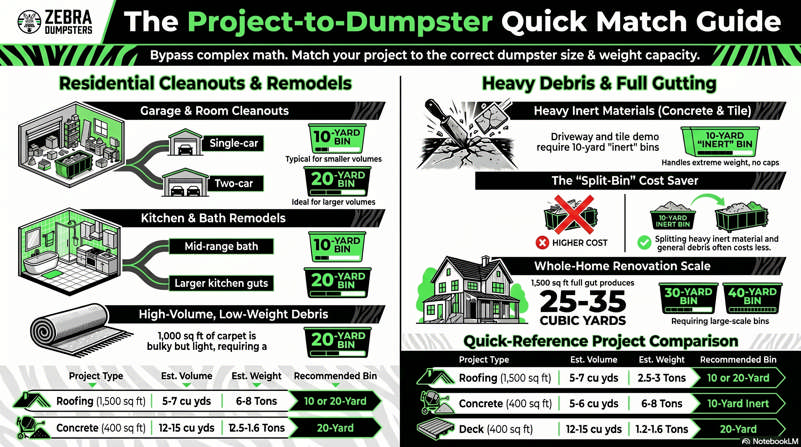
Skip the math entirely match your project to the closest template below:
- Single-car garage cleanout: 7-9 cubic yards, 0.8-1.4 tons. 10-yard general.
- Two-car garage cleanout: 10-13 cubic yards, 1.2-1.8 tons. 20-yard general.
- Bathroom remodel (mid-range, tile + tub + vanity): 4-6 cubic yards, 0.8-1.2 tons. 10-yard general.
- Kitchen remodel (mid-range, cabinets + countertops + flooring): 10-12 cubic yards, 1.5-2.5 tons. 20-yard general.
- Whole-floor carpet removal (1,000 sq ft): 8-10 cubic yards, 0.4-0.5 ton. 20-yard for volume.
- Whole-floor tile removal (1,000 sq ft): 10-15 cubic yards, 3-4 tons. 20-yard with overage OR split into 10-yard inert + 10-yard general.
- Roofing tear-off (1,500 sq ft, single layer): 5-7 cubic yards, 2.5-3 tons. 10-yard general (tight on weight) or 20-yard.
- Driveway concrete demo (400 sq ft, 4-inch thick): 5-6 cubic yards, 6-8 tons. 10-yard inert (no weight cap).
- Deck removal (400 sq ft, wood + pier blocks): 12-15 cubic yards, 1.2-1.6 tons. 20-yard general.
- Whole-home renovation (1,500 sq ft, full gut): 25-35 cubic yards, 3-5 tons. 30-yard general or 40-yard.
The split-bin patterns documented in the heavy debris disposal guide apply to anything where the load mixes inert material (concrete, dirt, brick) with general debris splitting often costs less than oversizing a single bin.
Worked Example: When the Math Saves Money
Scenario: Bay Area homeowner doing a 200 sq ft kitchen floor demo. Removing existing tile, replacing with luxury vinyl plank.
Visual estimate (no math): "It's just one room of flooring a 10-yard should be plenty." Books a 10-yard at $399.
Actual debris: 200 sq ft tile + thinset = 1,500 lbs × 200/100 ratio = 3,000 lbs (1.5 tons). Plus subfloor cleanup, baseboards, packaging = additional 0.3 tons. Total: 1.8 tons.
10-yard with overage: $399 base + 0.8 ton overage × $150 = $519. Plus the load is over the rim and the driver charges a $150 reload fee. Total: $669.
Right answer with the math: Estimated 1.8 tons → pick 20-yard at $549 base, 2.0 tons included. No overage, no reload fee. Total: $549. Math saved $120.
For more complex multi-material projects (kitchen + bath + flooring + cabinets), the math becomes essential surprises in the 1-2 ton range cost $150-$300 each. The pricing detail and tier table is at zebradumpsters.com/weight-limits-and-fees.
How to Estimate Without Doing Math
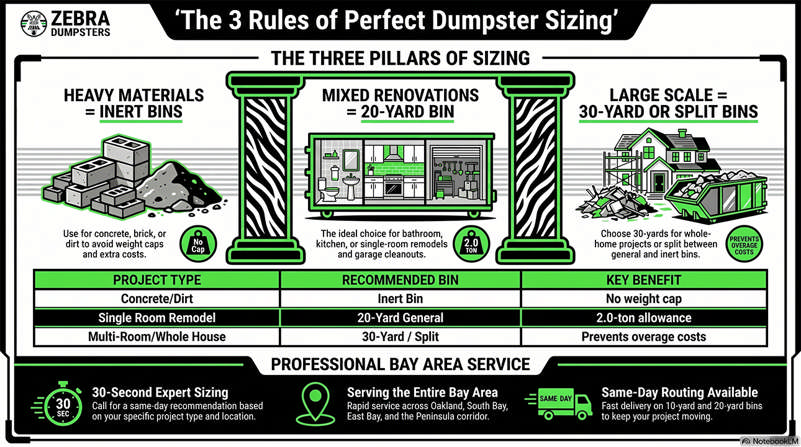
If the templates and math feel like overkill, three rules cover 80% of residential projects:
Rule 1: Heavy material = inert bin. Concrete demo, brick chimney teardown, driveway breakup, dirt excavation all go in an inert (heavy-material) dumpster. No weight cap on standard service, dramatically cheaper than overage.
Rule 2: Mixed renovation = 20-yard general. Bathroom remodel, kitchen remodel, single-room renovation, garage cleanout. The 20-yard's 2.0-ton allowance + 20 cubic yard volume handles 80% of these without overage or volume problems.
Rule 3: Whole-home or contractor scale = 30-yard or split bins. If the project is bigger than a single room (whole house, multi-room, demolition), default to a 30-yard general or split into general + inert. The single-40-yard approach often costs more once overage stacks up.
For homes in dumpster rental in Oakland and other Bay Area cities, calling Zebra Dumpsters with a 30-second project description usually gets a same-call right-size recommendation. The dispatcher has seen every project type and weight pattern in the region.
Zebra Dumpsters services the South Bay, East Bay, and Peninsula corridor with same-day routing on 10-yards and 20-yards. Call (408) 495-3006 to book or to get a sizing recommendation for a project that's not in the templates above.
Frequently Asked Questions
How accurate are these weight estimates?
Typical-load densities are usually within 15-20% of actual invoice weight. For mixed loads, the variance can be wider packaging-heavy loads come in lighter than predicted, dense-material loads heavier. Use the high end of each density range for safety margin.
What if I underestimate the weight?
You pay per-ton overage at $150 per ton (in Tier 1-2 cities; $165-$200 in Tier 3-4 East Bay cities). The overage is calculated based on the actual landfill weight ticket, not your estimate. There's no "you guessed wrong" penalty just the overage.
Can I switch to a bigger bin mid-project?
Yes, by booking a swap. The standard swap fee is $300 (pick up the full bin, deliver an empty bigger one). For projects that look likely to need a swap from the start, sizing up upfront usually beats the swap fee a 30-yard's $150 higher base rate is cheaper than the $300 swap.
What about inert dumpsters do they have a weight limit?
Standard inert (heavy-material) dumpsters have no weight limit for typical projects they're priced flat regardless of tonnage. The exception is special-recycling requirements (Green Halo certificate for dirt, specific facility routing) those have a threshold (2.5 tons for 5-yard, 5.0 tons for 10-yard) with $95/ton overage above the threshold in San Jose.
How do I weigh debris before pickup?
You can't, in practice the bin's landfill weight is the official number. The pre-pickup workaround: count the heaviest material types separately (X cubic yards of tile, Y cubic yards of mixed debris) and multiply by the densities in this guide. That estimate is what helps you pick the right bin upfront.