The most common reason a Bay Area porta potty delivery fails on the day of drop-off is not the unit, the schedule, or the driver. It is the address. Someone booked without checking whether the placement spot could actually receive the truck, or without knowing the city required a permit for the specific street, or without noticing a low-hanging tree limb the driver could not clear. The $250 dead-run fee (or $350 north of Millbrae or Oakland) that gets charged when a truck cannot drop the unit is entirely avoidable, and it starts with a 15-minute walk-through the day before delivery.
The placement question has answers that are more precise than most first-time renters realize.
Listen to this article
--:-- · narrated
On-property placement covers most Bay Area homes without a permit
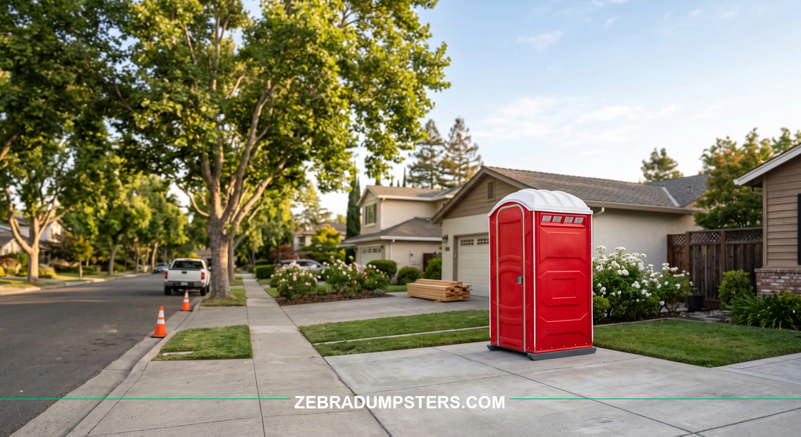
Standard driveway placement: no permit needed anywhere in the Bay Area.
Every porta potty placement falls into one of two categories, and the rules differ significantly.
On-property placement is any spot on the customer's own property: driveway, side yard, back yard, private parking lot, private street inside a gated community, or private construction lot. No city permit is needed for on-property placement in any Bay Area jurisdiction. The rules are physical: enough clearance for the truck, level ground for the unit, and reasonable service access.
Public right-of-way placement is any spot on public property: the street in front of a house, a public sidewalk, a curb parking space, or municipal property. Every Bay Area city requires a permit for right-of-way placement. Permits cost $25 to $150 and take 3 to 10 business days.
For most residential customers, on-property placement covers the need without any permit conversation. On a typical dumpster and porta potty rental in San Jose driveway, the whole delivery is invisible to the city. The permit path only comes into play when the property has no driveway (apartment buildings, some SF and Oakland row homes, some Peninsula condos) or when a large event needs multiple units the driveway cannot fit.
What the service truck actually needs to reach the spot
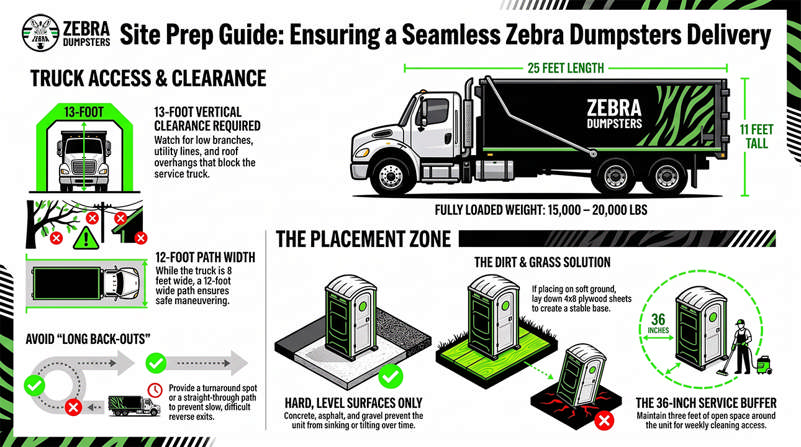
The service truck is bigger than most homeowners picture. Standard truck is about 25 feet long, 8 feet wide, 11 feet tall including the mounted crane. It weighs 15,000 to 20,000 pounds fully loaded.
Overhead clearance requires 13 feet minimum. Low-hanging tree branches, roof overhangs, and utility lines are the most common blockers. Path width needs 10 feet, ideally 12 feet. The narrow parts of the path (between two parked cars, through a gate, past a fence corner) matter more than the wide parts.
Turning radius matters too. Long narrow driveways where the truck has to back out for 200 feet are workable but slow. Truck-friendly properties have a driveway with a turnaround spot or a straight-through pull that ends at a public street.
The placement pad needs to be level and hard-surfaced. Concrete driveways, asphalt driveways, and paved parking areas all work. Gravel works. Dirt and grass do not, so the unit sinks and tilts. Laying down 4x8 plywood sheets solves this when the only spot is dirt or grass.
Side clearance around the unit needs 36 inches on each side for service truck access during weekly or biweekly cleanings. Placements against a fence, in a corner, or squeezed between the house and a hedge look fine on delivery day but fail two weeks later when the cleaning truck cannot reach them.
Skip the dead-run fee
Tell us where the truck can reach and we place the unit there
Delivery and pickup are one $80 fee. A blocked drop costs $250, so the 15-minute site walk in this guide pays for itself.
Permit rules for Bay Area street placement vary by city
Right-of-way placement rules differ meaningfully across Bay Area jurisdictions.
ADA units are wider than standard, which changes the placement math on a driveway.
San Jose requires an encroachment permit for street placement, at $75 residential, $150 commercial, 5 to 7 business days processing. See our dumpster placement laws in San Jose guide for the application process; the rules apply to porta potties the same way as dumpsters.
San Francisco requires a Special Traffic Permit, $50 to $200 depending on duration, 3 to 5 business days. Some downtown zones require additional Meter Removal fees. SF is the most complex Bay Area jurisdiction for porta potty street placement.
Oakland uses an encroachment permit through Public Works, $75 standard fee, 5 to 10 business days. Hill-district zones have additional slope restrictions. For porta potty rental in Oakland placements, factor the hill-district rules into the site walk.
Peninsula cities (Palo Alto, Menlo Park, Burlingame) run permits in the $50 to $100 range with 5 to 7 business days processing. Peninsula small cities like Atherton, Woodside, and Portola Valley have restrictive rules or case-by-case coordination, so book with extra lead time.
South Bay cities (Santa Clara, Sunnyvale, Mountain View, Cupertino) are the easiest Bay Area group for permit turnaround: $40 to $75 permits, 3 to 5 business days. East Bay cities (Hayward, Fremont, Union City, Newark) run similar.
The 15-minute site walk that avoids the dead-run fee
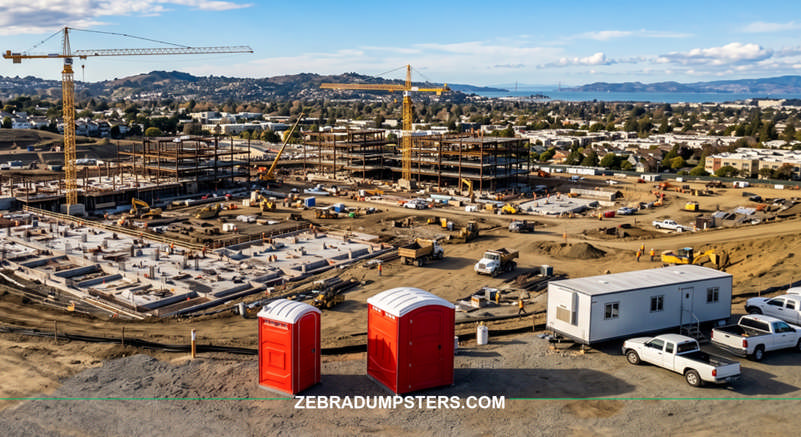
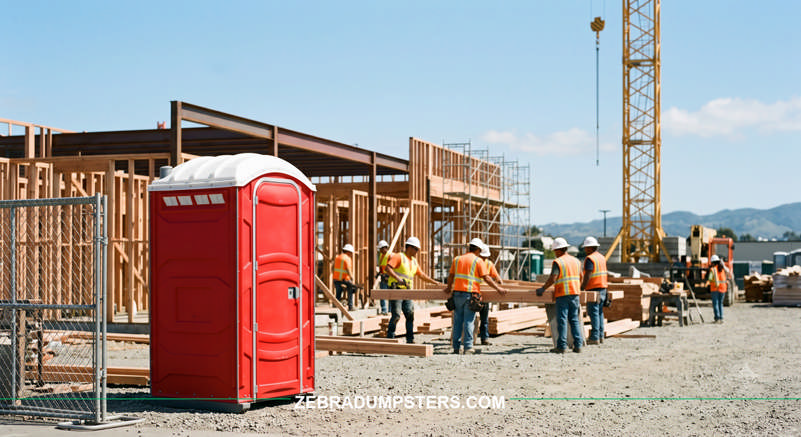
Getting the property ready for delivery is a 15-minute walk-around task the day before. Homeowners who do this essentially never have a delivery problem.Construction site placement: 36-inch service clearance, level pad, and clear service truck return path.
Walk the delivery path from the street to the placement spot. Look for parked cars in the way, low branches under 13 feet, gate widths under 10 feet, sprinkler heads that might get crushed, and decorative pavers that might crack under truck weight.
Confirm the placement spot dimensions. Standard porta potty is 4 feet wide, 4 feet deep. Add the 36-inch service clearance on each side and the spot needs to be roughly 10 feet by 4 feet. Mark the spot with painter's tape or chalk if there is any ambiguity.
Check for underground utility markings. Rare but real: the placement spot might sit above a gas line, water line, or septic tank. Any yellow or blue paint marks on the driveway should be photographed and mentioned to the driver.
Clear the placement path by moving parked cars, trim branches, roll up hoses, move trash bins to the curb. Notify neighbors if the delivery will temporarily block street access on a narrow street. A quick text to the neighbor about "porta potty delivery Wednesday morning" often prevents them from parking in a spot that would block the truck.
Confirm the address on the booking. Deliveries to the wrong address because of a typo count as dead-runs even when the driver made a good-faith attempt.
The mistakes that cost the $250 dead-run fee
Six patterns account for essentially all dead-run charges in the Bay Area.
Placing under a tree branch: truck cannot clear. Trim the branch or pick a different spot. Placing where a car needs to park daily: the unit gets bumped or blocked during service visits. Move to a spot that stays clear.
Placing on unlevel ground without a pad: the unit tilts. Level the ground or add plywood as a placement pad. Placing against a fence or wall: no service clearance on that side. Keep 36 inches on all sides.
Booking street placement without the permit: city tickets the unit within days, and the ticket runs $200 to $500. Get the permit before the unit arrives. Ignoring the return access path: the delivery truck reaches the spot once but the cleaning truck cannot make the tight turn on service visits. Test the path for the round trip.
For any Bay Area placement that involves permits, hillsides, gated properties, or unusual site conditions, the phone call is faster than online booking. Call (408) 495-3006 for the San Jose office (South Bay), Hayward at (510) 900-4664 (East Bay), or Burlingame at (650) 292-3003 (Peninsula). For standard residential driveway placements inside the service area, book online at zebradumpsters.com. The system flags known access issues before confirming. The porta potty rental cost guide for the Bay Area covers the base pricing across the four unit types once the placement question is resolved.
Flat pricing, every South Bay city
Porta potty rental from $125 per 28 days
Weekly cleaning is $145, the built-in handwash sink adds $10, and same-day delivery is available for $100.
Frequently Asked Questions
Do I need a permit for a porta potty in my driveway? No. Driveway placement is on-property and requires no city permit anywhere in the Bay Area. Only public right-of-way placement (street, sidewalk, curb parking space) needs a permit.
How much do porta potty street permits cost in the Bay Area? Permits range from $25 to $200 depending on city and duration. San Jose is $75 residential. San Francisco runs $50 to $200. Oakland is $75. Most South Bay cities are $40 to $75.
How long does it take to get a Bay Area street placement permit? Standard turnaround is 3 to 10 business days depending on the city. South Bay cities are usually fastest (3 to 5 days). SF and Oakland are 5 to 10 days.
What clearance does the service truck need? 13 feet overhead, 10 to 12 feet of path width, and a turnaround spot or straight-through pull. The unit itself needs a level pad (concrete, asphalt, or gravel) with 36 inches of service clearance on each side.
Can a porta potty be placed on grass or dirt? Not directly. The unit sinks and tilts. Lay down 4x8 plywood sheets as a placement pad if the only available spot is dirt or grass, and the truck can still deliver.
What happens if the truck can't drop the unit on delivery day? The dead-run fee is $250 (or $350 north of Millbrae or Oakland). The 15-minute site walk the day before delivery avoids this every time. Check overhead branches, path width, parked cars, and level ground.