Accessory Dwelling Unit construction is the dominant residential build trend in the Bay Area right now. California's SB 9 and SB 10 legislation (effective 2022 onward) makes ADUs easier to permit on most single-family lots. Bay Area cities have been issuing ADU permits at 3-5x the rate of new homes since 2023, and most projects involve significant demolition and construction debris that homeowners need to manage.
This guide covers debris management for a typical Bay Area ADU project: the demo phase (clearing the build site), the construction phase (framing through finish), and the right dumpster strategy across the 8-to-16-week timeline. Numbers are calibrated for the most common ADU types in the Bay Area: detached 600-1,200 sq ft backyard ADUs and 400-800 sq ft garage conversions.
Listen to this article
--:-- · narrated
ADU Project Types and Their Debris Profiles
Three ADU types dominate Bay Area permits. Each has a different debris profile.
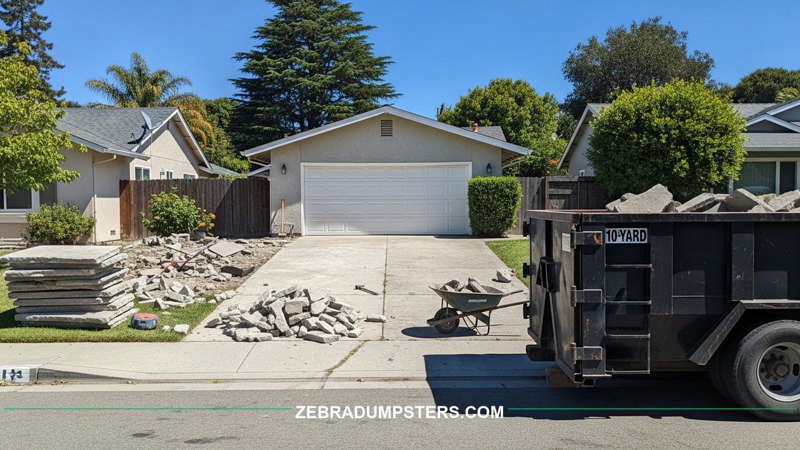
Type 1: Detached backyard ADU on cleared lot. Build on a previously empty area of the lot (former lawn, garden, or paved patio). Demolition is minimal just the patio pavers or concrete pad if any, plus any small trees. Construction is from scratch. Build time: 8-12 weeks. Total debris: 15-25 cubic yards across the project (most from construction packaging, not demo).
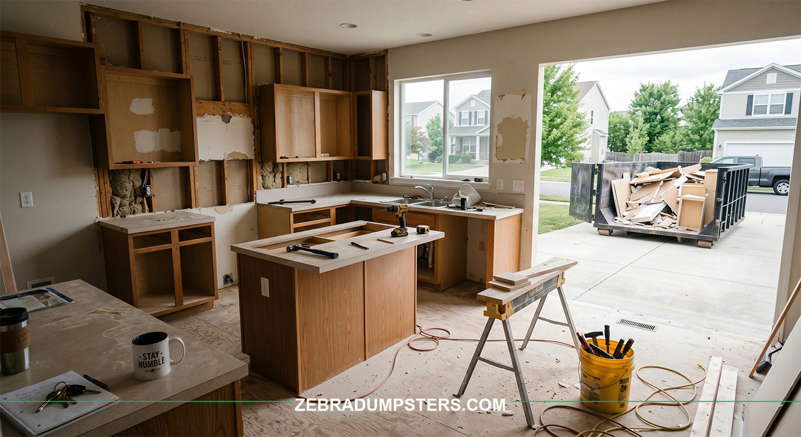
Type 2: Garage conversion ADU. Convert an existing detached or attached garage into living space. Demolition is significant old garage door, garage interior finishes, sometimes the floor slab needs leveling or new drains. Construction adds new walls, plumbing, electrical, full finish. Build time: 6-10 weeks. Total debris: 18-28 cubic yards (heavier on demo than Type 1).
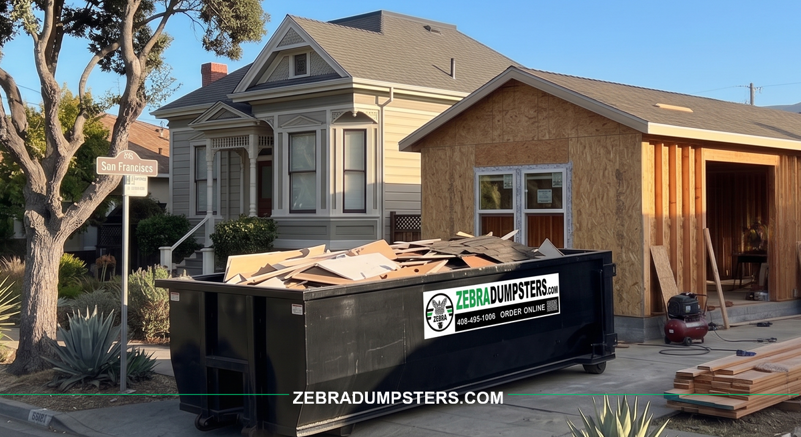
Type 3: Detached backyard ADU with existing-structure demolition. Demolish an existing shed, old garage, sunroom, or addition to clear the build site. Then build the ADU from scratch. This is the most debris-heavy. Build time: 10-16 weeks. Total debris: 30-50 cubic yards (significant demo + full construction).
The cumulative debris is misleading because it's spread across the project timeline. The actual peak when the dumpster needs to be on-site is shorter and more concentrated.
Phased Dumpster Strategy for an ADU Build
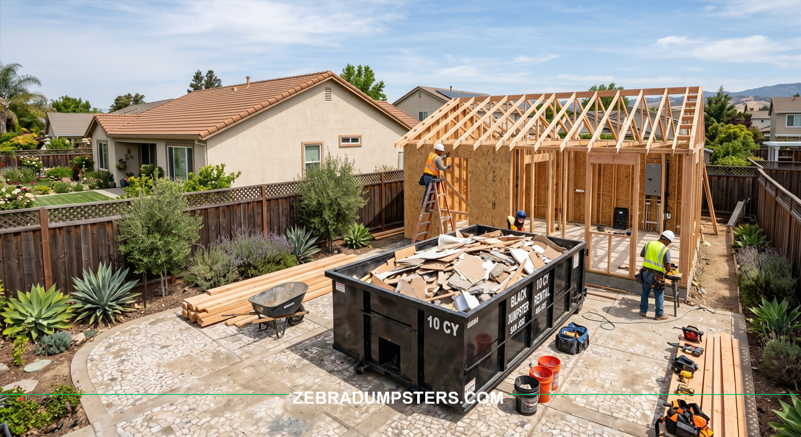
A typical 800 sq ft detached backyard ADU on a partially-cleared lot generates debris in three distinct phases. Each phase needs a different dumpster:
| Phase | Week | Volume | Debris Weight | Dumpster |
| Demo / site prep | Week 1-2 | 3-8 cubic yards | 1-3 tons | 10-yard general OR 10-yard inert (depending on debris type) |
| Framing / rough-in | Week 3-6 | 4-6 cubic yards | 0.8-1.2 tons | 10-yard general |
| Drywall / finish | Week 7-12 | 5-8 cubic yards | 0.8-1.2 tons | 10-yard general |
For most Type 1 ADUs (cleared lot, detached build), the strategy is three sequential 10-yard rentals timed to phase peaks rather than one large bin sitting on the driveway for 12 weeks. Three 10-yards at $430 each = $1,290 plus a few extra days here and there. Compare to a 20-yard sitting for 12 weeks at $550 base + 12 weeks × 7 days × $45 extra-day fee = $550 + $3,780 = $4,330. The phased approach saves $3,000+.
For Type 3 ADUs with existing-structure demolition (shed, old garage, or sunroom coming down before the ADU goes up), the demo phase shifts to a 20-yard or 30-yard. A typical shed demolition produces 6-10 cubic yards of debris. An old detached garage demolition produces 12-20 cubic yards. Match the bin to the actual structure coming down.
Crews working ADU builds in dumpster rental in Oakland and other dense Bay Area cities often pre-book three separate 10-yard delivery windows so the dumpster cycles in/out as each phase completes driveway never has more than one bin at a time.
Three phases, three deliveries
Book the bins as the build moves, not all at once
Phasing a 10-yard through demo, framing and finish came to about $1,485 across twelve weeks. Holding one 20-yard for the whole build came to $4,330, almost all of it extra-day fees. Price each phase for your own address.
Bay Area Pricing for an ADU Build
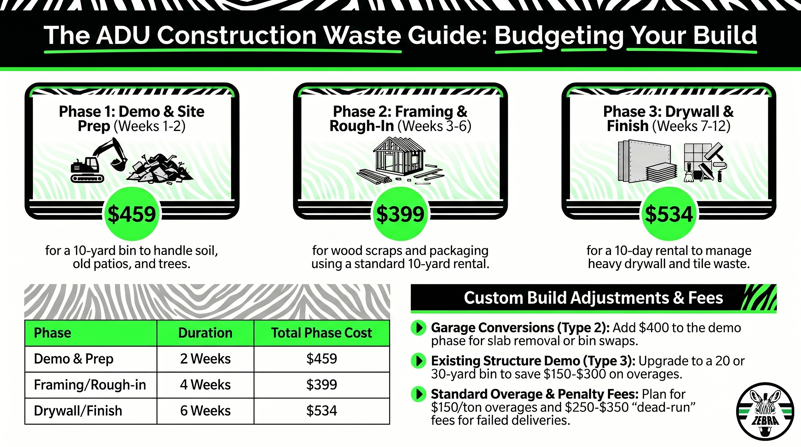
Phased pricing for the typical 800 sq ft Type 1 detached ADU build, San Jose tier:
Phase 1 Demo / site prep (Week 1-2, 10-yard):
- Base rental: $430 (7 days)
- Debris: 5 cubic yards (old patio, trees, soil from foundation hole)
- Weight: 1.4 tons (mostly dirt and old patio)
- Overage: 0.4 tons × $150 = $60
- Total: $490
Phase 2 Framing / rough-in (Week 3-6, 10-yard):
- Base rental: $430 (7 days)
- Debris: 5 cubic yards (framing scraps, packaging, off-cuts)
- Weight: 0.9 tons (mostly wood)
- Total: $430
Phase 3 Drywall / finish (Week 7-12, 10-yard):
- Base rental: $430 (extended to 10 days = +3 extra days × $45 = $135)
- Debris: 7 cubic yards (drywall scrap, tile cuts, finish material packaging, paint cans)
- Weight: 1.0 ton
- Total: $565
Project total: $1,485 for dumpster rental across 12 weeks of build.
For Type 2 garage-conversion ADUs, swap Phase 1 to a larger bin or split into a 10-yard general + a 10-yard inert (for the garage slab if it's coming up). Cost adds about $400 to the demo phase.
For Type 3 ADUs with existing-structure demolition (shed, old garage), Phase 1 jumps to a 20-yard ($550) or a 30-yard ($680). Adds $120-$250 to the demo phase but avoids overage and a second delivery.
Standard fees apply: per-ton overage $150 in most South Bay/East Bay cities, $100 same-day delivery outside core cities, $250-$350 dead-run fee if delivery fails. Prices subject to change. Verify current rates at zebradumpsters.com/weight-limits-and-fees.
Bay Area Permit Realities
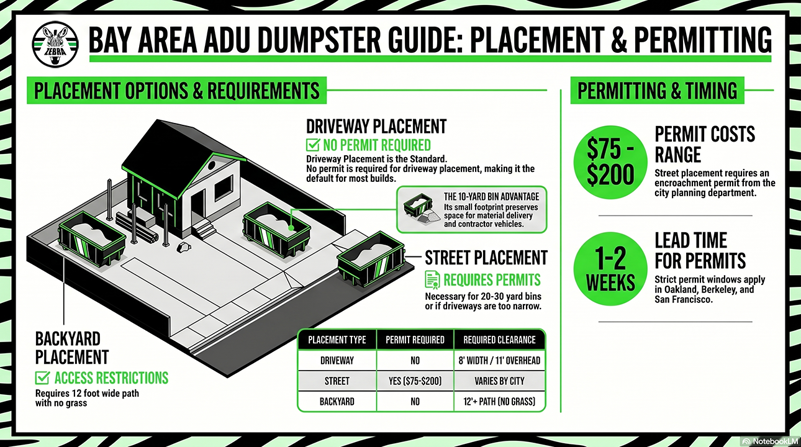
ADU construction needs the building permit (covered separately by the city's planning department) but the dumpster placement also needs attention:
Driveway placement (no permit): If your driveway accommodates a 10-yard (most do — 22 ft access, 11 ft overhead, 8 ft width), no permit needed. This is the default for most Bay Area ADU builds. The 10-yard's small footprint leaves room for contractor vehicles and material delivery trucks.
Street placement (permit required): If the driveway can't fit the bin or you need a larger 20-yard / 30-yard for demo, the bin goes on the street under an encroachment permit. Bay Area cities charge $75-$200 for the permit. Some cities (Oakland, Berkeley, parts of San Francisco) have strict permit windows apply 1-2 weeks before delivery.
Backyard placement (rare): Some ADU projects with side-yard gate access >10 feet wide can drop the bin in the backyard near the build site. This requires the dumpster company to maneuver a delivery truck through the gate most refuse unless there's clear 12+ foot clearance and the path isn't grass. For homes on flag lots or with very narrow side yards, plan on driveway or street placement, not backyard.
For ADU permit requirements at the city level, see the related Bay Area dumpster permit guide. The full construction-site debris workflow is in construction site cleanup checklist. For the 40-yard option (large Type 3 demolition projects), see the 40-yard guide.
What Goes In an ADU Construction Dumpster
Phase 1 (demo / site prep) heavy and inert:
Concrete (old patio, partial foundation), pavers, soil from foundation excavation (clean dirt only no contaminated soil), small tree stumps (under 12" diameter), root systems, gravel, brick. For heavy demo materials in volume, use an inert dumpster (no weight limit) rather than general-debris (1.0-ton limit). The cost is the same but inert is cheaper per ton.
Phase 2 (framing) bulky and light:
Cut lumber ends, plywood off-cuts, OSB scraps, framing nails, packaging cardboard, building wrap (Tyvek), foam insulation off-cuts, plumbing pipe ends (PVC, ABS, copper), electrical wire scraps, junction boxes packaging.
Phase 3 (finish) mixed and packaging-heavy:
Drywall scrap, tile cuts, flooring off-cuts (LVP, hardwood, tile), cabinet packaging, fixture boxes, paint cans (dried out only wet paint goes to HHW), light fixture packaging, appliance packaging, granite/quartz scraps.
What CANNOT go in any of the dumpsters:
- Wet paint, paint thinner, solvents Bay Area county HHW
- Asbestos materials (if found in existing structures being demoed) certified abatement only
- Refrigerant-bearing items (old A/C units, refrigerators in the existing structure) refrigerant evacuation required first
- Treated lumber in volume (pressure-treated, painted) separate handling at landfill, may be excluded
- Tires from old yard items separate handling fee
Zebra Dumpsters services the South Bay, East Bay, and Peninsula corridor with same-day routing on 10-yards and 20-yards. Call (408) 495-3006 to book an ADU project phase-based scheduling helps. Prices subject to change. Verify current rates at zebradumpsters.com/weight-limits-and-fees.
Same yard, every phase
Keep one number for the whole build
Most ADU builds run twelve weeks or more and need a bin three separate times. Call once and dispatch keeps the site, the access notes and the schedule, so each delivery is one short conversation rather than a fresh booking.
Frequently Asked Questions
What size dumpster do I need for an ADU build?
For a typical 800 sq ft detached backyard ADU, plan three sequential 10-yard rentals across the 12-week build one for demo/site prep, one for framing/rough-in, one for drywall/finish. For garage-conversion ADUs, the demo phase often needs a larger bin or a split (10-yard general + 10-yard inert for the slab). For Type 3 ADUs that include demolishing an existing shed or old garage, the demo phase needs a 20-yard or 30-yard.
How much does dumpster rental cost for an ADU project?
About $1,500 for a typical Type 1 (cleared-lot) ADU build using the phased 10-yard strategy. Type 2 (garage conversion) runs $1,600-$2,100 because of the heavier demo phase. Type 3 (demolish existing structure first) runs $1,900-$2,900. These figures cover dumpsters only, not the ADU build itself.
Do I need a permit for the dumpster during ADU construction?
Only if the bin sits on the street rather than the driveway. Most Bay Area single-family lots accommodate a 10-yard on the driveway without a permit. For larger 20-yard or 30-yard bins (Type 3 demo), street placement is common and the permit costs $75-$200 with 1-2 weeks processing time.
Can dirt from the foundation go in a regular dumpster?
Yes, as long as the dirt is uncontaminated (no oil, paint, or chemical residue). Pure dirt is technically inert material it goes more cheaply in an inert dumpster (no weight limit) than in a general-debris bin. For an ADU foundation hole (typically 30-60 cubic yards of soil for a slab foundation), plan on multiple inert-bin pulls or a contractor's separate soil-removal service. Mixed dirt + foundation forms can stay in the general-debris bin.
What about asbestos in older structures?
If demolishing a pre-1980 structure (shed, old garage, sunroom) as part of the ADU project, there's a real chance of asbestos-containing materials vinyl floor tile, popcorn ceiling, exterior siding, pipe insulation. Test before demolition. Asbestos materials are NOT dumpster items and require certified abatement contractors. Test kits run $30-$50; certified testing $250-$500. Budget for this as a possible additional cost on Type 2 and Type 3 ADU projects.