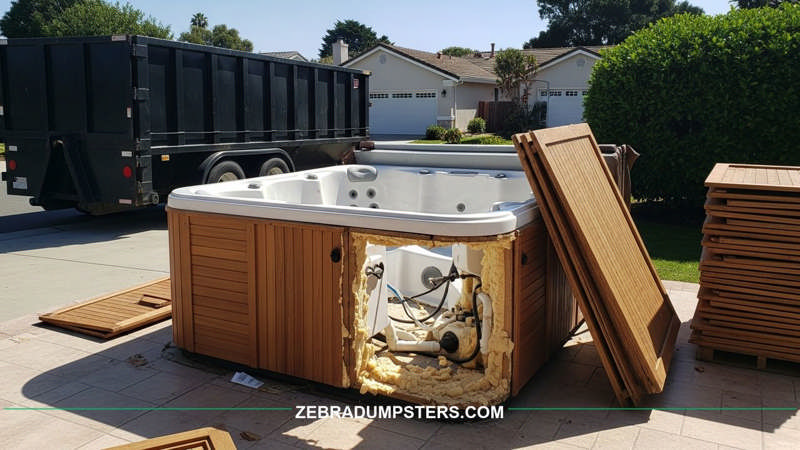
Hot tubs are among the harder DIY removal projects a Bay Area homeowner takes on. They're heavier than they look (a fully-built shell plus jets and motor weighs 800 to 1,500 pounds even drained), they're awkward to cut up (the acrylic shell, the foam insulation, the wood or composite cabinet, and the metal jet hardware all behave differently under a saw), and the disposal isn't a single drop-off because the parts route to different facilities.
This guide is the practical removal-and-disposal plan: what tools you need, the demolition sequence that actually works on Bay Area patios, the right dumpster size for the debris, the rules for the motor and ozonator (they don't always go in the bin), and the realistic cost of doing the project DIY versus hiring it out. The Bay Area is full of mid-1990s built-in spas being demoed during home remodels this is how you handle one.
Listen to this article
--:-- · narrated
Drain, Disconnect, and Prepare
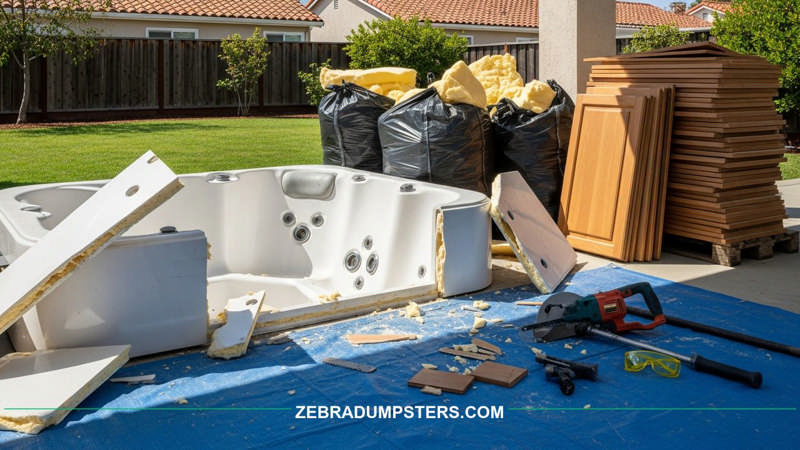 The acrylic shell cut into 2-to-4-foot panels for loading. Foam fragments bagged separately to keep them contained.
Before any saws come out, the hot tub needs to be drained and electrically disconnected. Skipping this step turns a one-day removal into a multi-day cleanup of soaked subfloor and a potentially-live electrical hazard.
Drain the tub completely. Open the drain valve at the base. Most hot tubs hold 300 to 500 gallons. Full drainage takes 30 to 60 minutes through a garden-hose outflow. Run the hose to a storm drain or to a landscaped area downhill chlorinated water can stress lawn grass for a few weeks but won't kill it. Avoid draining bromine-treated water onto edible-garden beds.
Disconnect electrical. Turn off the breaker (most Bay Area hot tubs are on a dedicated 240V GFCI 50-amp breaker). At the spa pack the control box on one side of the tub confirm power is off with a non-contact tester. Remove the spa-pack cover and disconnect the line wires. If the tub was hardwired (no plug), cap the supply wires and pull them back through the conduit. If it was plugged, just unplug. For an in-ground spa with conduit running under decking, the homeowner can usually leave the breaker off and the wire in place. A licensed electrician handles the final disconnect during the larger remodel.
Disconnect plumbing. The supply lines from the heater and jets run inside the cabinet. Remove the access panel on the front of the cabinet. Cut the rigid PVC pipes with a hand saw or PVC cutter. The pipes drain residual water keep towels or a shallow bucket below.
Prepare the work area. Move yard furniture and patio plants away. Spread tarps to catch acrylic and foam dust. Stage a 10-yard or 20-yard dumpster on the driveway or street. A 10-yard handles most above-ground tubs. A 20-yard is the safer call for in-ground spas with concrete demo. The full sizing math is in section 3.
Demolition Sequence
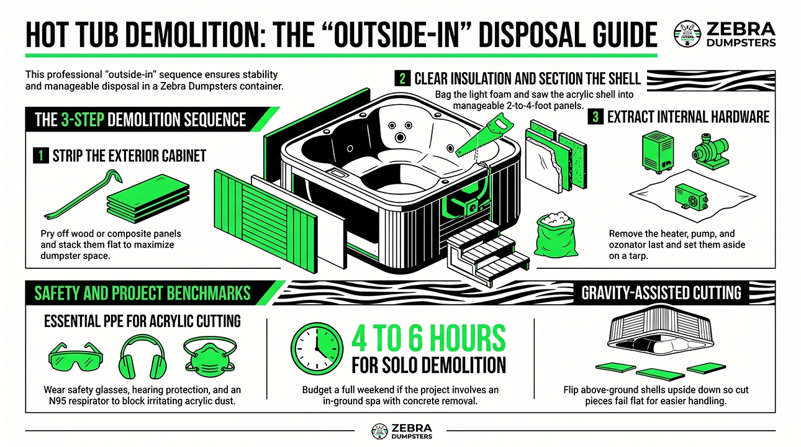
The cleanest demolition order is outside → in: cabinet first, then shell, then plumbing and electrical hardware. Reversing this leaves the structurally-supportive cabinet holding the heavy shell while you try to break it apart.
Step 1: Cabinet. Most Bay Area hot tub cabinets are wood (cedar, redwood, or composite synthetic wood). Pry off each panel with a flat bar the panels are usually screwed to a frame from inside the cabinet. Watch for staples and brad nails that re-emerge as the panel comes free. Stack the panels for the dumpster.
Step 2: Shell exterior foam. A urethane foam layer wraps the bottom and sides of the acrylic shell for insulation. Cut it away with a utility knife or oscillating multi-tool. Foam fragments are light but voluminous bag them in contractor bags before loading the dumpster, or they'll blow around the neighborhood.
Step 3: Acrylic shell. This is the loudest, dustiest step. Use a reciprocating saw with a wood/metal demolition blade. Cut the shell into 2 to 4 foot panels small enough to lift, large enough to keep the cut count reasonable. Wear safety glasses, hearing protection, and an N95 (or better) respirator. The acrylic dust is sharp and irritating to lungs. For above-ground tubs, you can usually flip the shell upside down on the patio first, and gravity helps the cut pieces fall flat. For in-ground spas, cut downward into the existing cavity.
Step 4: Plumbing and jet hardware. Remove the heater, pump, and ozonator from inside the cabinet. These are the components that don't necessarily go straight in the dumpster see section 4 on disposal routing. Set them aside on a tarp.
Step 5: Concrete pad or in-ground shell (in-ground only). Above-ground tubs usually sit on a poured concrete pad or paver patio that stays in place after removal. In-ground spas have a concrete bowl that's a separate concrete-demo project. The math for concrete demo overlaps with the heavy debris disposal guide.
A typical above-ground tub demolition for a Bay Area homeowner takes 4 to 6 hours of solo work or 2 to 3 hours with two people. In-ground spas with concrete demo run a full weekend.
Dumpster Sizing for a Hot Tub Project
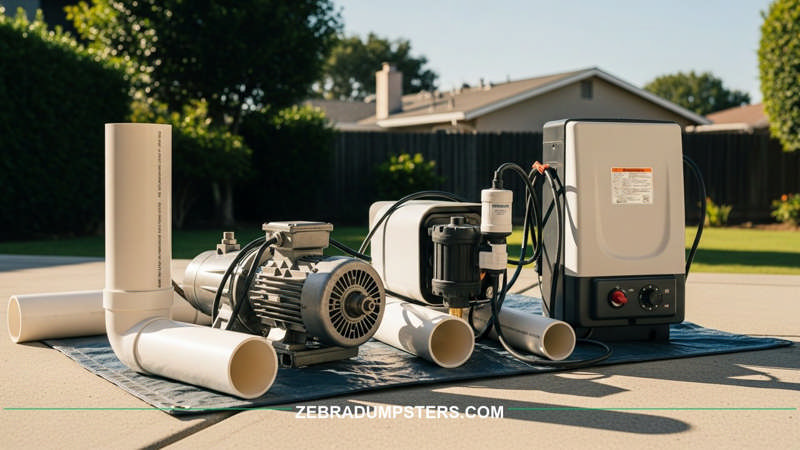 The pump motor goes to scrap metal. The heater control board and ozonator route to e-waste recycling.
Hot tub debris is bulky but not extremely heavy except for the concrete on in-ground projects. The right dumpster size depends on which type you're removing and whether the surrounding patio also goes.
| Project | Volume | Weight | Recommended Bin |
| Above-ground tub, no patio | 4–6 cubic yards | 800–1,200 lbs | 10-yard general (cheapest fit) |
| Above-ground tub + minor decking removal | 6–10 cubic yards | 1.0–1.8 tons | 10-yard if light, 20-yard if borderline |
| In-ground spa, shell only (concrete stays) | 5–8 cubic yards | 1,500–2,500 lbs | 10-yard general |
| In-ground spa + concrete bowl demo | 8–14 cubic yards | 3–6 tons | 20-yard general (or split — 10 general + 10 inert) |
| Hot tub + full backyard remodel | 15–25 cubic yards | 4–8 tons | 20-yard or 30-yard depending on concrete volume |
Two notes that change the math:
Concrete drives the weight. The acrylic shell, foam, and cabinet from a typical 6-person hot tub weigh about 1,000 pounds combined. The concrete bowl from an in-ground spa weighs 3 to 5 tons by itself. If the project includes the concrete, weight becomes the limiting factor, not volume. Splitting into two bins (a 10-yard general for the shell debris and a 10-yard inert for the concrete) often costs less than a single 20-yard with overage on the concrete weight.
The patio is its own project. Many Bay Area homeowners removing a hot tub also rip out the surrounding deck or paver patio at the same time it's the only chance to do it without working around the tub. Wood deck adds 2 to 4 cubic yards of debris but minimal weight. Paver patio adds 5 to 10 cubic yards and 2 to 4 tons. Plan accordingly.
Above-ground or in-ground
The concrete is what decides the size
An above-ground shell cut into panels fits a 10-yard at $430. An in-ground spa with a concrete surround needs the 20-yard at $550, because the concrete is where the weight lives. Price both for your address before demo weekend.
Disposal of Motor, Ozonator, and Jets
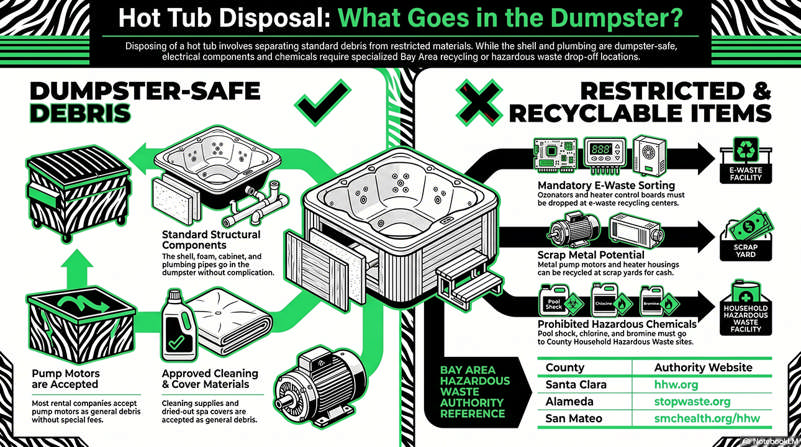
The shell, foam, cabinet, and plumbing pipes go in the dumpster without complication. The motor (pump), heater, and ozonator are different they contain components that don't always belong in landfill-routed waste.
The pump motor. Standard hot tub pump motors are AC induction motors with a copper winding. They're recyclable as scrap metal. Bay Area scrap-metal yards (recycling centers in San Jose, Hayward, Oakland) accept motors and pay $0.10 to $0.30 per pound for the steel, with a small bonus for the copper inside. A typical hot tub pump weighs 25 to 40 pounds not a meaningful payout, but the right disposal channel. If you skip the scrap yard, the motor goes in the dumpster as general debris. Most rental companies accept this without a special fee.
The heater. Electric hot tub heaters contain a heating element and sometimes a control board. The element and metal housing are recyclable scrap. The control board is e-waste and should not go in a general dumpster California's e-waste rules technically prohibit it. Practical compliance: pull the control board out (it's usually a small plastic-housed PCB on the side of the heater), drop it at the e-waste section of any Bay Area recycling center, then send the rest with the metal scrap.
The ozonator. Most Bay Area hot tubs from the 2000s on have an ozonator (a small UV or corona-discharge ozone generator that helps keep water clean). It's a small electrical device plastic housing, low-voltage transformer, sometimes a UV bulb. Treat it as e-waste: drop at a recycling center, not in the dumpster. Some ozonator models contain a small UV bulb that should not break in transit, and a sealed bag is sufficient.
Quaternary chemicals and old chemistry. Pool/spa shock, chlorine tablets, bromine, pH-up/pH-down these are NOT dumpster items. They're household hazardous waste. Each Bay Area county runs free HHW drop-off for residents: Santa Clara County (hhw.org), Alameda County (stopwaste.org), San Mateo County (smchealth.org/hhw), and Contra Costa County (centralsan.org). Cleaning supplies and any dried-out spa cover (which often has wet foam from years of use) can go in the regular dumpster.
For a homeowner running a project in dumpster rental in Palo Alto or other Peninsula cities, the e-waste and HHW sites are usually a single Saturday-morning trip combine it with the donation run from the larger cleanup.
Cost Breakdown: DIY vs. Hire It Out
Hot tub removal is one of the projects where DIY makes economic sense for above-ground tubs and starts to break even on in-ground spas with concrete demo. The cost comparison:
DIY: above-ground tub. 10-yard dumpster rental from $430 in San Jose; reciprocating saw blades $25 (3 demolition blades); disposable PPE (respirator, glasses, gloves) $20; time 4 to 6 hours solo, or 2 to 3 hours with help. Total: about $475.
Hire it out: above-ground tub. Removal-only service quote (Bay Area) $400 to $700, depending on access. No dumpster needed (the service hauls it). Time 2 to 3 hours, you supervise. Total: $400 to $700.
The DIY and hire-out costs are nearly identical for above-ground tubs. DIY wins if the tub is also part of a larger backyard project (the dumpster's already there for the deck removal, landscape redo, etc.). Hire-out wins if the access is tight and the homeowner doesn't want to manage 1,000 pounds of dismembered hot tub.
DIY: in-ground spa with concrete demo. 20-yard dumpster rental from $550 in San Jose; concrete demolition tools (rented jackhammer $80/day; rebar cutters $40/day) $120 for two days; reciprocating saw blades, masonry blades $50; PPE $30; time full weekend (16 to 20 hours of work). Total: about $750.
Hire it out: in-ground spa with concrete demo. Removal + demo service quote (Bay Area) $1,800 to $3,500. Total: $1,800 to $3,500.
In-ground projects with concrete demo show a clear DIY savings of $1,050 to $2,750 at the cost of a full weekend of physical work. The trade-off is one each homeowner makes individually.
For homeowners booking dumpster rental in Walnut Creek or other East Bay cities, weekend rentals are easy to schedule with Friday afternoon delivery and following-Friday pickup.
Zebra Dumpsters services the South Bay, East Bay, and Peninsula corridor with same-day routing for 10-yards and 20-yards. Call (408) 495-3006 to book or to discuss whether a single bin or a split (general + inert) is right for an in-ground concrete demo. Prices subject to change. Verify current rates at zebradumpsters.com/weight-limits-and-fees.
One weekend, one bin
Have it on the driveway before you start cutting
Cutting a shell into panels goes fast; carrying those panels to a bin that has not arrived does not. Book the delivery for the morning you start, and the whole job stays inside one weekend.
Frequently Asked Questions
How much does it cost to remove a hot tub in the Bay Area?
DIY removal of an above-ground hot tub costs about $475 with a 10-yard dumpster, blades, and PPE. Hiring a removal service runs $400 to $700 for the same scope. In-ground spas with concrete demolition cost about $750 DIY (20-yard dumpster, jackhammer rental, blades) or $1,800 to $3,500 with a contractor a meaningful DIY savings on the bigger projects.
What size dumpster do I need for a hot tub?
For an above-ground hot tub with no patio work, a 10-yard general-debris dumpster fits the 4 to 6 cubic yards of cut shell, foam, cabinet, and plumbing well under the 1.5-ton weight limit. For an in-ground spa with concrete bowl demolition, the project shifts toward weight-driven sizing a 20-yard or a split (10 general + 10 inert) usually beats a single 20 with overage on the concrete weight.
Can I throw the hot tub motor in a dumpster?
Yes, technically, but the better disposal is a Bay Area scrap-metal yard. Hot tub pump motors are recyclable as scrap metal copper winding inside a steel housing and pay $0.10 to $0.30 per pound. The control board on the heater is e-waste under California rules and should not go in a general dumpster. Pull the board off and drop it at the e-waste section of any recycling center.
How long does it take to remove a hot tub?
A typical above-ground tub takes 4 to 6 hours of solo demolition or 2 to 3 hours with a helper, plus 30 to 60 minutes of draining time before any saws come out. In-ground spas with concrete bowl removal usually run a full weekend (16 to 20 hours). The dumpster rental window of seven days comfortably covers either project.
Do I need a permit to remove a hot tub?
Removal alone usually doesn't trigger a permit in most Bay Area cities, since you're not modifying a structure or running new electrical. The exception is when removal is part of a larger remodel replacing the patio, building a deck where the tub was, or removing the dedicated 240V circuit. In those cases the permit covers the broader scope, not the tub specifically. Confirm with your local building department before starting if the project involves any electrical changes.