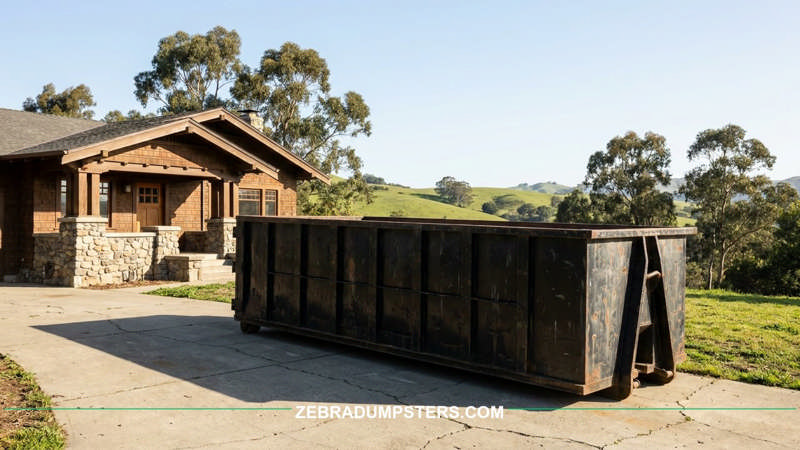
Spring in the Bay Area is the rare two-month window when the weather makes outdoor work pleasant and indoor projects don't compete with summer travel plans. May and June are the busiest months of the year for dumpster rentals because of it garage cleanouts, yard redos, attic clearings, and "we should have done this five years ago" projects all converge.
This guide is a practical plan for a Bay Area spring cleaning project: the realistic scope of what one weekend or one two-weekend stretch can clear, the dumpster size that matches that scope, the pricing math that decides whether a 10-yard or 20-yard is right, and the items that cannot go in a dumpster (so you don't get hit with a contamination fee). The goal is a finished cleanup, not an abandoned half-cleared garage in mid-June.
Listen to this article
--:-- · narrated
Scope the Project Before You Book
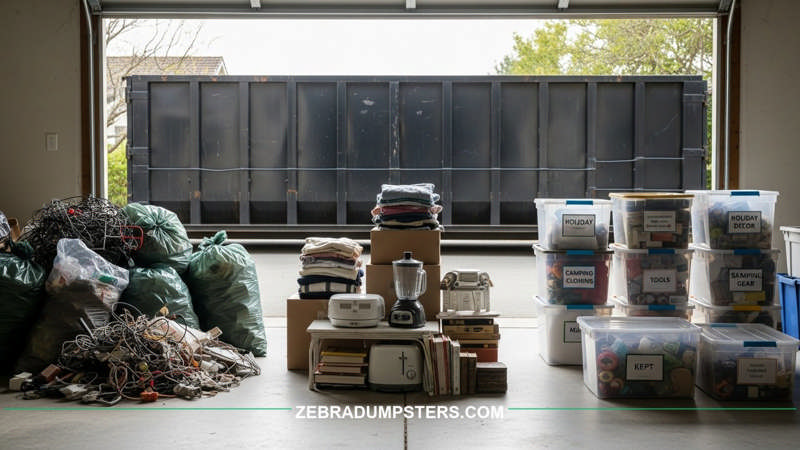 Sort first, load second — the trash, donate, and keep piles separate before anything goes in the bin.
Most homeowner spring cleaning projects fall into one of four scope tiers. Picking the right tier upfront sets every other decision rental size, weekend count, and budget.
Tier 1: Single-zone clearout. One specific area: just the garage, just the attic, just the front yard. Most common. Volume: 6 to 10 cubic yards. Weight: usually under 1.5 tons unless the zone has heavy items (concrete planters, exercise equipment, old appliances). Time: one weekend.
Tier 2: Two-zone clearout. Garage + yard, or attic + basement. Common when one zone naturally drives debris into another (clearing the garage requires moving yard tools, which exposes yard waste). Volume: 10 to 15 cubic yards. Weight: 1.5 to 2.5 tons. Time: one to two weekends.
Tier 3: Whole-home spring clean. Garage, yard, attic, basement (if any), one or two interior rooms (kid's old bedroom, home office reorg). Volume: 15 to 22 cubic yards. Weight: 2.5 to 4 tons. Time: two to three weekends with a stretch in between for sorting and donation runs.
Tier 4: Move-out or pre-listing clean. Selling the house, prepping for a remodel, or doing the cleanup that should have happened five years ago. Volume: 22 to 30+ cubic yards. Weight: 4 to 6 tons. Time: three to four weekends, or a single concentrated week with help.
The honest scope check: walk the property with a notepad on a Saturday morning before booking. List every zone. Estimate cubic yards per zone. Add 25% for "things you forgot were there" the garage attic-shelf storage, the side-yard scrap pile, the basement crawlspace. That total is your bin volume.
Pick the Right Dumpster Size
Spring cleaning sizing is mostly volume-driven, with a weight floor for projects that include yard waste, old appliances, or any home-improvement debris.
| Project Tier | Volume | Weight | Recommended Bin |
| Tier 1 — Single zone | 6–10 cubic yards | Under 1.5 tons | 10-yard general |
| Tier 2 — Two zones | 10–15 cubic yards | 1.5–2.5 tons | 10-yard if light, 20-yard if mixed-density |
| Tier 3 — Whole-home spring clean | 15–22 cubic yards | 2.5–4 tons | 20-yard general |
| Tier 4 — Move-out / pre-listing | 22–30+ cubic yards | 4–6 tons | 30-yard general |
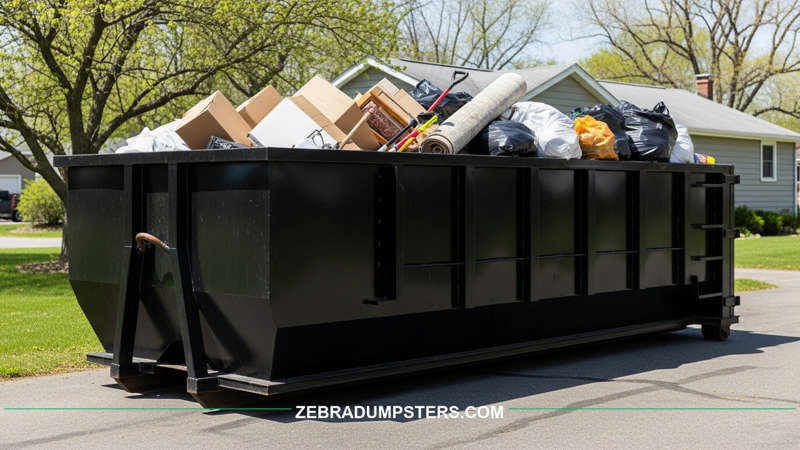
The 10-yard is the spring-cleaning workhorse for Tier 1 and lighter Tier 2 projects. It handles a full garage cleanout (typically 7 to 9 cubic yards for a standard two-car garage) with headroom and fits on most single-car driveways. The detail on what fits is in the garage cleanout dumpster rental guide.
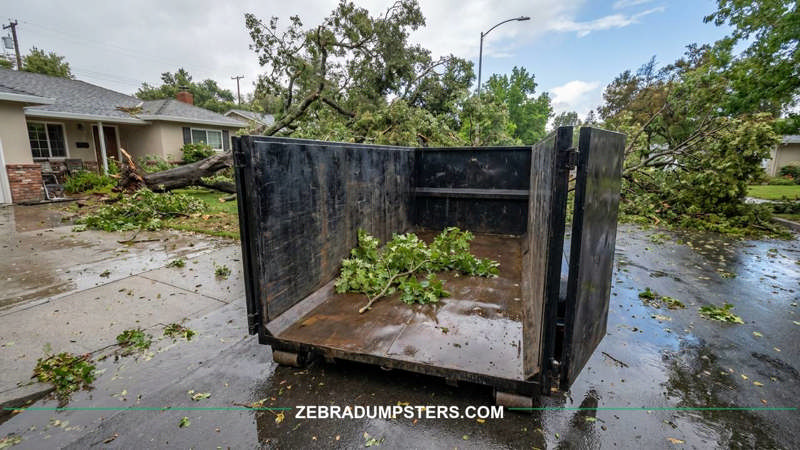
For yard-heavy projects, watch the weight ceiling. Yard waste with sod and dirt is much denser than people expect a single tree removal plus sod scraping can hit 3 tons of debris from less than 8 cubic yards of volume. The yard waste dumpster rental guide covers the green-waste vs. general-debris routing decision that affects pricing.
Two zones or more
The 20-yard is the spring-cleaning default
Garage plus yard runs 10 to 15 cubic yards, which is right on the 10-yard's edge. The 20-yard is $120 more and removes both the volume risk and the overage risk. Open it with your ZIP to see your own rate.
Bay Area Pricing for a Spring Cleaning Project
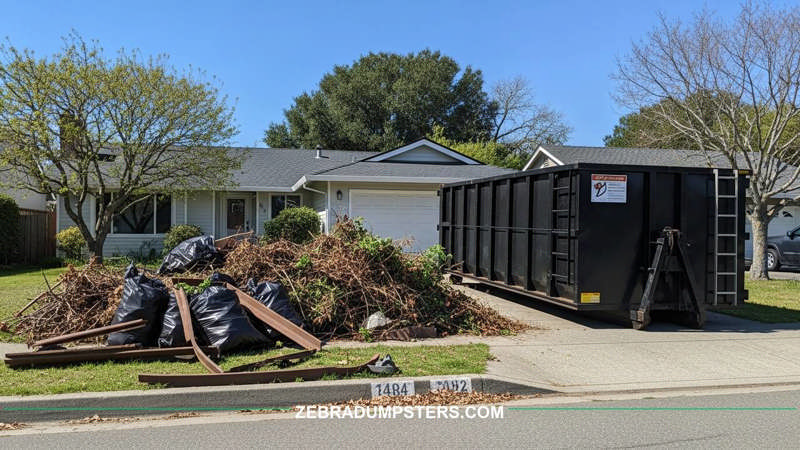 Yard work plus garage cleanout typically combines for 10 to 15 cubic yards: borderline 10-yard, comfortable 20-yard.
The 10-yard starts at $430 in San Jose, the 20-yard at $550 and the 30-yard at $680. Rates rise with distance from the yard, so check your own city. All include seven days, a tonnage allowance (1.0 / 2.0 / 3.0 tons respectively), and one delivery + one pickup.
A worked example for a typical Tier 2 spring cleaning project (garage + front yard) in dumpster rental in San Jose: garage cleanout (7 cubic yards, 1.0 tons) + front-yard hedge teardown (5 cubic yards, 0.8 tons) = 12 cubic yards, 1.8 tons total. Bin choice: 20-yard ($550 base, 2.0 tons included). Overage: zero (under 2.0 tons). Extra-day fees: zero (project finishes in five days). Total: $550.
Compare to the same project with a 10-yard: bin choice 10-yard ($430 base, 1.0 ton included). Overage: 0.8 tons × $150 = $120. Volume problem: 12 cubic yards exceeds 10-yard capacity, so a second bin is the only way to finish, and that is a second delivery at its own rate. Total: $430 + $120 + $430 = $980.
The 20-yard wins by $430 on a project that's right on the 10-yard borderline. The pattern for Tier 2 projects: pick the 20-yard whenever the combined volume might exceed 10 cubic yards or the weight might exceed 1.0 ton.
Standard add-on fees apply across all sizes: per-ton overage $150/ton in most South Bay and East Bay cities, up to $200/ton in some far-East Bay cities; same-day delivery $100 outside San Jose and Campbell (same-day in San Jose proper is included if booked before 9 AM); dead-run fee $250 in South Bay/East Bay, $350 north of Millbrae or Oakland; extra rental days beyond seven $45 each.
Prices subject to change. Verify current rates at zebradumpsters.com/weight-limits-and-fees.
Spring Cleaning Project Plan (Weekend by Weekend)
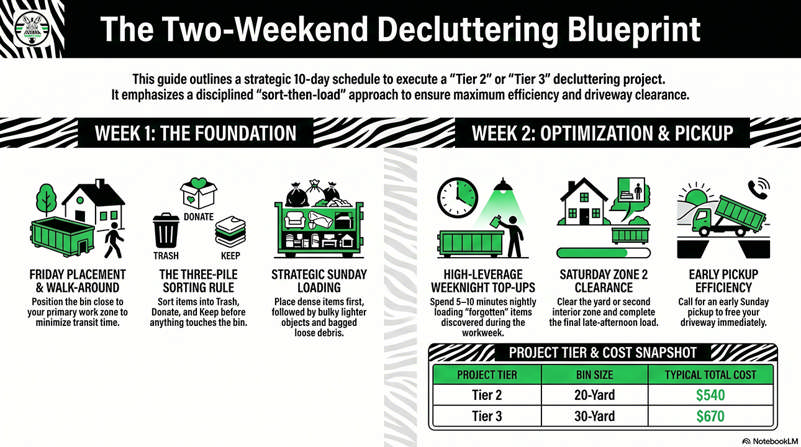
A successful spring cleaning project beats the half-finished failure mode by following a tight weekend-by-weekend plan. Here's the version that works for Tier 2 and Tier 3 projects in the Bay Area.
Friday afternoon, week 1. Bin delivers to driveway. Position close to the garage door if the project starts there, or close to the side gate if yard work starts there. Walk-around with the driver to confirm placement.
Saturday, week 1: sort + first load. Three piles outside the bin: trash (goes in), donate (goes to the donation pile), and keep (goes back inside). Don't touch the bin until the sort is done once items go in, they can't easily come back out. Donation runs to dumpster rental in Hayward charity dropoffs and Goodwill end-of-day Saturday clear out the keep-or-donate ambiguity.
Sunday, week 1: load. The trash pile goes in the bin. Dense items first (broken concrete planters, exercise equipment frames), then bulky lighter items, then bagged loose debris. End-of-day stop is bin half-full to two-thirds full.
Monday-Friday, week 1. Bin sits on the driveway. Top-up loading evenings (5 to 10 minutes per night) for items found during the workweek that didn't make the weekend sort. This is the highest-leverage time of the project: the "I forgot we had this" items get found gradually.
Saturday, week 2: finish + final pile. The yard or second zone gets cleared. Pile against the bin. Final loading happens late afternoon.
Friday, week 2 (or Monday, week 3): pickup. Bin gets hauled. Standard 7-day rental covers the project. If you finish early on Sunday, week 2, call for early pickup. It's free, frees up the driveway, and the company saves a trip.
Total project cost, typical Tier 2: $550 (20-yard) + zero overage + zero extra days = $550. For Tier 3, swap in the 30-yard at $680 base.
What Cannot Go in a Spring Cleaning Dumpster
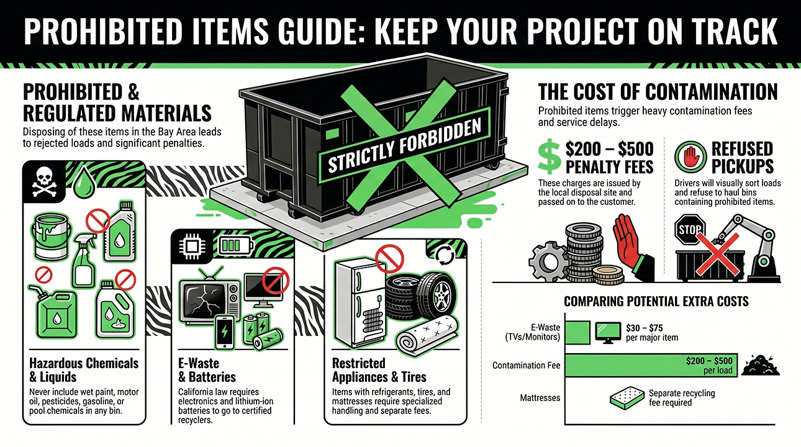
This is where contamination fees and refused pickups come from. Bay Area landfill and recycling facilities reject loads with prohibited items, and the rejection fee gets passed through.
Always prohibited (in any bin): hazardous chemicals (paint thinner, motor oil, gasoline, pesticides, herbicides, drain cleaner, pool chemicals); wet paint (latex paint with active liquid dried-out latex paint cans are accepted, let them air-dry first with the lid off); asbestos-containing materials (old vinyl-asbestos floor tiles, popcorn ceiling debris, certain HVAC ducting from pre-1980 homes test if unsure); tires (separate handling fee at the disposal facility); batteries (car batteries, lithium-ion power tool batteries, lead-acid batteries); refrigerators, freezers, and AC units WITH refrigerant (the refrigerant must be evacuated by a certified tech first; appliances without refrigerant are accepted).
Often prohibited (varies by facility): electronics (e-waste TVs, computers, monitors, printers Bay Area e-waste must go to a certified recycler under California state law; many dumpster providers charge $30 to $75 per major item if e-waste shows up in the load); mattresses (separate handling fee California requires recycling); treated lumber in volume (usually OK in small amounts mixed with other debris; full loads of treated wood may be reclassified).
The estate-cleanout overlap. If the spring clean is also doubling as an estate or pre-listing cleanout, the volume of e-waste and mattresses goes up dramatically. The estate cleanout guide covers the right disposal channel for those items.
The penalty. Showing up at the disposal facility with prohibited items in the load triggers a contamination fee, typically $200 to $500 depending on the item. The driver may also refuse to haul the bin until the prohibited items are removed.
Crews working dumpster rental in Oakland and other Bay Area cities sort visually before loading the truck. If they spot prohibited items, they'll point them out and ask you to remove them better than having the load rejected at the gate.
Zebra Dumpsters services the South Bay, East Bay, and Peninsula corridor. Call (408) 495-3006 to book a spring cleaning project or to discuss the right size for your specific scope. Prices subject to change. Verify current rates at zebradumpsters.com/weight-limits-and-fees.
Two weekends, one bin
Book the delivery for Friday afternoon
The plan in this guide runs across two weekends with the bin on the driveway the whole time. Seven days covers it, and if you finish early the pickup call is free. Tell us the Friday and we will land it that afternoon.
Frequently Asked Questions
What size dumpster do I need for spring cleaning?
For a single-zone project (just the garage, or just the front yard), the 10-yard fits with headroom. For a two-zone project (garage plus yard) where total volume is 10 to 15 cubic yards, the 20-yard is the safe call the price gap is small ($120 to $130) and it avoids overage and a second delivery. For a whole-home spring clean approaching 20+ cubic yards, jump to the 30-yard.
When is the busiest time to rent a dumpster in the Bay Area?
May and June. Spring cleaning, end-of-school-year garage clearouts, and pre-summer landscape projects all peak in those two months. Booking lead time goes from same-day to 2 to 3 days for popular sizes. If you want a specific weekend, call 5 to 7 days ahead during peak season.
How long can I keep the dumpster on my driveway?
Standard rental is seven days. Most weekend spring cleaning projects finish in 4 to 6 days. Same-day pickup is free if you finish early. For multi-weekend projects, book the 14-day rental window upfront it's cheaper than chained 7-day extensions and gives you the work-week buffer between weekends to keep top-loading items as you find them.
Can I throw away old paint and chemicals?
No. Liquid paint, paint thinner, motor oil, gasoline, pesticides, pool chemicals, and similar items are prohibited in any dumpster. Dried-out latex paint (let cans air-dry with the lid off for a few days) is accepted. For wet paint or chemicals, drop off at your county's household hazardous waste facility most Bay Area counties offer free drop-off for residents. Santa Clara County, Alameda County, and San Mateo County all run multiple HHW sites.
Do I need to be home for delivery and pickup?
Not usually. The rental company needs the placement spot confirmed at booking (where on the driveway, which orientation). Most providers will deliver to a marked spot without you being present. Pickup follows the same rule leave the bin clearly accessible and the driver hauls it. Confirm with the booking agent if you want notification calls before delivery and pickup.