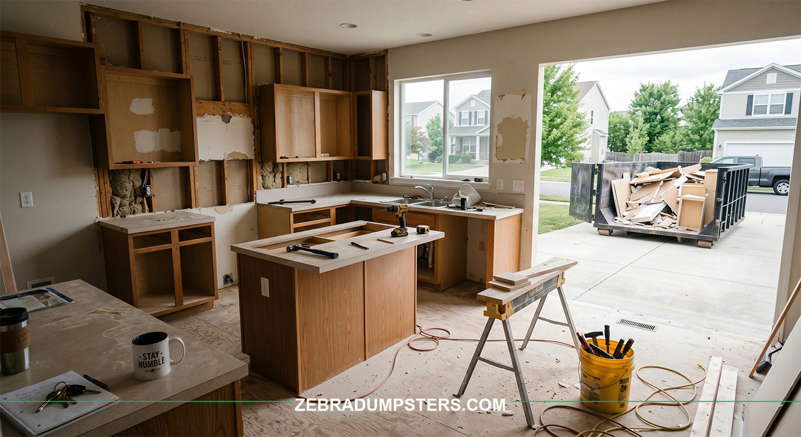
A kitchen remodel is the most popular renovation project in the Bay Area, and one of the most underestimated when it comes to debris. Most homeowners picking a dumpster size for kitchen remodel work choose too small a 10-yard for what really needs a 20-yard and end up paying for a swap mid-project. The mismatch happens because kitchen remodel debris isn't dense (drywall, cabinets, flooring, tile backsplash) so it doesn't trigger the obvious "this is heavy" gut-check, but it's voluminous: cabinet boxes are bulky, flooring layers stack, and packaging from new appliances and cabinets adds another 2 to 3 cubic yards on its own.
This guide is the Bay Area kitchen remodel sizing playbook: the realistic debris volume by project tier (cosmetic, mid-range, full gut), the right dumpster size for each, the timing across a multi-week remodel, and the pricing math that makes a 20-yard the safe default. The numbers below are calibrated to typical Bay Area single-family kitchen footprints (150 to 350 sq ft).
Listen to this article
--:-- · narrated
Kitchen Remodel Tiers and Debris Volume
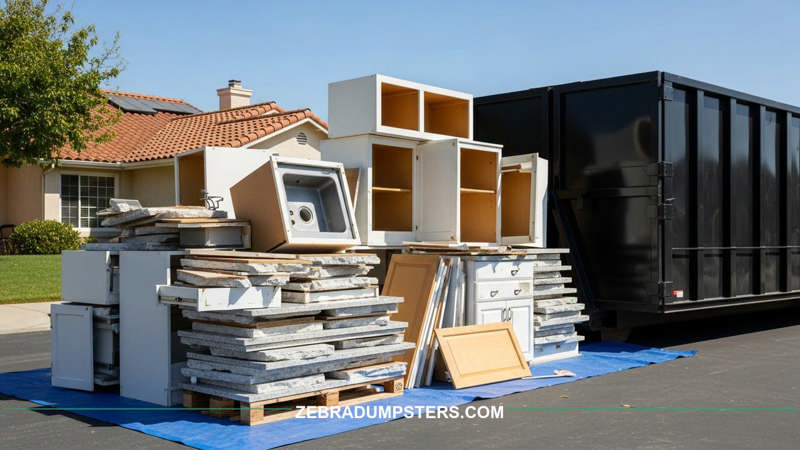 Cabinets, drawers, and countertop fragments — the bulk of a mid-range kitchen remodel's 8 to 12 cubic yards of debris.
Cabinets, drawers, and countertop fragments, the bulk of a mid-range kitchen remodel's 8 to 12 cubic yards of debris.
Kitchen remodels fall into three clear tiers based on what gets removed and replaced. Each tier has a predictable debris volume and the right dumpster choice.
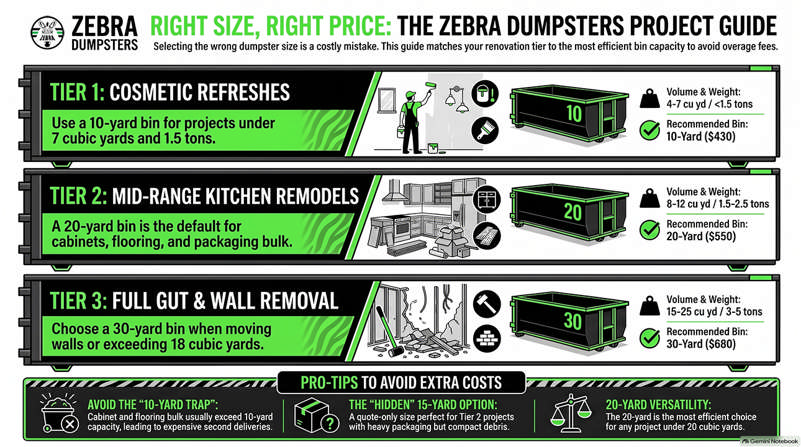
Tier 1: Cosmetic refresh. Cabinet refacing or paint, hardware swap, new countertop, sometimes new flooring on top of existing. No demolition of cabinets or walls. Debris is mostly old flooring (if replaced), countertop fragments, and packaging from new materials. Volume: 4 to 7 cubic yards. Weight: under 1.5 tons.
Tier 2: Mid-range remodel. Cabinets replaced, countertop replaced, flooring replaced, possibly a small layout change. Walls intact, no plumbing or electrical relocation. Debris: old cabinets, old countertop slab, old flooring, tile backsplash, and significant packaging volume from incoming materials. Volume: 8 to 12 cubic yards. Weight: 1.5 to 2.5 tons.
Tier 3: Full gut. Everything goes: cabinets, countertops, flooring, all wall finishes, sometimes drywall to studs. Layout changes that require new plumbing rough-in, electrical relocation, or wall removal. Old appliances often included. Volume: 12 to 18 cubic yards (more if walls come down). Weight: 2.5 to 4 tons.
The volume math: standard upper and lower cabinets for a 200 sq ft kitchen run ~4 cubic yards, since cabinets are mostly air but the bulk takes up real volume. A granite or quartz countertop slab is ~1.5 to 2 cubic yards and carries most of the weight in a kitchen project. Flooring adds ~2 cubic yards per layer, tile backsplash ~0.5, drywall (if walls come down) ~1.5 to 3, and packaging from new materials another ~2 to 3 cubic yards of cardboard, foam, plastic wrap, and pallet wood.
A typical Tier 2 mid-range kitchen remodel adds up to 10 to 12 cubic yards once everything is included, including the packaging that often gets forgotten in the estimate.
Right Dumpster Size for Each Tier
The 20-yard is the default kitchen remodel size for Tier 2 and lighter Tier 3 projects. The 10-yard fits Tier 1 and very small Tier 2 projects. The 30-yard is the right call for full Tier 3 with wall removal.
| Project Tier | Volume | Weight | Dumpster | Cost (from, San Jose) |
| Tier 1 - Cosmetic refresh | 4-7 cu yd | Under 1.5 tons | 10-yard general | $430 |
| Tier 2 - Mid-range remodel | 8-12 cu yd | 1.5-2.5 tons | 20-yard general | $550 |
| Tier 3 - Full gut, walls intact | 12-18 cu yd | 2.5-3.5 tons | 20-yard general | $550 + overage |
| Tier 3 - Full gut + wall removal | 15-25 cu yd | 3-5 tons | 30-yard general | $680 |
Prices are San Jose bases. East Bay and Peninsula cities run one to two tiers higher (the 20-yard is $660 in Hayward and Oakland's tier lands at $760).
The most common sizing mistake is picking a 10-yard for what's really a Tier 2 project. The reasoning the homeowner uses: "It's just a kitchen, how much can it really be?" The reality: cabinet bulk plus packaging plus flooring layers exceeds 10 cubic yards on most Tier 2 projects, and a second bin delivery plus overage at $150 per ton closes most of the price gap to just booking the 20-yard upfront.
There is no size between the 10 and the 20 in our line. If a Tier 2 remodel feels like it sits in that gap, the honest answer is to take the 20-yard: it is $120 more than the 10-yard and doubles the included tonnage from 1 ton to 2, which costs less than a second bin and an overage.
The opposite mistake, going 30-yard for a Tier 2 project, is rare but expensive. The 30-yard base rental ($680) versus the 20-yard ($550) costs $130 more for capacity that won't get used. The 20-yard is the right call any time the project total stays under 20 cubic yards. The detailed 20-yard dimensions and what fits are in the dumpster size guide.
Kitchen remodel
20-yard dumpster, $550 in San Jose with 2 tons and 7 days
Cabinets, drywall, tile and the old appliances in one bin. Appliances are $25 each as special items in San Jose.
Project Timing and Dumpster Scheduling
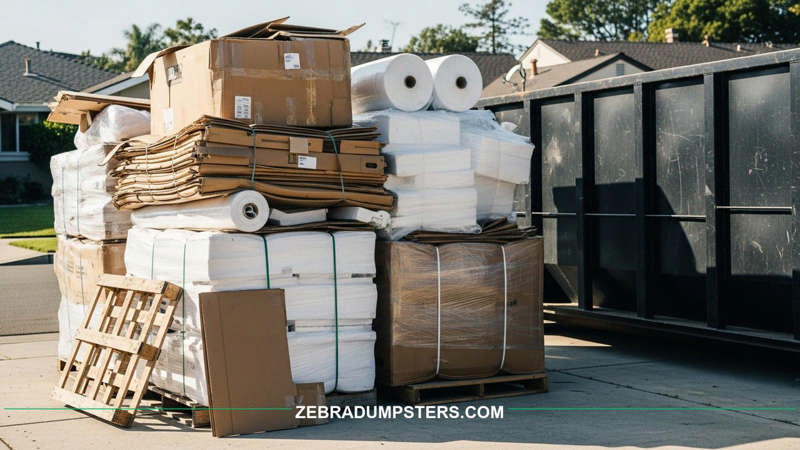 Finish-week packaging — new cabinets and appliances generate 2 to 3 cubic yards of cardboard, foam, and plastic on its own.
Finish-week packaging: new cabinets and appliances generate 2 to 3 cubic yards of cardboard, foam, and plastic on its own.
Kitchen remodels run two to six weeks depending on tier. The dumpster doesn't need to sit on the driveway for the whole project. Three windows usually cover the debris generation.
Window 1: Demo (week 1). This is the heaviest debris week. Old cabinets, countertops, flooring, and tile backsplash all come out in the first 3 to 5 work-days. A 7-day rental window starting Monday of demo week covers the whole demo phase comfortably.
Window 2: Rough-in to drywall (weeks 2-3). Less debris, mostly drywall offcuts, framing scraps, and packaging from rough-in materials. Many homeowners skip the dumpster here entirely and bag the debris for regular trash.
Window 3: Finish + cleanup (week 4 or later). Packaging from new appliances, cabinets, countertops, flooring, and fixtures. This is the second-largest debris window. A 10-yard for the final week handles it.
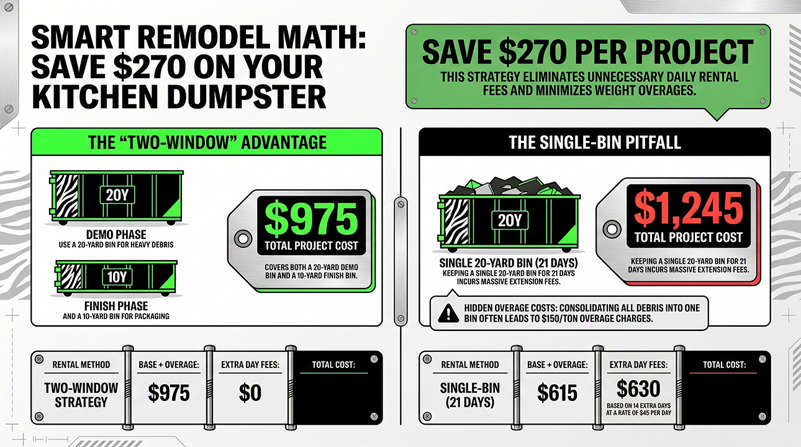
The dumpster strategy that fits most Bay Area Tier 2 projects: a single 20-yard during demo week, then bag the small amounts of mid-project debris for regular pickup, then a 10-yard for the finish week. Total dumpster cost: ~$550 + $430 = $980 across the project.
The alternative strategy, keeping a single 20-yard on the driveway for 3 to 4 weeks, costs more in extra-day fees ($45/day x 14 days = $630 on top of base) and ties up the driveway. Most Bay Area homeowners prefer two shorter rentals. For homeowners running a remodel in dumpster rental in Mountain View or other Peninsula cities, the demo-week schedule benefits from booking delivery for Friday afternoon: it gives the contractor a fresh bin Monday morning without delivery delays.
Bay Area Pricing Math for the Remodel
A Tier 2 mid-range kitchen remodel in the Bay Area has predictable dumpster costs. Worked example for a 200 sq ft kitchen in dumpster rental in San Jose:
Demo week (20-yard): Base rental $550 (San Jose tier). Debris: 11 cubic yards, 2.1 tons (cabinets + flooring + counter + backsplash). Overage: 0.1 tons x $150 = $15. Project finishes in 5 days, no extra-day fees. Window total: $565.
Finish week (10-yard): Base rental $430 (San Jose tier). Debris: 5 cubic yards, 0.4 tons (packaging + offcuts). No overage. Project finishes in 6 days, no extra-day fees. Window total: $430.
Two-window remodel total: $995.
Compare to a single-bin 20-yard kept for 21 days: base rental $550, debris 16 cubic yards total at 2.5 tons, overage 0.5 tons x $150 = $75, and extra days 14 x $45 = $630. Single-bin total: $1,255. The two-window approach saves $260 on a typical Tier 2 project. The math gets more favorable for longer remodels (6+ weeks).
Standard add-on fees: per-ton overage $150/ton in most Bay Area cities (up to $200/ton in some far-East Bay tiers), same-day delivery $100 outside San Jose and Campbell, dead-run fee $250 in South Bay/East Bay and $350 north, and extra rental days beyond seven at $45 per day. For the deeper pricing reference, see the San Jose dumpster rental pricing guide. Prices subject to change. Verify current rates at zebradumpsters.com/weight-limits-and-fees.
What Goes In, What Doesn't
Most kitchen remodel debris is dumpster-eligible without complication. A few specific items require separate handling.
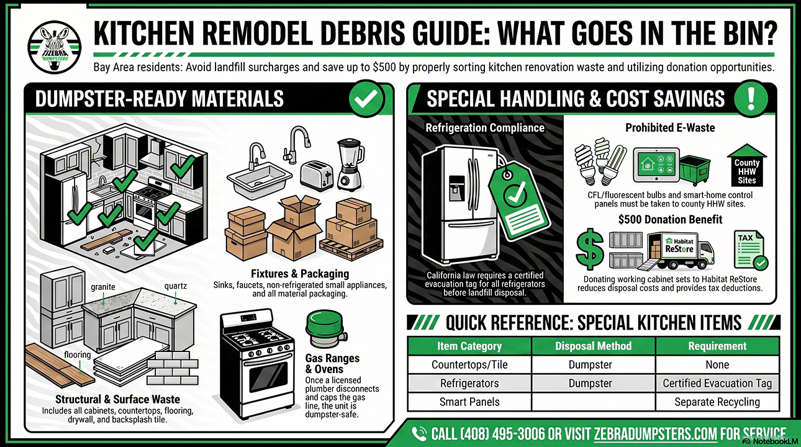
Goes straight in the dumpster: cabinet boxes, drawers, and doors. Countertop fragments in granite, quartz, laminate, or butcher block. Old tile, backsplash, and flooring of every type. Drywall scrap from wall openings, plumbing fixtures, packaging from new materials, and old non-refrigerated small appliances (microwave, toaster oven, coffee maker).
Needs separate handling:
Refrigerator and freezer. California requires refrigerant evacuation by a certified tech before disposal. Without the evacuation tag, the appliance is rejected at the landfill (cost passes through to the dumpster bill). Bay Area county HHW programs and most appliance retailers offer recycling. Cost: $25 to $75 per unit.
Range and oven (if gas). Disconnect the gas line before removal, usually a permitted job by a licensed plumber. The disconnected unit goes in the dumpster as scrap metal once the gas is shut off and the line capped.
CFL and fluorescent bulbs. Mercury content makes them e-waste, not dumpster items. Drop at the e-waste section of any Bay Area recycling center or county HHW site. Smart-home control panels are e-waste too.
Worth donating instead of dumping: working cabinets in good condition (Bay Area Habitat for Humanity ReStores in Oakland, San Jose, Concord, and Sunnyvale all accept cabinet sets, with free pickup for whole sets) and working appliances. For homeowners running a project in dumpster rental in Berkeley or other East Bay cities, the donation pickup adds a Saturday morning to the schedule but cuts $300 to $500 from disposal cost on a Tier 2 remodel.
The full B2B-side debris workflow for contractors managing larger kitchen projects is in the construction dumpster rental guide for contractors. Zebra Dumpsters services the South Bay, East Bay, and Peninsula corridor with same-day routing on most kitchen remodel sizes. Call (408) 495-3006 to book or to discuss the right window strategy for a multi-week remodel.
Schedule it with the demo
Book the bin for demolition day and call for pickup when it is full
Extra days past 7 are $45, so load it and release it rather than letting it sit through the tile phase.
Frequently Asked Questions
What size dumpster do I need for a kitchen remodel?
For a cosmetic refresh (no cabinet replacement), a 10-yard fits with headroom. For a typical mid-range remodel where cabinets, countertops, and flooring are all replaced, the most common Bay Area scenario, the 20-yard is the right call. Total debris runs 8 to 12 cubic yards. For a full gut with wall removal, jump to a 30-yard.
Is a 10 or a 20 yard dumpster right for a kitchen remodel?
We do not run a 15-yard, so the choice is the 10 or the 20. For a compact 150 to 200 sq ft kitchen without wall removal, the 10-yard at $430 usually holds the cabinets, countertop and flooring, but watch the weight: it includes 1 ton, and tile and stone reach that before the box looks full. Anything larger than that, or a wall coming down, book the 20-yard at $550.
How much does dumpster rental cost for a kitchen remodel?
A typical mid-range kitchen remodel runs $565 to $1,000 in dumpster cost depending on whether you use one 20-yard for the whole project or split into a 20-yard (demo) plus a 10-yard (finish week). The two-window approach usually saves $200 to $300 because it avoids extra-day fees during the slow rough-in and finish phases.
How long should I keep the dumpster for a kitchen remodel?
Demo phase only. Most homeowners and contractors finish the heavy debris work in 3 to 5 days, and the 7-day rental window covers it comfortably. For a multi-week remodel, you don't need the bin between demo and finish. A separate 10-yard rental for the finish week (when packaging from new cabinets and appliances arrives) is cheaper than holding the demo bin for the whole 3 to 4 week project.
Can I throw old appliances in the kitchen remodel dumpster?
Yes, with one exception: refrigerators, freezers, and any unit containing refrigerant must have the refrigerant evacuated by a certified technician first. Without the evacuation tag, the appliance is rejected at the landfill and the rejection fee gets passed back to the dumpster bill. Old ovens, ranges, microwaves, and dishwashers go straight in. Gas appliances need their gas line disconnected before removal.
Can I put old granite or quartz countertops in a dumpster?
Yes. Granite, quartz, marble, and engineered stone countertops all go in a standard general-debris dumpster. They are heavy, with a typical kitchen countertop slab weighing 200 to 400 pounds, but they're accepted at standard landfill routing. Mixed in with the kitchen remodel debris, they don't trigger any special handling fee.