The security deposit conversation is the one that pushes most Bay Area move-out cleanouts from a casual project into a deadline scramble. A tenant learns the walkthrough is in three days, opens the garage door to a decade of stored boxes, and realizes the trip-to-the-dump math does not work. A landlord walks into a unit after a five-year tenancy and finds a couch, two mattresses, a broken TV, and a garage full of paint cans that the vacating tenant left behind. Both problems have the same solution, and both benefit from booking the dumpster before the walkthrough, not after.
After 8 years and 15,000-plus Bay Area cleanouts, the move-out job has its own rhythm, its own volume math, and its own set of surprises that do not show up on other kinds of demo work. This guide walks through the timeline that keeps deposits intact, the right dumpster size by home type, and the categories of stuff that make the biggest cost difference.
Listen to this article
--:-- · narrated
The Move-Out Cleanout Timeline
The single best predictor of how much a move-out cleanout costs is when the dumpster gets booked relative to the walkthrough. Booking two weeks out lets you use the standard delivery window and sort things slowly. Booking two days out means paying for same-day service and racing the clock. Here is the sequence that keeps costs down.
Fourteen to seven days before move-out: Walk every room and note what stays, what goes, and what needs a decision. Photograph anything with resale value. Book the dumpster online for delivery three days before the walkthrough. That gives you 72 hours of loading time with the box on site, plus a 4-hour buffer on either end for delivery and pickup.
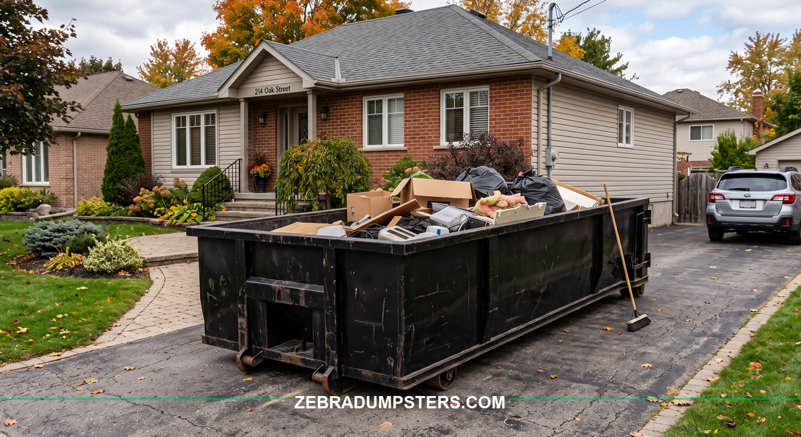
Three days before: Dumpster arrives in the morning. Start with the garage or storage room. These are the categories that make the deposit conversation hardest, and they take the most time to sort. Move to the kitchen next, then bedrooms, then the living room. Load the heaviest items first at the front of the dumpster so weight distributes across the axles.
Day of walkthrough: Everything targeted for disposal is already in the dumpster. Clean surfaces, patch nail holes, and do the final vacuum. The dumpster can stay on site up to 7 days if the pickup is scheduled around the walkthrough.
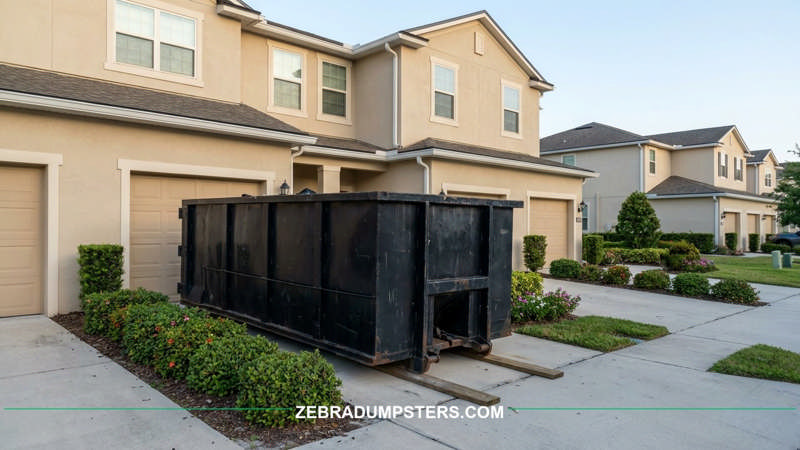
Day of pickup: The truck arrives during a 2-hour window. If the driveway or curb parking is blocked, the truck will not drop the box. That is a $250 dead-run fee (or $350 north of Millbrae or Oakland) that eats a big chunk of the deposit savings.
The dumpster rental period is 7 days included, with $45 per extra day if the project runs long. For most single-day walkthroughs, the standard window covers everything.
What Actually Fills a Move-Out Dumpster
A typical Bay Area move-out generates more debris than the homeowner or tenant expects. The mental model of "a few trash bags" undercounts the pile by 3 to 5 times. What actually shows up on the driveway.
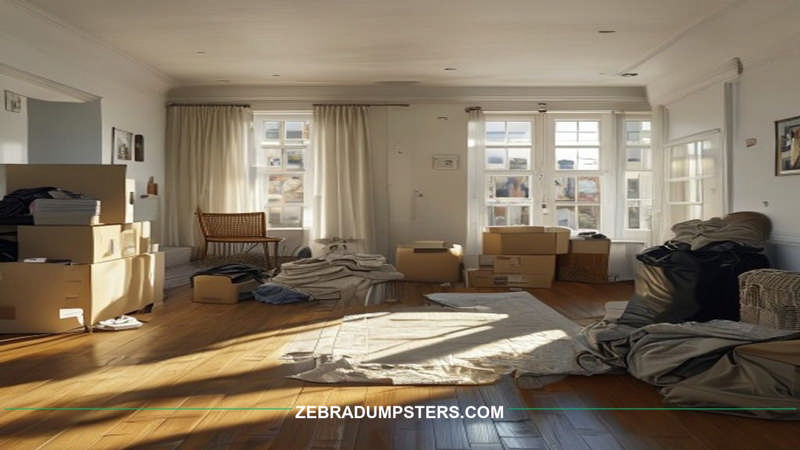 Mid-move-out: boxes stacked, clothes piled, one abandoned chair. Time to book the dumpster.
Furniture and mattresses. The single largest category by volume in most cleanouts. A queen mattress and box spring is 3 cubic yards. A three-seat sofa is 2 to 3 cubic yards. A dining table with 6 chairs is another 2. Add a dresser and a bookcase and half a 20-yard dumpster is gone before anything else goes in.
Boxes of "we forgot we had this". The garage, attic, and back closet contents that never got unpacked from the last move. Books, holiday decorations, kids' school work, exercise equipment used twice. This category runs 2 to 5 cubic yards on average.
Old electronics. TVs, monitors, printers, ancient stereos, and cable boxes. These carry a per-item disposal fee in the Bay Area: $25 each in San Jose, $100 each in other cities. Five televisions in Oakland is $500 in disposal charges alone. Selling working ones on a resale page for $20 each pays for the entire dumpster.
Kitchen and pantry. Half-full spice jars, unused appliances (breadmaker, panini press, second toaster), expired pantry contents. Not heavy but bulky, and often includes the small appliance that needs a per-item fee.
Clothes and linens. Bags and bags of them. Move-outs often end with a "take it all to the dumpster" moment on clothes that were sorted for donation but never dropped off. Textile recycling programs exist, but at the deadline they usually lose to the roll-off.
Yard and garage projects that never finished. Bags of dried potting soil, broken planters, half-used bags of concrete, an old bike frame missing a wheel. These add up to 2 to 3 cubic yards without feeling like much.
Paint and hazardous items. These do not go in the dumpster. Paint cans, batteries, propane tanks, motor oil, cleaning chemicals, and old smoke detectors go to household hazardous waste facilities. Loading them into a general-debris dumpster gets the load rejected at the transfer station and the whole box comes back. Take them to a hazardous waste facility before the dumpster shows up.
Move-out deadline
20-yard dumpster from $630 in San Jose, 2 tons and 7 days included
Delivered to the driveway, loaded over the weekend, gone before the walkthrough. Same-day delivery is often available.
Dumpster Sizing by Home Size and Length of Tenancy
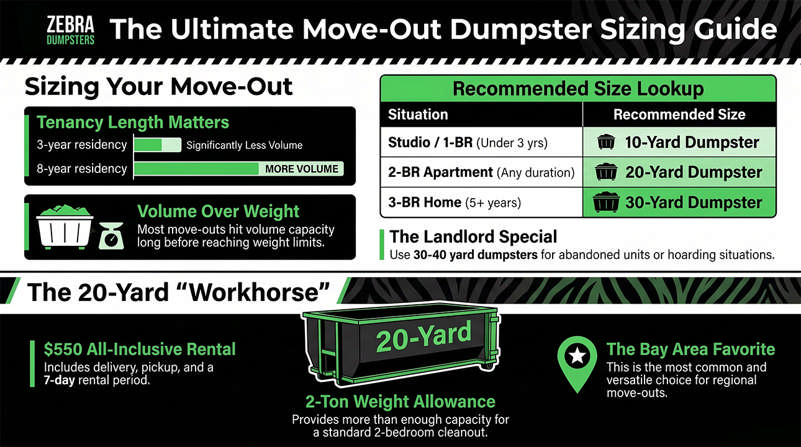
The right dumpster size for a move-out depends on two factors: how many rooms are involved and how long the current occupant has been there. A 6-month rental has very different volume than an 8-year one.
| SituationRecommended dumpster | |
| Studio or 1-bedroom, tenancy under 3 years | 10-yard general-debris dumpster |
| Studio or 1-bedroom, tenancy 3+ years | 20-yard general-debris |
| 2-bedroom apartment or condo, any tenancy | 20-yard general-debris |
| 3-bedroom single-family home, tenancy under 5 years | 20-yard general-debris |
| 3-bedroom single-family home, tenancy 5+ years | 30-yard general-debris |
| 4+ bedroom home, whole-house clearance | 30-yard or 40-yard |
| Landlord turnover on a fully-abandoned rental | 30-yard general-debris |
The 20-yard is the workhorse for most Bay Area move-outs. It runs $630 for a 7-day rental including delivery, pickup, and 2 tons of included weight. For a straightforward two-bedroom apartment cleanout, the whole project fits inside that number with margin to spare. Most move-outs come nowhere near the weight limit, so overweight fees are rarely a concern here. Volume is the constraint.
The one exception is a landlord turnover after a hoarding situation, or an abandoned unit where multiple mattresses, appliances, and years of stuff have to come out. That is when the 30-yard or 40-yard becomes the right call, and where the weight limits and fees page becomes worth reading for the fine print.
The Deposit-Saving Categories
The biggest deposit hits in Bay Area rentals come from a small number of items the tenant is supposed to remove but often leaves behind. These are the categories that landlords charge back at retail rates, meaning $200 for a mattress they will haul away for $75.
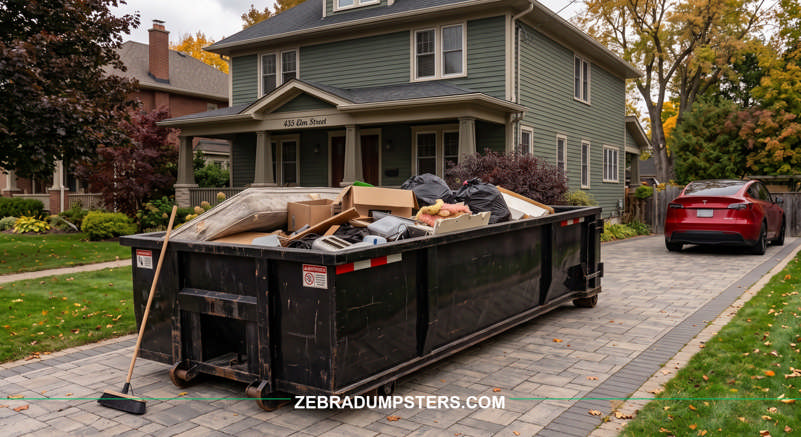
Mattress and boxes staged in the roll-off during a move-out. Load heavy items first.
Mattresses and box springs. California requires proper mattress disposal, and landlords bill this at the highest rate they can justify. A queen mattress plus box spring runs $50 to $100 in landlord charges. Loading it into the dumpster during a $630 rental effectively costs about $30. The savings are real.
Appliances the tenant brought in. Portable dishwashers, mini-fridges, freestanding wine coolers, second washers. If the tenant installed it, the tenant removes it. Landlord charges for these run $150 to $300 each because the landlord has to arrange separate haul-away. In-the-dumpster cost is the per-item appliance fee: $25 in San Jose, $75 in other Bay Area cities.
Furniture the tenant "gifted" the landlord. Sofas, dressers, and dining sets left behind because the tenant did not want to move them. Landlord charges to remove: $75 to $200 per piece. Dumpster load cost: nothing beyond the space it takes up. Just put it in the box.
Kitchen appliances left in the pantry or garage. That second microwave, the standalone slow cooker, the espresso machine from a decade ago. Each is $25 or $75 as an appliance fee. Same disposal math as bigger appliances but on smaller items.
Bulk yard debris on a rented single-family home. Overgrown weeds, an old play set the previous owner installed, a bag of broken pavers. Yard waste can go into a general-debris dumpster in most Bay Area cities as long as it stays under 25 percent of the load and no dirt is included.
Our mattress and furniture disposal guide covers the specifics on what qualifies for the appliance fee and what counts as standard general debris.
Landlord vs Tenant Responsibilities on Turnover
The move-out cleanout question comes up on both sides of the lease, and the responsibilities split differently depending on what is happening.
Tenant-scheduled move-out. The tenant is responsible for removing everything they brought in, plus normal cleaning. Anything not removed by the walkthrough date can be charged back at landlord-arranged disposal rates. Booking a dumpster for the last 3 days of the tenancy is almost always cheaper than paying landlord chargebacks.
Landlord turnover after a normal move-out. If the tenant left the unit clean and empty, the landlord turnover job is usually paint, small repairs, and maybe a carpet clean. A dumpster is not needed for that scope. Most Bay Area turnovers do not involve one.
Landlord turnover after an abandoned or evicted tenancy. This is where the dumpster becomes essential. The landlord ends up removing months or years of accumulated stuff, and the volume math looks like a 30-yard general-debris job. In some cases the outgoing tenant has left hazardous items (paint, chemicals, batteries) that add a hazardous waste facility trip on top of the dumpster.
Estate move-out (deceased tenant or owner). This is a different job with different pacing. Timeline is longer, valuables need to be reviewed, and the tone is different. Our estate cleanout guide covers that specific case in depth.
Same-Day Delivery for the Deadline Crunch
Same-day dumpster delivery in the Bay Area runs a $100 surcharge on top of the standard $80 delivery fee. For move-outs specifically, the $100 fee is often the single best money spent in the whole cleanout. The math works like this.
A tenant realizes on Monday afternoon that the walkthrough is Wednesday morning. Standard delivery is 2 to 3 business days out, which does not work. Same-day delivery for Tuesday morning costs $100 extra. The alternative is losing a $2,000 deposit because the walkthrough finds a garage full of stuff. Even if the tenant recovers only half the deposit through cleanout effort, the $100 pays back 10 times over.
Same-day works best when the address is inside the standard service area and the driveway is clear. It works less well for hilly Oakland or Peninsula addresses that need smaller trucks. Booking online at zebradumpsters.com shows whether same-day is available for the specific address as soon as the address is entered.
Getting Around the No-Truck Parking Rule
San Francisco, Oakland, and a handful of other Bay Area cities have residential zones with restricted truck parking. A dumpster left in the street may need a permit, and the truck delivering it may be limited to certain hours. Two ways to handle this.
Driveway placement. Any driveway with 36 inches of clearance on each side of the dumpster works for placement. This is the default for single-family homes and duplexes. No permit needed.
Street placement with a permit. Apartment buildings and rentals without a driveway can still get a dumpster if the city allows street placement with a permit. Costs run $25 to $75 depending on the city, and the permit is arranged by the tenant or landlord (not the dumpster company). Our dumpster placement laws in San Jose guide covers the permit specifics for South Bay cities.
For apartments with no on-street parking option, the practical answer is renting a moving truck for the day and hauling directly to a transfer station. This costs about the same as a dumpster and works when placement is impossible.
Common Move-Out Cleanout Mistakes
Six patterns show up on invoices when a move-out cleanout goes sideways:
Waiting until the day of the walkthrough to book. Same-day delivery is available but the $100 surcharge stacks with the panic of trying to load a whole apartment in 4 hours. Book at least 3 days ahead if at all possible.
Loading paint cans and chemicals into the dumpster. These will fail transfer station intake, and the whole load gets rejected. That is a $250 dead-run plus a new dumpster rental. Take hazardous items to a household hazardous waste facility before the dumpster arrives.
Booking too small to save $60. A 10-yard costs about $160 less than a 20-yard, but if the volume calls for a 20-yard, booking a 10-yard means paying for a second dumpster mid-project. Two 10-yards cost about $310 more than one 20-yard, plus a lost day.
Skipping the driveway walk. If the truck cannot drop the dumpster because a car is parked in the driveway or a branch is too low, the dead-run fee is $250. Two minutes of prep the night before saves this every time.
Loading the dumpster above the fill line. Loads have to sit below the top rail to be hauled legally. An overfilled dumpster comes back empty, and now the tenant pays for a second box plus a second delivery. Watch the line, especially on the last day.
Not sorting for resale before loading. That mattress in decent shape, the working microwave, the coffee table someone might want. Fifteen minutes of listing on a local resale page can recover $100 to $300 in cash. Value that comes out of the dumpster is value that pays for the rental.
The move-out cleanout is one of the few projects where the biggest cost variable is the tenant's or landlord's own timing. Book early, sort ahead, and the dumpster is a $630 line item that saves several thousand in deposit charges or landlord-arranged haul-away. Wait until the last day, and the same job becomes a scramble that eats the savings.
Priced by ZIP, no surprises
Enter your delivery ZIP and see every size before you book
Mattresses, sofas and appliances are $25 each in San Jose. Extra days past 7 are $45.