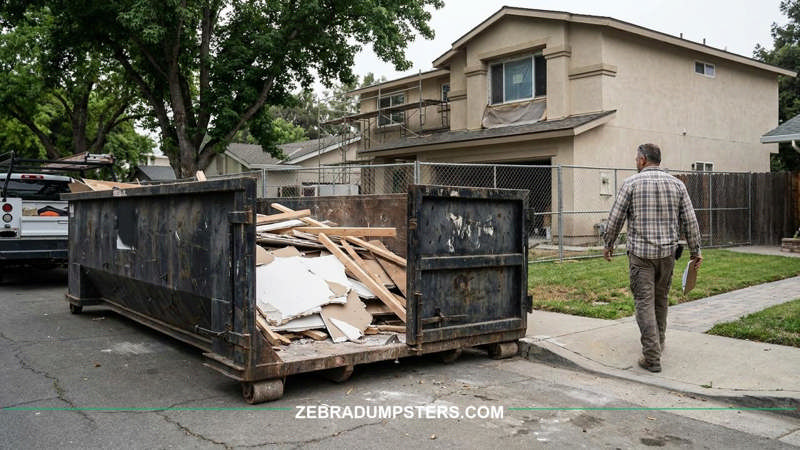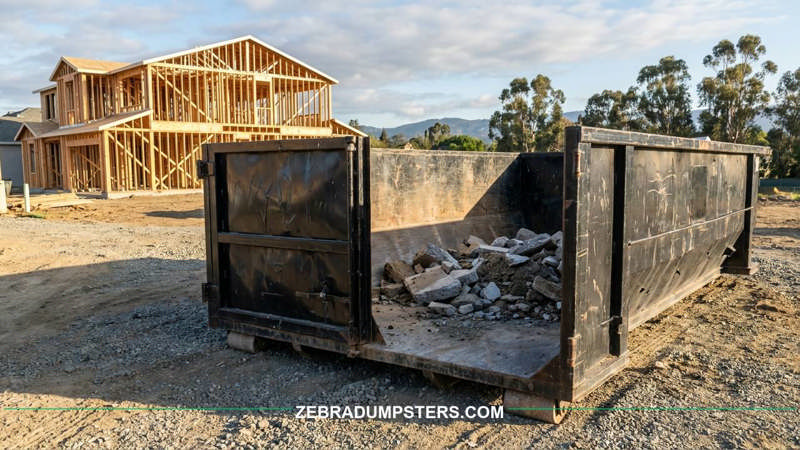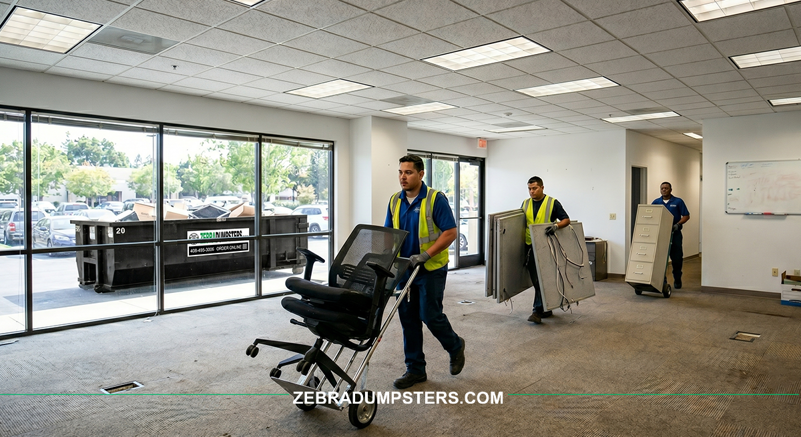
Office cleanouts and tenant-improvement (TI) demolitions are different from residential remodels in scale, timing, and what fits in a dumpster. A 5,000 sq ft office space being cleared for the next tenant generates 30-60 cubic yards of debris in 1-2 weeks of demo work. Property managers, building owners, and TI contractors who plan the dumpster strategy right save 20-40% over the cost of single-bin oversized rentals.
This guide covers Bay Area commercial cleanouts and TI demos: typical debris volumes for office, retail, and restaurant spaces, the right bin sizes by project type, the timing of bin swaps across a typical 2-week demo, and the items that need separate handling channels (electronics in volume, fluorescent fixtures, regulated furniture). Numbers calibrated for Bay Area commercial pricing tiers.
Listen to this article
--:-- · narrated
Commercial Cleanout Types and Their Debris Profiles
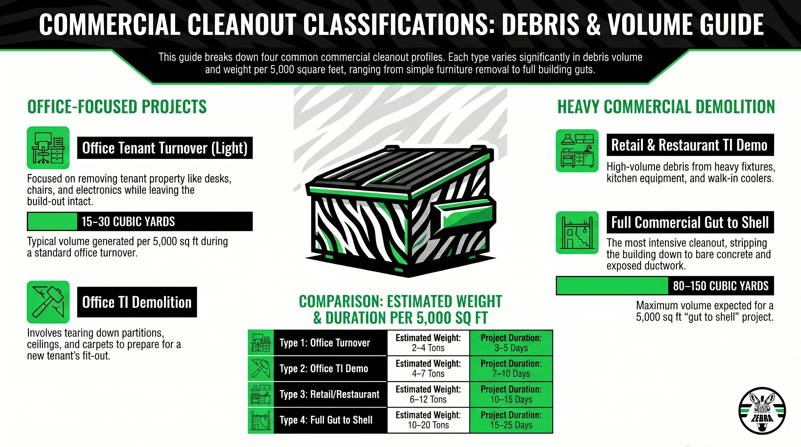
Four common commercial cleanout scenarios in the Bay Area. Each has a different debris profile and dumpster strategy.
Type 1: Office tenant turnover (light). Standard office space being cleared for the next tenant. Existing build-out stays (drop ceilings, partitions, carpet). Just removing tenant property: desks, chairs, file cabinets, cubicles, printers, monitors. Debris: 15-30 cubic yards per 5,000 sq ft. Weight: 2-4 tons. Time: 3-5 days.
Type 2: Office TI demolition. Tear-down of existing build-out to prepare for new tenant's fit-out. Demo includes partitions, drop ceilings, lighting fixtures, carpet, doors, sometimes flooring. Debris: 40-70 cubic yards per 5,000 sq ft. Weight: 4-7 tons. Time: 7-10 days.
Type 3: Retail / restaurant TI demolition. Heavier than office because of fixtures (display shelving, kitchen equipment, walk-in coolers, bar/counter installations). Often includes plumbing rough-in changes. Debris: 50-100 cubic yards per 5,000 sq ft. Weight: 6-12 tons. Time: 10-15 days.
Type 4: Full commercial gut to shell. Down to bare concrete floor, exposed columns, exposed ductwork. Common for repurposing older buildings. Debris: 80-150 cubic yards per 5,000 sq ft. Weight: 10-20 tons. Time: 15-25 days.
Most Bay Area commercial cleanouts the dumpster company handles are Type 1 or Type 2. Type 3 and Type 4 happen but typically come with a general contractor managing the whole demo as a single contract.
Bin Sizing and Swap Strategy
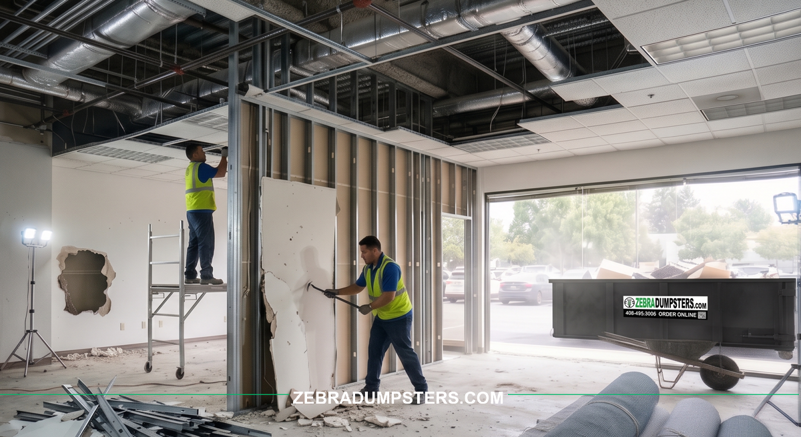
Single-bin rental of a 40-yard for the entire project is the most common mistake on Type 1 and Type 2 commercial cleanouts. The 40-yard's 4.0-ton allowance is plenty, BUT extra-day fees for keeping it on-site for 7-15 days add up fast. The better strategy: 20-yard or 30-yard with planned swaps.
| Type | Total Debris | Total Weight | Bin Strategy |
| Type 1 — Office tenant turnover | 15-30 yards | 2-4 tons | 20-yard (3-5 day rental, fits the whole load) |
| Type 2 — Office TI demo | 40-70 yards | 4-7 tons | 30-yard + swap, OR two 20-yards back-to-back |
| Type 3 — Retail / restaurant TI | 50-100 yards | 6-12 tons | 30-yard + 1-2 swaps, OR 40-yard + swap |
| Type 4 — Full gut to shell | 80-150 yards | 10-20 tons | 40-yard + 2-3 swaps |
Why swaps beat single-bin rentals on Type 2+: a 40-yard sitting in your property's loading dock or parking lot for 10 days costs $910 base + 3 extra days × $45 = $1,045. Two 20-yards over the same period: $630 × 2 = $1,260 but ALL the weight fits inside the 4.0-ton combined allowance with zero overage. Single 40-yard with 7 tons of debris means 3-ton overage at $155 = $465 overage on top of base. Net 40-yard total: $1,510. The two-20-yard swap strategy saves about $250.
For larger projects (Type 3 and Type 4), the swap math depends on the timing of debris peaks. Walls and ceilings come down in week 1. Lighter finishes come out in week 2. Plan the first bin for the heavy demo and the second for the lighter cleanup.
Crews managing TI projects in dumpster rental in San Jose commercial corridors often pre-book the entire swap sequence upfront so each phase has fresh capacity.
Commercial rates, residential pricing
The per-bin rate is the same, the logistics are not
A 30-yard is $786 and a 40-yard $910 in San Jose whether the address is a house or a tenant suite. What changes is the permit, the dock window and the overage, because commercial debris is denser. Price the bins for the site.
Bay Area Commercial Pricing
Commercial pricing in the Bay Area is similar to residential per-yard but includes some differences worth knowing:
Per-yard cost (commercial-zone delivery):
- 10-yard general: from $472
- 20-yard general: from $630
- 30-yard general: from $786
- 40-yard general: from $910
The per-bin base is the same as residential, but commercial projects often incur:
Loading-dock or parking-lot placement fees: If the bin sits in a commercial property's parking lot or loading dock area, no city permit required (private property). But some commercial property managers charge their own placement fees. Confirm with the property's leasing manager.
Permit fees (street placement): Bay Area cities charge $75-$300 for commercial dumpster permits on city streets. Higher than residential because commercial bins are larger and often there longer. San Francisco's rate runs $200-$300 for a 30-yard or 40-yard street drop.
Per-ton overage: $150/ton in most South Bay/East Bay cities, $200/ton in some far-East Bay tiers. Commercial debris tends to be denser than residential (more concrete, metal, fixtures), so plan for overage on heavy demo projects.
Dead-run fee: $250 in the South Bay and East Bay, $350 north of Millbrae or Oakland, the same as residential. Charged if delivery fails usually due to blocked loading dock or missing placement coordination.
Worked example. 5,000 sq ft office TI demo in dumpster rental in Santa Clara, Type 2 scope:
- Phase 1 (Week 1, heavy demo): 30-yard rental, $786 base, 4.5 tons of debris. Overage: 1.5 tons × $155 = $232.50. Total: $1,018.50.
- Phase 2 (Week 2, cleanup + remaining demo): 20-yard rental, $630 base, 2.0 tons. No overage. Total: $630.
- Total project: $1,648.50. Compare to a single 40-yard for 10 days: $910 + extra-day fees ($45 × 3 = $135) + 2.5-ton overage ($387.50) = $1,432.50. Slightly cheaper but you risk the bin filling before the project ends and swapping a 40-yard mid-project means paying for a second delivery, which wipes out the saving.
Prices subject to change. Verify current rates at zebradumpsters.com/weight-limits-and-fees.
Logistics: Loading Docks, Parking Lots, and Street Placement
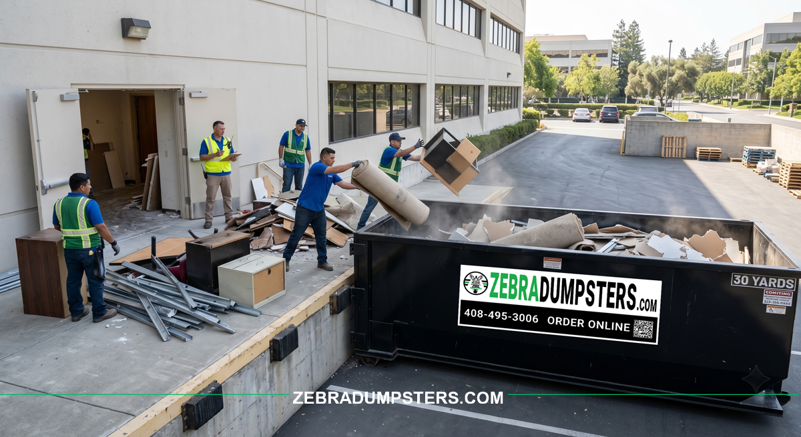
Three placement scenarios for commercial bins. Each has different requirements.
Loading dock placement. Best option if your building has one. Bin sits at the dock, debris loads directly from the building. Requires the dock to clear other deliveries during your rental window coordinate with the property manager. The 30-yard or 40-yard fits most commercial loading docks, and the 20-yard works for all.
Parking lot placement. Common for stand-alone retail or office buildings. Pick the corner of the lot least disruptive to customers/employees. Mark the space with cones during the rental. Bins can stay 7-15 days on private property without permits (private property is private property though the building owner may have rules).
Street placement (encroachment permit required). If neither dock nor lot is viable. Bay Area cities require:
- Encroachment permit from public works ($75-$300, processing 1-2 weeks)
- Some cities require traffic-safety reflectors and lights at night
- Some require the bin to be off-street during weekday rush hours
- Permits typically issued for 5-10 day windows, and longer projects need extensions
For commercial cleanout volumes (40+ cubic yards), the per-bin footprint matters. A 30-yard is 22 ft long × 8 ft wide. A 40-yard is 22-24 ft long × 8 ft wide × 8 ft tall. Make sure dock or lot can accommodate the height especially some loading-dock entrances have low overhead clearance.
The detail on construction-site cleanup that overlaps with commercial TI is in construction dumpster rental guide for contractors. For the 40-yard option, see the 40-yard dumpster page.
Commercial-Specific Debris Channels
Office furniture in volume: Standard dumpster accepts office furniture (desks, cubicles, chairs, file cabinets) without complication. The exception: workstations with built-in electrical systems and power-data conduits those route as e-waste in some Bay Area cities. If your demo includes 20+ cubicles, the cumulative wiring and panel-tagged components push the load past simple general-debris.
Office electronics in volume: Old computer monitors, printers, copiers, server-room equipment, network gear California's e-waste law applies. Bay Area certified e-waste recyclers (Stoneyfork, ECS Refining, Cal Recycle) accept these. Many will pickup commercial volumes free in exchange for the recoverable metal value. Schedule a separate e-waste pickup BEFORE the dumpster delivery saves dumpster volume and complies with California law.
Fluorescent / LED ceiling fixtures: Bay Area commercial spaces typically have grid-system drop ceilings with multi-bulb fluorescent or LED panels. The bulbs (CFL, fluorescent tubes) are e-waste. The fixtures themselves (metal housing, ballasts) can mostly go in the dumpster except the ballasts (which contain PCBs in older fixtures). For pre-1980s fluorescent fixtures, test ballasts for PCB before disposal they require certified handling.
Commercial carpet: Standard dumpster accepts commercial carpet. Bay Area carpet recycling programs (carpetrecovery.org) offer free pickup for clean commercial carpet in 5,000+ sq ft volumes worth a call for big TI projects.
Restaurant equipment: Walk-in coolers, range hoods, refrigerators all require refrigerant evacuation before disposal. Most are dumpster-eligible once evacuated. Used commercial kitchen equipment also has resale value Bay Area used-restaurant-equipment dealers buy walk-in coolers and ranges in working condition.
Hazardous materials in older buildings: Asbestos in pre-1980 commercial spaces (vinyl tile flooring, popcorn ceilings, pipe insulation, fireproofing materials), lead paint in pre-1978 buildings, mercury switches and thermostats in older HVAC. Test before demolition. Certified abatement only never in a dumpster.
Zebra Dumpsters services commercial customers across the South Bay, East Bay, and Peninsula corridor. Call (408) 495-3006 to discuss a TI demo or office cleanout schedule. Prices subject to change. Verify current rates at zebradumpsters.com/weight-limits-and-fees.
Phase the bins to the demo
Two 20-yards usually beat one 40-yard
Walls come down in week one and finishes in week two, so a single 40-yard sits half empty then overflows. Splitting it came out about $250 cheaper on the worked example and removed the overage entirely.
Frequently Asked Questions
What size dumpster do I need for an office cleanout?
For a typical office tenant turnover (5,000 sq ft, furniture and equipment only, no demo), a single 20-yard handles 15-30 cubic yards in 3-5 days. For an office TI demolition (build-out tear-down), plan two 20-yards or one 30-yard with a swap halfway through the 7-10 day demo. The single-40-yard approach often costs more once overage and extra-day fees stack up.
How much does a commercial dumpster cost in the Bay Area?
The 20-yard starts at $630, the 30-yard at $786 and the 40-yard at $910 base in San Jose same per-yard as residential. Commercial projects often add: $155/ton overage, $75-$300 street permit if the bin can't sit on private property, $250-$350 dead-run if delivery fails. A typical 5,000 sq ft office TI runs $1,300-$1,800 in total dumpster cost across the project.
Can I put office electronics in the dumpster?
No. California's e-waste law prohibits monitors, computers, copiers, printers, servers, and network gear in general-debris dumpsters. Schedule a separate commercial e-waste pickup with a certified recycler (Stoneyfork, ECS Refining, Cal Recycle) BEFORE the dumpster delivery. Many recyclers offer free commercial pickup for volumes over 20-30 units. Saves dumpster volume and keeps you compliant.
Do I need a permit for a commercial dumpster?
Not if the bin sits on the property's loading dock, parking lot, or any other private property. Permit only required if the bin lands on a public street. Bay Area cities charge $75-$300 for commercial street permits apply 1-2 weeks before delivery. San Francisco rates run higher ($200-$300 for a 30-yard or 40-yard).
What about asbestos in older office buildings?
Real risk for pre-1980 buildings vinyl-asbestos floor tile, popcorn ceilings, pipe insulation, fireproofing. Test BEFORE demolition. Never assume. Test kits run $30-$50; certified surveys $500-$2,000 depending on building size. Asbestos materials require certified abatement contractors they're NEVER dumpster-eligible. Budget $2,000-$10,000+ for asbestos abatement on Type 2-4 commercial projects in older buildings.