An ADA compliant portable toilet is a single-user unit built so a wheelchair user can get in, turn around, transfer to the seat and get out again: a 60-inch turning space, a 32-inch clear door, a seat 17 to 19 inches high and grab bars on the walls. In California the count rule is short. Every cluster of portable toilets open to the public needs at least one accessible unit, and once a cluster passes 20 units, 5 percent of it must be accessible, rounded up. Units used only by construction crews are exempt.
Most pages on this topic say "one per 20" or blame Cal/OSHA. Both are wrong, and our earlier version of this guide said the same. Below is the code, with section numbers. One note: Zebra rents standard units, not ADA units. We lay out the bank so the handicap porta potty you source elsewhere fits on the route.
How Many ADA Porta Potties Are Required?
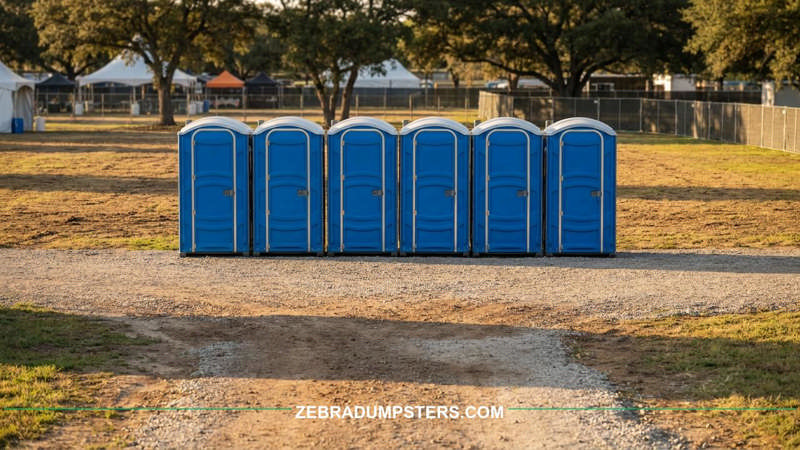
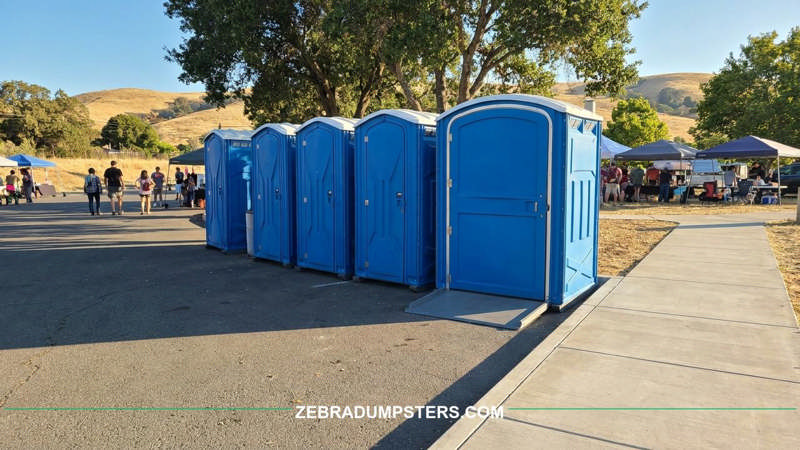
Here's the catch: the rule works per cluster, not per site. A cluster is any group of units set together in one spot. Two banks of six at opposite ends of a fairground are two clusters, so they need two accessible units.
Inside each cluster the number is 5 percent, and fractions round up (2010 ADA Standards 104.2). So one accessible unit covers a cluster of 1 to 20, and 21 units need two.
| Your layout | Units per cluster | Accessible units required |
|---|---|---|
| One bank at a backyard-size public event | 1 to 8 | 1 |
| One bank at a fair or market | 9 to 20 | 1 |
| One large bank | 21 to 40 | 2 |
| Two banks of 6 at opposite gates | 6 each | 2 (one per bank) |
| Three banks of 15 at a festival | 15 each | 3 (one per bank) |
Based on 2025 CBC 11B-213.2 Exception 3 and 104.2 rounding. Your event permit can ask for more.
The ADA does not set how many toilets to bring. Section 213.1 applies only "where toilet facilities are provided." The total comes from Cal/OSHA for workers and from your event permit for guests. For the guest math, see our guide on how many portable toilets you need.
And the "one ADA unit per 20 toilets" line you will see everywhere? The 20 comes from Cal/OSHA's worker ratio, one toilet per 20 employees (8 CCR 1526). It is a headcount for crews, and it says nothing about accessibility.
Events and job sites
Standard units delivered, and a layout that leaves room for the accessible one
We rent standard portable toilets and hand wash stations across the South Bay. We do not rent ADA units, but we will place our bank so your accessible unit sits on a level, open route.
Federal Rules vs California Rules for Portable Toilets
The two texts are worded differently but land on the same number. Quote the California version in a San Jose permit file.
The 2010 ADA Standards, section 213.2 Exception 3, say that where single-user portable units are clustered, "no more than 5 percent" of the units at each cluster have to comply. It is written as a limit on the obligation. Read with the rounding rule, a cluster of any size still ends up needing one.
The 2025 California Building Code, section 11B-213.2 Exception 3, drops the limit wording: "5 percent, but no fewer than one" of the units at each cluster "shall comply." The floor of one is written into the rule. Nobody can argue that a 10-unit bank at 5 percent rounds to zero.
For a business or public event in California, plan to the state text. It is what a local inspector works from.
What Are the 2026 ADA Bathroom Requirements?
Nothing changed federally in 2026. The change is in California: the 2025 edition of the California Building Code took effect on January 1, 2026, and it keeps the same 5-percent-but-at-least-one rule and the same construction exemption.
What Makes an ADA Compliant Porta Potty
A wheelchair sticker on the door does not make a unit compliant. Section 213.2 sends every accessible portable unit back to the toilet room rules in Chapter 6, so it has to measure up on each line below.
| Feature | Requirement | Section |
|---|---|---|
| Turning space | 60-inch circle or a T-shaped space | 304, 603.2.1 |
| Door | 32 inches clear opening minimum | 404.2.3 |
| Seat height | 17 to 19 inches to the top of the seat | 604.4 |
| Toilet position | Centerline 17 to 18 inches from the side wall in California (federal allows 16 to 18) | 11B-604.2, 604.2 |
| Grab bars | Side bar 42 inches long minimum, rear bar 36 inches minimum, 33 to 36 inches above the floor | 604.5, 609.4 |
| Entry | Level threshold or a ramp that meets ramp rules | 303, 405 |
| Sign | International Symbol of Accessibility on the unit | 703.7.2.1 |
California's Chapter 11B uses the same dimensions except the toilet centerline, which must be 17 to 18 inches from the side wall. Ask your supplier for a spec sheet.
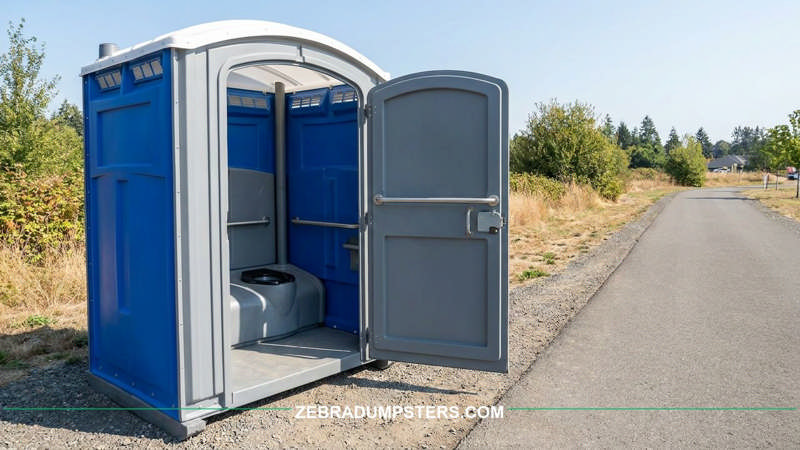
Outside, the unit needs an accessible route: firm, level ground from the path to the door. Typical accessible units are about 5.5 feet wide and a bit over 7 feet deep, so reserve that space plus the door swing. If the unit sits on a sidewalk or in the street, check our notes on porta potty placement and permits first.
Are ADA Porta Potties Required on Construction Sites?
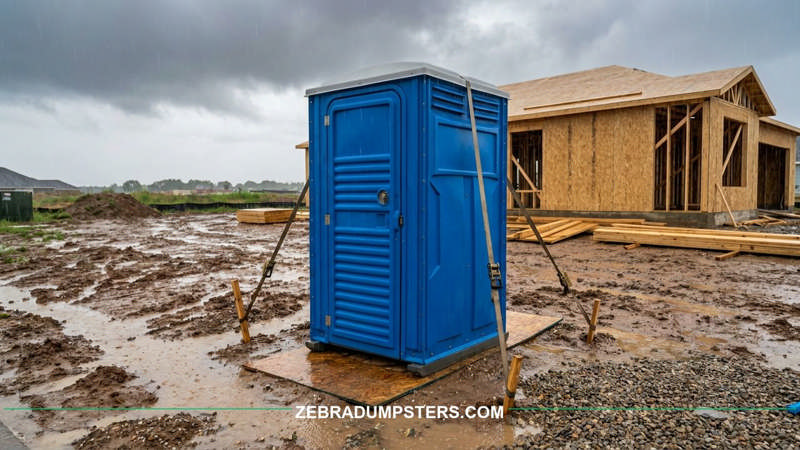
Usually not. The reality is both the federal Standards (203.2) and California (11B-203.2) exempt "portable toilet units provided for use exclusively by construction personnel on a construction site." Those units do not have to meet 213 or sit on an accessible route.
The word that matters is exclusively. The exemption holds while only the crew uses the toilets. It gets weak when other people start using them too:
- A sales trailer or model home where buyers walk the site
- A remodel where the homeowner or tenants use the job toilet
- A public frontage job where the unit is the only toilet passersby can reach
- A site that hosts an open house, a ribbon cutting or an inspection tour
In those cases treat the unit as public and follow the cluster rule above.
Cal/OSHA does not require an accessible unit. Section 1526 sets one toilet per 20 employees of each sex and says nothing about disability. Section 3364, the general industry rule, uses its own count table and also says nothing about disability. A worker who needs an accessible toilet is a separate employer accommodation question. For crew counts and service schedules, see our construction site toilets page.
Do You Need an ADA Porta Potty for Your Event?
If the public can attend, plan on yes. Street fairs, markets, festivals, races and anything on city park land fall under the rule above. A private party on private land, with invited guests only, is generally outside Title III. Many Bay Area event permits ask for an accessible unit anyway, so read your permit conditions first.
What happens if the event has none?
In California the risk is a lawsuit under the Unruh Civil Rights Act. Civil Code 52(a) sets statutory damages of "in no case less than four thousand dollars," and California counts them per occasion a person was denied access, not per missing grab bar (Civil Code 55.56). The same law reduces the minimum for some small businesses that fix the problem quickly. Federal civil penalties under Title III are sought by the U.S. Attorney General, not by private plaintiffs. This is general information, not legal advice. A Certified Access Specialist (CASp) can review your site.
The cheaper fix is the table above: one accessible unit per cluster, on a level path.
Planning a public event
Tell us your guest count and layout, and we will plan the standard units around it
Standard units and hand wash stations, delivered and serviced. Bring your accessible unit from an ADA supplier and we will leave its space on the route.
Frequently Asked Questions
What is an ADA compliant porta potty?
ADA stands for the Americans with Disabilities Act. An ADA compliant porta potty is a single-user portable toilet that meets the accessible toilet rules: a 60-inch turning space, a 32-inch clear door, a level or ramped entry, grab bars, a 17 to 19 inch seat and the accessibility symbol on the unit.
How many ADA porta potties do I need for an event?
At least one in every cluster of portable toilets, and 5 percent of any cluster larger than 20, rounded up. Two separate banks need one accessible unit each.
Are ADA porta potties required on construction sites in California?
Not when the toilets are used only by construction personnel. California Building Code 11B-203.2 exempts them. If buyers, tenants or the public also use them, treat them as public toilets.
What are the dimensions of an ADA porta potty?
Inside, it needs a 60-inch turning circle and a 32-inch clear door. Outside, typical units are about 5.5 feet wide and a bit over 7 feet deep, so plan a flat area of roughly 6 by 8 feet plus the door swing.
Does Zebra rent ADA portable toilets?
No. We rent standard portable toilets and hand wash stations. We can plan and place the standard bank so an accessible unit from an ADA supplier fits on a level route next to it.