
Construction Dumpster Rental in San Jose and the Bay Area
Construction waste dumpster rental for job sites from San Jose to Concord: 5 to 40 yard bins for general construction debris, plus inert bins for concrete, asphalt and dirt with no weight cap. Flat rate, seven days on site, same-day delivery available. A 20-yard is $630 in San Jose.
★ 4.9/5 · 240+ Google reviews · Same-day delivery available · 8+ years in the Bay Area

How Much Does a Construction Dumpster Cost?
In San Jose a construction dumpster runs $439 for a 5-yard up to $910 for a 40-yard, with a 20-yard, the size most residential jobs take, at $630. That is a flat rate covering delivery, pickup, seven days on site and the tonnage included with that size. Above the included tonnage, extra weight is $155 per ton in San Jose. Rates rise with distance from the yard, so check your own city in the table below before you bid the job.
The lowest-priced bin is the 5-yard general at $439 in San Jose. For heavy, clean material the inert bin is the cheaper choice: a 5-yard inert is From $585 with no weight cap, where the same concrete mixed into a general load would be billed by the ton.
Hauling concrete, dirt or asphalt? Those go in an inert bin with no weight cap, which is usually the cheaper choice for heavy material.
General-debris bins
A construction debris dumpster for wood, drywall, framing offcuts, packaging, fixtures and mixed site waste. Priced by weight above the included tonnage. No concrete, brick or dirt.
5 Yard Dumpster Rental

$439 in San Jose
- Includes 0.5 ton of disposal
- Punch-list and single-trade cleanup
- 7 days on site included
10 Yard Dumpster Rental

$472 in San Jose
- Includes 1 ton of disposal
- Bath or kitchen strip-out, small tenant improvement
- 7 days on site included
20 Yard Dumpster Rental

$630 in San Jose
- Includes 2 tons of disposal
- Most residential jobs: framing waste, whole-floor demo
- 7 days on site included
30 Yard Dumpster Rental

$786 in San Jose
- Includes 3 tons of disposal
- Whole-house remodel, roofing tear-off, large TI
- 7 days on site included
40 Yard Dumpster Rental

$910 in San Jose
- Includes 4 tons of disposal
- Commercial demolition, full-building cleanout
- 7 days on site included
Inert bins
Clean concrete, asphalt, brick and dirt only. No weight cap under standard service. No stucco, no rebar or wire sticking out more than 3 inches, and every piece under 3 feet.
5 Yard Inert Dumpster
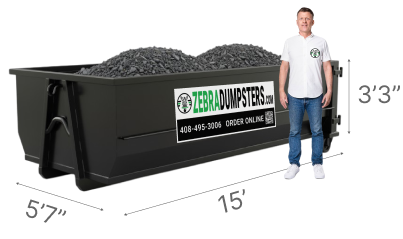
From $585 in San Jose
- No weight limit (inert materials only)
- Patio slab, walkway, footings, small dirt haul
- 7 days on site included
10 Yard Inert Dumpster
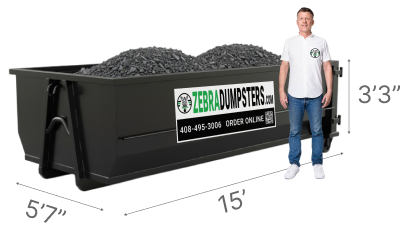
From $640 in San Jose
- No weight limit (inert materials only)
- Driveway removal, excavation spoil, asphalt
- 7 days on site included
There is no 15-yard in our fleet. If you have been quoted one elsewhere, the 20-yard is the equivalent here. Full weight allowances and every fee are published on our weight limits and fees page.
Construction Dumpster Prices by City
One flat rate per city, set by how far the yard is from the site. These are the cities where most of our construction work sits. Every city we serve has its own page with the full seven-row table.
| City | 10 Yard | 20 Yard | 30 Yard | 40 Yard |
|---|---|---|---|---|
| San Jose | $472 | $630 | $786 | $910 |
| Sunnyvale | $615 | $715 | $815 | $915 |
| Mountain View | $640 | $740 | $840 | $940 |
| Hayward | $636 | $780 | $926 | $1,070 |
| Union City | $636 | $780 | $926 | $1,070 |
| Oakland | $736 | $880 | $1,026 | $1,170 |
| Richmond | $786 | $930 | $1,076 | $1,220 |
| Livermore | $861 | $1,005 | $1,151 | $1,295 |
| Concord | $886 | $1,030 | $1,176 | $1,320 |
| Palo Alto | $640 | $740 | $840 | $940 |
Prices are the current marketplace rates for each city. See all 60 cities on our service areas page.
The One Choice That Changes the Bill: General vs Inert
Every other decision on this page is worth tens of dollars. This one is worth hundreds, and it is the mistake we see most often on job sites.
General-debris bin: priced by weight
Takes wood, drywall, framing offcuts, packaging, cabinetry, flooring, fixtures, roofing material and mixed site waste. Each size includes a tonnage allowance, 0.5 ton on the 5-yard up to 4 tons on the 40-yard, and anything above it is billed per ton from the scale ticket. It does not take heavy material like concrete, brick or dirt.
Price a 20-yard general binInert bin: no weight cap
Takes clean concrete, asphalt, brick and dirt, and nothing else. There is no weight limit under standard service, because the material goes to recycling rather than landfill. The rules are strict: no stucco, no rebar or wire sticking out more than 3 inches, every piece under 3 feet, and no garbage. Above 5% garbage the load is reclassified as general debris, with 1 ton included and $155 to $200 per ton after by city, plus a $300 cleaning fee on a contaminated heavy bin.
Price a 10-yard inert binWhat that difference looks like on a real slab
Take a 200 square foot patio slab, four inches thick. That is about 2.5 cubic yards of concrete, which weighs roughly 5 tons. It belongs in an inert bin, because general-debris bins do not take concrete, brick or dirt. Here is what that weight would cost if it ended up mixed into a general load:
- 5-yard inert bin, San Jose: From $585. No weight cap, so the 5 tons cost nothing extra.
- 20-yard general bin, San Jose, if the concrete were mixed in: $630 base, 2 tons included, 3 tons over at $155 = $465 in overage. Total $1,095, about $510 more for the same concrete, and a bin over a safe weight can be refused at pickup.
The same logic applies to driveway removal, footings, chimney teardowns and excavation spoil. If the load is heavy and clean, it belongs in an inert bin. More on this in our guides to concrete disposal and driveway removal costs.
Construction Dumpster Sizes by Job Phase
Sizing by building type produces the wrong answer, because the same house generates completely different waste at each stage. Size by the phase in front of you.
Demolition & strip-out
Bins fill faster here than in any other phase. Lath, plaster, cabinetry, flooring and framing come out together and fill by volume long before they fill by weight. A 20-yard covers most single-floor residential demo, and a 30-yard is the safer call on a whole house.
Concrete, asphalt & excavation
Heavy and clean, so it goes in an inert bin every time. A 5-yard handles a patio, walkway or footing run, and a 10-yard handles a driveway or an excavation spoil pile. Never mix framing scrap into it.
Framing & rough-in
Bulky and light: offcuts, banding, sheathing scrap, packaging from mechanical and electrical deliveries. A 20-yard is normally right, and the weight allowance is rarely the binding constraint on this phase.
Drywall & finish
Drywall scrap is denser than it looks and this phase is where jobs go over tonnage. On a whole-house job a 30-yard costs less than a 20-yard plus the overage. Drywall is also recyclable when it is kept clean of tape and joint compound packaging.
Roofing tear-off
Shingles are the densest common roofing waste, so a roofing bin runs out of weight before it runs out of space. Size on the tear-off weight rather than the roof area, and budget the overage rather than hoping to land under it.
Tenant improvement & commercial
Ceiling grid, partitions, carpet tile and office fit-out come out as high-volume, low-density waste. A 40-yard is usually the economical bin, but the access matters more than the size, so measure before you book.
Planning the Drop on a Live Job Site
Four things that decide whether the first delivery goes in clean. None of them is about the bin. All of them are about the site.
Footprint and access
A 20-yard is 16 ft long, 6.6 ft (about 6 ft 7 in) wide and 5.3 ft tall. A 30-yard is 22 ft long, 7.5 ft wide and 6.3 ft tall, so allow a level pad of about 22 by 8 ft. A 40-yard is 22 ft long, 7.5 ft (7 ft 6 in) wide and 8 ft tall. The truck needs a straight approach and clear overhead room to tilt the bed, so the usual blockers are low branches, carport roofs and parked vehicles rather than the bin footprint itself. If the drop point is tight, tell dispatch when you book instead of on delivery day.
Street placement
A bin on your own driveway or inside the site fence normally needs no permit. Curbside or in a parking lane needs an encroachment permit, and the cost, lead time and who may apply vary by city. San Mateo, for example, issues them to residents only and asks for at least 10 business days. A missing permit is the single most common reason a first delivery fails. Our guide answers do I need a permit for a dumpster city by city.
Timing and swaps
Seven days are included, extra days are $45. Pickup runs one to three days after the ready call, so call it in before the next trade needs the space. A swap is a second delivery at that size's rate, so compare it against one larger bin before booking, because a single 30-yard usually beats two 20-yards.
Failed deliveries
If the driver arrives and cannot place the bin, whether from blocked access, a locked gate or a missing permit, that is a dead run at $250, or $350 north of Millbrae or Oakland. Cancelling inside 24 hours is $100. Both are avoidable with one phone call the day before.
Contractor Dumpster Rental for Repeat Jobs
Most of our construction waste dumpster work is repeat business: the same contractors, a new address every few weeks. This is how the service works when a job runs longer than one bin.
Weekly swaps, not weekly trash service
On a long job, weekly dumpster service means a scheduled swap: we pull the full bin and set an empty one in the same spot. It is not a trash collection route, and kitchen garbage stays out of the bin. Each swap is billed as a new delivery at that size's rate, so on a job with a steady flow of debris a 30 or 40-yard on a swap schedule usually costs less than a string of 20-yards.
Contractor accounts
Contractor accounts are welcome. Call (408) 495-3006 to set one up before the next job starts, so repeat orders book under your company name instead of a fresh order each time, and the office knows which sites and contacts belong to you.
Scheduling around trades
Book the bin to land the day before demo starts, not the morning of. Pickup runs one to three days after the ready call, so call it in as the phase winds down, before the next trade needs the space. When a phase finishes early, same-day delivery is the fallback: included in San Jose and Campbell, a $100 add-on elsewhere, subject to truck availability.
What a Construction Job Actually Gets Charged
The flat rate covers delivery, pickup, seven days and the included tonnage. These are the only things that add to it.
Weight
- Overweight
- $155 per ton
- Above the included tonnage in San Jose, Campbell, Sunnyvale, Cupertino and Saratoga. $165 in most of the Peninsula and East Bay. Up to $200 per ton in the furthest cities. Billed from the transfer-station scale ticket.
- Contaminated inert load
- $300 cleaning
- An inert bin more than 5% garbage is also reclassified as general debris: 1 ton included, then $155 to $200 per ton by city.
Time
- Extra days
- $45 per day
- Beyond the seven included. Next-day pickup when you finish early costs nothing. Same-day pickup adds $100 outside San Jose and Campbell.
- Same-day delivery
- $100
- Included in San Jose and Campbell. Charged elsewhere, subject to truck availability.
Access
- Dead run
- $250
- If we arrive and cannot place the bin: blocked access, a locked gate, no permit. $350 north of Millbrae or Oakland.
- Cancellation
- $100
- If cancelled within 24 hours of the delivery window.
Construction Dumpster Rental: Common Questions
The questions contractors ask before booking.
Construction Dumpster Delivery Across the Bay Area
Same-day delivery available across Santa Clara County, the East Bay and the Peninsula. Each city page carries its own flat rates.
South Bay
East Bay
Book the Bin for Your Next Job
Same-day delivery available • Flat rates, no hidden fees • Swaps scheduled around your trades