Every December we get the same phone call from a new superintendent somewhere in San Jose. The porta potty is lying on its side, the door is in the mud, and the crew has been using the gas station down the street since 6 AM. It happens after the first real wind of the rainy season, and it almost never happens to a unit that was placed with winter in mind.
A portable toilet that works fine on a dry August job site turns into a problem between November and March for three reasons: wind, mud, and dark. Here is how we set units up for the wet months, and what we have learned from picking a few of them back up.
The Wind Problem Starts Before the Rain Does
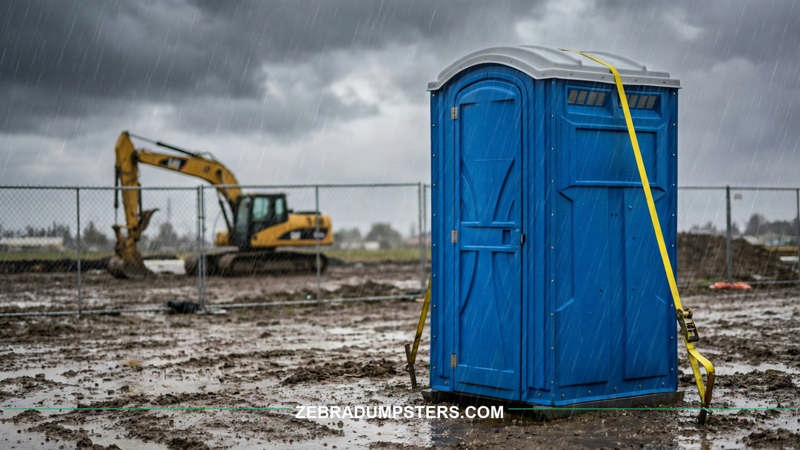
A standard unit weighs around 200 pounds empty, stands over seven feet tall, and presents a flat wall to the wind on every side. The tank adds weight as it fills, but on a Monday after service it is empty and at its lightest. Winter storms in the South Bay come in from the south and southwest, and gusts over 45 mph are normal a few times each season. That combination tips units over.
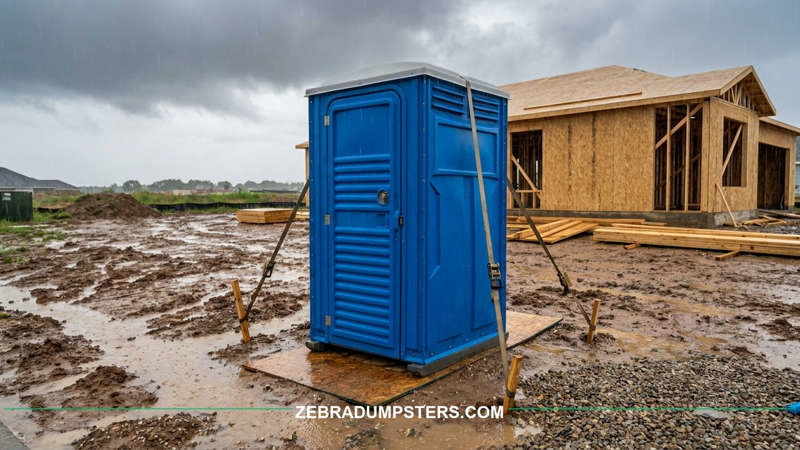
The fix costs almost nothing. On dirt, drive two stakes through the base flanges and run a ratchet strap over the roof to a third stake behind the unit. On concrete or asphalt, where you cannot stake, put two sandbags on the base skids and strap to a nearby fence post or a jersey barrier. A stake-and-strap kit is about $30 at any hardware store. We recommend it on every construction site from November on, and the crews who use it have never called us about a tipped unit.
Door direction matters too. Face the door away from the prevailing wind, which in winter means the door points north or east. A door that faces the storm catches gusts like a sail and stresses the hinge, and a worker stepping out into a 40 mph headwind loses the door handle.
Mud Is a Service Problem, Not Just a Cleanliness Problem
The question we hear most often in January is why the unit was not cleaned on schedule. The honest answer, most of the time, is that the service truck could not get to it. A pump truck weighs several tons and does not drive onto a saturated lot. If the unit sits 80 feet past where the truck can safely stop, it does not get serviced that week.
Put winter units within 25 feet of solid ground the truck can reach, which usually means the street side of the site or the compacted gravel entrance. Set the unit on a pallet or a sheet of plywood so the base does not sink, and so the floor stays above the puddle instead of in it. A unit that sinks two inches into clay tilts, and a tilted unit is the one workers refuse to use.
Weekly cleaning earns its extra $20 in the rainy season. With 15 people tracking mud in and out, a biweekly unit is unpleasant by day nine. Our guide on porta potty cleaning schedules for Bay Area sites covers the crew-size math. The short version is that any winter site with more than eight workers should be on weekly service.
Winter job site setup
Weekly-service unit, $145 per 28 days, flat in every South Bay city
Delivery and pickup are one $80 fee. Tell us at booking where the truck can reach and we place the unit there, not in the mud.
Sunset Is at 4:50 PM. Nobody Plans for That
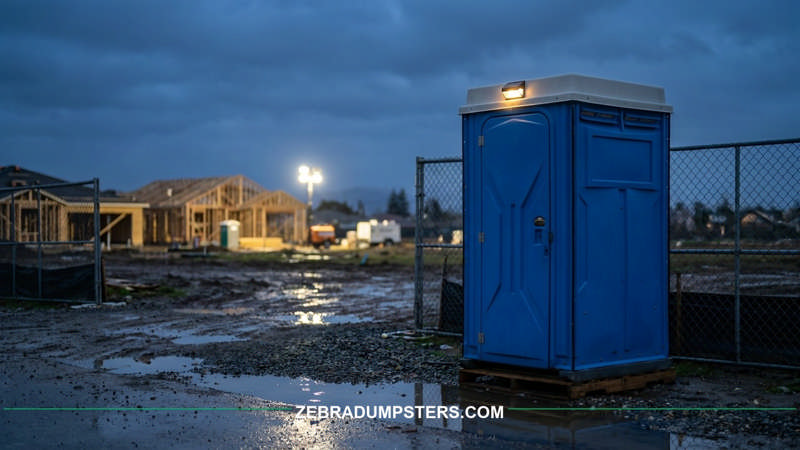
In mid-December the sun sets in San Jose at about 4:50 PM. A crew that starts at 7 AM is working in the dark at both ends of the day, and the porta potty is usually parked in the darkest corner of the lot because that is where it was out of the way in July.
Two things help. A solar motion light zip-tied to the roof edge costs about $25 and lasts the season. And a location near the site entrance, where the work lights already reach, beats the far corner in winter even if it was the wrong spot in summer. Moving a unit 40 feet is a five-minute job for the driver on the next service visit. Just ask.
Cold is the one winter problem the Bay Area mostly skips. Units in Campbell or Santa Clara rarely see a hard freeze, so the tank chemicals and the handwash water do not need the antifreeze additives that Sacramento or Tahoe sites use. What surprises most people is that the built-in handwash sink is more useful in winter, not less. Muddy hands and a $10 sink upgrade beat a frozen sanitizer pump every time.
What We Set Up Differently From November to March
The reality is that a winter placement takes an extra ten minutes at delivery and saves a service call later. The checklist our drivers use looks like this.
| Check | Summer setup | Rainy-season setup |
|---|---|---|
| Anchoring | None on flat ground | Two stakes plus ratchet strap, or sandbags on pavement |
| Ground | Any level spot | Pallet or plywood, never bare clay, above the low point of the lot |
| Distance to truck access | Up to 50 feet | Within 25 feet of pavement or compacted gravel |
| Door direction | Toward the crew | North or east, away from the storm side |
| Service interval | Biweekly for small crews | Weekly for any site over eight workers |
| Lighting | Not needed | Solar motion light, unit near the entrance |
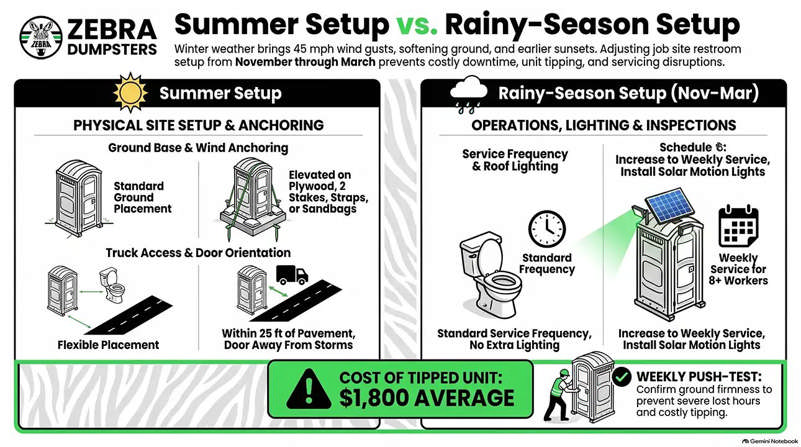
One common mistake is treating a unit that came through one storm as proven. Ground that held a stake in November is soup by February after four more inches of rain. Walk the unit once a week, push on the top corner, and if it rocks, re-drive the stakes.
Site logistics change too. For a South Bay winter site, a construction site toilet rental on weekly service with the built-in sink is the setup we recommend from November.
The city rules do not change with the season. Our porta potty placement and permit guide covers sidewalk setbacks and HOA notice, which apply in January exactly as they do in July.
The Cost of Getting It Wrong Is a Day of Work, Not a Toilet
A tipped or unusable unit sounds like a $145 problem. It is not. Cal/OSHA requires a toilet on site for the crew every day, and the superintendents we work with will not run a 12-person crew without one. A unit down at 7 AM on a Tuesday in January means a crew standing around until the replacement lands, or workers driving off site every couple of hours. One Los Gatos framing contractor told us a single tipped unit cost him roughly $1,800 in lost hours before the replacement arrived that afternoon.
Frankly, the strap kit and the plywood are the cheapest insurance on the site. Eight winters of porta potty rental in San Jose have taught us that the sites that lose a day are always the ones that skipped the ten minutes at setup. Book the weekly service, stake it, keep it near the street, and the toilet will be the one thing on the site that does not care about the weather.
Same-day toilet delivery in the South Bay
Unit down this morning? We can usually land one today
Same-day delivery for a $100 expedited fee across San Jose, Campbell, Santa Clara, Saratoga, Los Gatos and Milpitas. Standard delivery is $80, and we place it where the service truck can reach it.
Frequently Asked Questions
Can a porta potty blow over in the wind?
Yes. An empty unit weighs about 200 pounds and can tip in gusts above 40 mph, which the South Bay sees several times each winter. Two stakes and a ratchet strap on dirt, or sandbags and a strap on pavement, keep it upright.
Where should a portable toilet go on a muddy job site?
On a pallet or plywood, above the low point of the lot, and within about 25 feet of pavement or compacted gravel so the service truck can reach it after rain. The far corner of a saturated lot is where units go unserviced.
Does rain change how often the unit needs cleaning?
It should. Mud tracked in by a crew makes a biweekly unit unpleasant within about nine days. Any winter site with more than eight workers is better on weekly service, which is $145 per 28 days instead of $125.
Do Bay Area porta potties need antifreeze in winter?
Rarely. San Jose, Campbell and Santa Clara seldom see a hard freeze, so standard tank chemicals and handwash water are fine. That is one winter problem the Bay Area mostly skips.
How fast can a replacement unit arrive if one tips?
Same-day delivery is available in the South Bay for a $100 expedited fee on top of the standard $80 delivery. Most replacement requests placed in the morning land the same afternoon.