A framing crew starts a Peninsula home build in February. The construction schedule shows 11 months to certificate of occupancy. Somebody has to book the porta potty, and the booking looks nothing like the one-week event rental version. The unit count changes as trades move on and off the site. The cleaning cadence changes when the crew size doubles for drywall week. The billing changes because everything is monthly, not one-time. And the hand-wash question becomes a Cal/OSHA question, not a comfort question.
After 8 years of putting units on Bay Area job sites that ran anywhere from three months to two years, the long-term rental has its own math and its own scheduling questions. This guide walks through the monthly cost model, the moments during a build when the setup should change, and the specific mistakes we see supers make when they try to run the porta potty logistics the same way they would run a one-week event rental.
Listen to this article
--:-- · narrated
The Monthly Billing Model
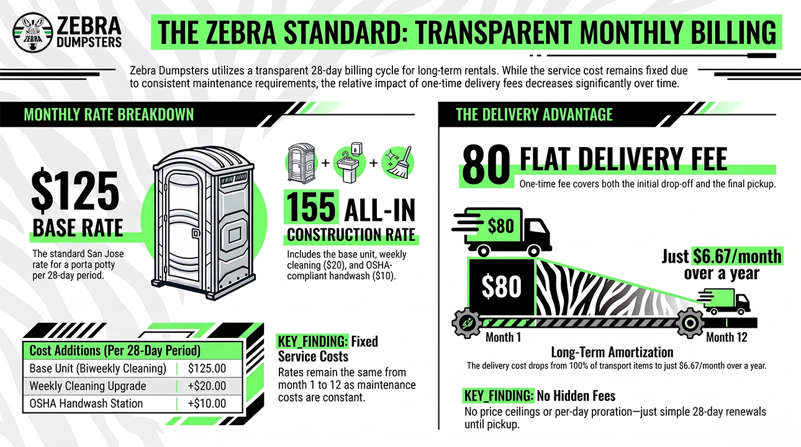
Long-term porta potty rental in the Bay Area is billed in 28-day periods, and the rate stays the same from month one to month twelve. There is no "long-term discount" in the sense of a lower per-month rate on month 6 than on month 1. The cost of servicing a unit is the same in every period: a cleaning truck comes out, empties the tank, refills consumables, and drives back. The marginal cost per period does not go down, so the price does not either.
What does drop on a long rental is the relative weight of the one-time fees. The $80 flat delivery fee covers both drop-off and pickup for the entire rental period. On a 1-week event, that $80 is 100 percent of the transport line item. On a 12-month construction rental, the same $80 is amortized across 12 months, or about $6.67 per month of equivalent transport. The dumpster feels almost delivery-free by month 3, and the effective cost per period converges toward just the unit rental plus cleaning.
The published San Jose rate for a standard porta potty with biweekly cleaning is $125 per 28-day period. Weekly cleaning adds $20, so the standard construction rate lands at $145 per month per unit. Add the $10 built-in handwash for OSHA compliance and the number is $155 per month per unit. A three-unit setup running for 10 months at $155 per unit per month plus a single $80 delivery totals $4,730 for the entire duration, or about $158 per unit per month all-in.
For very long jobs (12 months and beyond) the same rate structure continues. There is no ceiling and no per-day proration past the standard 28-day period. Just monthly renewals until the crew moves off site and the pickup is scheduled.
When to Add a Unit and When to Pull One
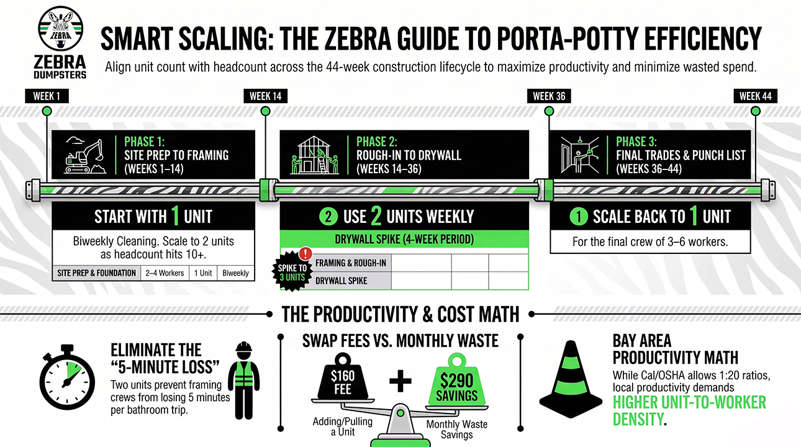
The single most common mistake we see on long-term construction jobs is booking the "peak crew" unit count from day one and paying for empty capacity for the first four months. A well-run project scales unit count with actual head count, and the schedule mostly writes itself if you follow the trade sequence.
Framing week is when the head count spikes and cleaning cadence needs to move to weekly.
Site prep and foundation (weeks 1-6): 2 to 4 workers on site. One porta potty with biweekly cleaning is enough. This is the leanest phase.
Framing (weeks 6-14): Head count spikes to 8-14 as the framing crew and roofers overlap. Cleaning cadence should move to weekly during this phase, and a second unit becomes worth the $145 monthly cost if the crew consistently runs above 10 people. Cal/OSHA guidance calls for one toilet per 20 workers, but Bay Area productivity math is different: two units keep the framing crew from losing 5 minutes each per bathroom trip.
Rough-in trades (weeks 14-24): Plumbing, electrical, HVAC all cycle through. Head count is variable but rarely tops 12 at any moment. Two units with weekly cleaning is the workhorse setup. This is the longest phase and where most of the porta potty spend lands.
Drywall and interior finishes (weeks 24-36): Head count spikes again during hanging and taping, then drops. Three units help during the drywall week and can be pulled after. If the schedule shows a clear 4-week spike followed by lighter finish work, adding a third unit for 4 weeks and pulling it back to 2 saves $290 versus keeping it on the whole project.
Final trades and punch list (weeks 36-44): Back to 3-6 workers. One unit is enough, but pickup is usually deferred to the final week because the last thing the schedule wants is a bathroom trip logistics problem before certificate of occupancy.
The delivery and pickup coordination for scaling up or down is a single scheduled visit each direction, so adding a unit mid-project and pulling it back later adds two $80 delivery fees and nothing else. Compared to keeping the extra unit sitting unused for four months at $145 each, the swap saves money.
Job site units
Weekly-service porta potty, $145 per 28 days
Every 28-day period is billed the same, cleaning and supplies included. Add the built-in handwash sink for $10 to cover Cal/OSHA washing rules.
The OSHA Compliance Layer
Cal/OSHA requires a specific ratio of toilets to workers on construction sites, and it also requires hand-wash access. These are not suggestions. Site inspectors do walk construction sites in the Bay Area and check.
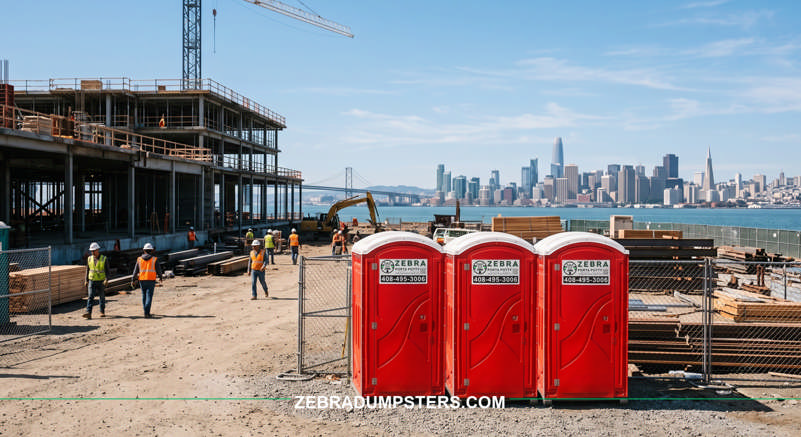
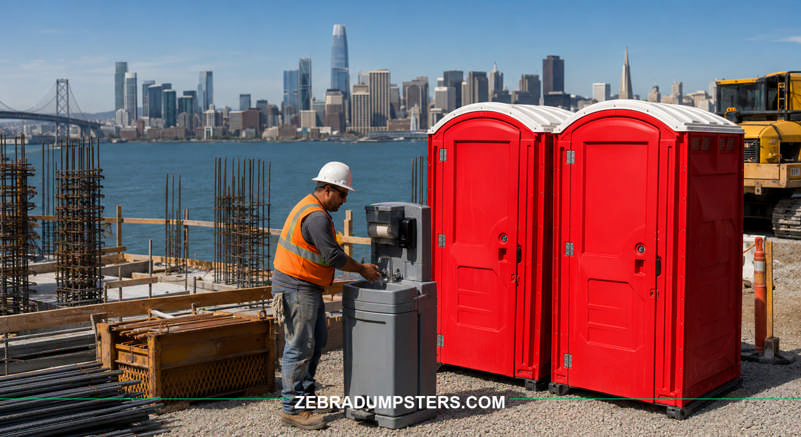
Porta potty plus standalone handwash on a Bay Area residential build.
The ratio, from the current standard, is roughly one toilet per 20 workers, one urinal per 40 male workers. In practice most residential construction sites in the Bay Area have small enough crews (under 20) that a single unit satisfies the ratio. But the ratio math applies to the maximum head count during any hour of the workday, not the average. If drywall week has 22 people on site for even one afternoon, the ratio has been temporarily out of compliance.
The details on the ratio, unit types, and edge cases are in our construction site toilet calculator guide, and it is worth reading during the schedule review at the start of the project.
Hand-wash access is a separate line item. Cal/OSHA requires a hand-wash facility within 25 feet of each toilet, with running water or an equivalent cleaning solution. On Bay Area residential sites, the two ways to satisfy this are the built-in handwash inside the porta potty itself ($10 add-on) or a separate standalone handwash station ($140 per month) placed near the toilet cluster.
The built-in handwash is cheaper per month but has a small basin that runs dry faster during peak use. On a small crew of 4-6, the built-in works. On a crew of 10 or more, the standalone station is worth the $140 because the built-ins get used up before the next cleaning cycle and workers stop washing.
ADA compliance is a separate question. If any worker on the crew has a disability that requires an ADA-accessible unit, the standard porta potty does not work. Our ADA portable toilet placement guide covers the specific units and placement rules for those cases.
Cleaning Cadence Trade-Offs on Long Jobs
Cleaning frequency is the biggest cost lever on a long-term rental, and it is worth revisiting each month based on how the crew has actually been using the unit. Biweekly cleaning (one visit every two weeks) is the base tier at $125 per month per unit. Weekly cleaning is $145 per month. The $20 delta is small on paper and adds up over a 12-month job.
When biweekly is enough: Small crews under 4 people, or projects where workers use the porta potty only during breaks and not throughout the day. Weekend-only sites (like DIY builds and small remodels) also work on biweekly.
When weekly is necessary: Any project with 5 or more people on site for 5 or more days per week, or projects with food service on site (framing crews often have lunch delivered). Any project where the workday runs over 8 hours consistently. Any project during the summer months when Bay Area heat makes bathroom use spike.
When an emergency cleaning is worth it: Between the scheduled visits, if the unit is clearly not going to make it to the next cadence, an emergency cleaning runs $75-$95. This happens once or twice per year on a typical construction job and is much cheaper than upgrading to weekly for a whole month.
The pattern we see on projects that stay on budget: start at biweekly during site prep, move to weekly at the framing phase, stay at weekly through interior finishes, and drop back to biweekly during the last few weeks of punch list. The transitions can happen on any 28-day period boundary without penalty.
Placement Coordination With Trade Schedules
The porta potty needs to be in a location that stays accessible as the site changes. That is harder than it sounds on a residential construction project. The framing crew wants it close to the foundation. The drywall crew wants it away from the interior. The final grading crew wants it off the driveway.
The default placement is on the driveway near the street, if there is one. This works from day one through drywall. When exterior work starts (siding, paint, hardscape), the unit sometimes has to move. Moving a porta potty on the same site is a $30-$45 charge if scheduled with a routine cleaning visit. It is worth doing once mid-project rather than working around a badly-placed unit for four months.
For sites with limited driveway or no driveway (ADUs, backyard builds, hillside projects), placement in the front setback or on a temporary construction pad works. The unit needs 36 inches of clearance on each side for service truck access. If the placement is uphill or in a tight corner, the service truck may not fit, which means the placement has to change.
Access matters when the job includes deliveries and material staging. A porta potty placed in the path of concrete delivery trucks or crane operations delays the job by 15-30 minutes each time and eventually gets in the way. The 30-minute site walk at the start of the project to pick the porta potty spot pays back for the whole rental period.
The Multi-Trade Combo Booking
Long-term construction projects also involve dumpster rental for the debris, and there is a coordination win in booking both from the same vendor. On a 10-month residential build, a typical setup might look like:
- Two porta potty units (framing → interior finishes) - One handwash station - Multiple dumpster swaps: framing scraps, drywall waste, packaging, finish trim, and final punch-list debris
The porta potty rental cost guide covers the base pricing per unit. Combined with the dumpster booking, there is often a workflow simplification (one contact, one billing statement, one scheduling call for the whole site) that saves 1-2 hours per month of super time. That is worth more than any small discount.
For jobs sited outside the immediate Bay Area service area or requiring specialized ADA units, the pricing conversation shifts and is quoted individually. Most standard residential and commercial construction jobs in the South Bay, East Bay, and Peninsula fit inside the published rate structure.
Common Long-Term Construction Rental Mistakes
Six patterns that show up on long-term job invoices:
Booking the peak head count from month one. Paying for three units during a 12-week foundation phase when the head count is 4 wastes $580. Book the phase-appropriate count and scale up.
Staying at biweekly cleaning through framing week. Framing crews go through the unit fast. A biweekly cadence during a 30-person framing week means an emergency cleaning by day 8 and unhappy workers by day 10. Move to weekly for the phase.
Skipping the handwash. Cal/OSHA cited the site inspection. The built-in handwash costs $10 per month per unit. Not having it is a compliance risk on any site over 4 workers.
Placing the unit somewhere that has to move later. A porta potty in the middle of what becomes the final driveway hardscape zone has to move at week 30. Plan the placement with the site plan open the first day.
Not scheduling the pickup coordination. The unit stays on site until the pickup call is placed. If the project wraps and the super forgets to schedule pickup, the unit collects another month of rental. Set a calendar reminder for the last week.
Trying to run one unit for 15 workers. It technically satisfies the OSHA ratio during the average day, but line waits eat 20-30 minutes per worker per week during peak use. Two units at $145 each per month recover their cost in productivity within a week of the framing phase.
Booking the Setup for a Long-Term Job
For a typical Bay Area residential construction project of 8-12 months, the workhorse setup is two porta potty units with weekly cleaning and one built-in handwash on each. Total monthly cost is around $310 for the two units plus a one-time $80 delivery. Adding a third unit for the 4-week drywall spike adds $145 plus another $80 delivery for the swap, then $80 for pulling it back to 2.
The San Jose porta potty rental page has the live per-unit pricing and same-day booking. For projects that need coordination with dumpster deliveries, calling the San Jose office at (408) 495-3006 handles both from one conversation. The pricing is the same as the online booking, but the setup conversation is faster on the phone for complex jobs.
The porta potty is a small line item on a construction budget, and the impact of getting it right is not the dollar savings on the rental itself. It is the crew productivity, the OSHA compliance, and the schedule confidence that comes from not having to think about bathroom logistics ever again after the first month. Book the right setup at the right cadence, place it in the right spot, and the whole thing runs quietly in the background for the length of the project.
Multi-unit sites
Call for a crew-size setup across San Jose and the South Bay
One $80 delivery per drop, units added or pulled as the trades change. Same-day replacement available for $100.